- Search traffic dropped 36% across publisher sites in the first half of 2026, with organic click-through rates falling 61% when Google surfaces AI Overviews at the top of search results.
- 35 major health systems face financial pressure in 2026 as days cash on hand becomes a critical metric while patient acquisition channels collapse and CFOs scrutinize every marketing dollar.
- Media leaders expect search traffic to fall another 43% within three years, with one-fifth predicting losses above 75%, forcing healthcare systems to shift from platform-dependent channels to owned patient relationships.
- Google began testing healthcare ads within AI Mode in June 2026, creating a paid advertising channel to replace organic traffic that healthcare organizations previously captured through content and SEO.
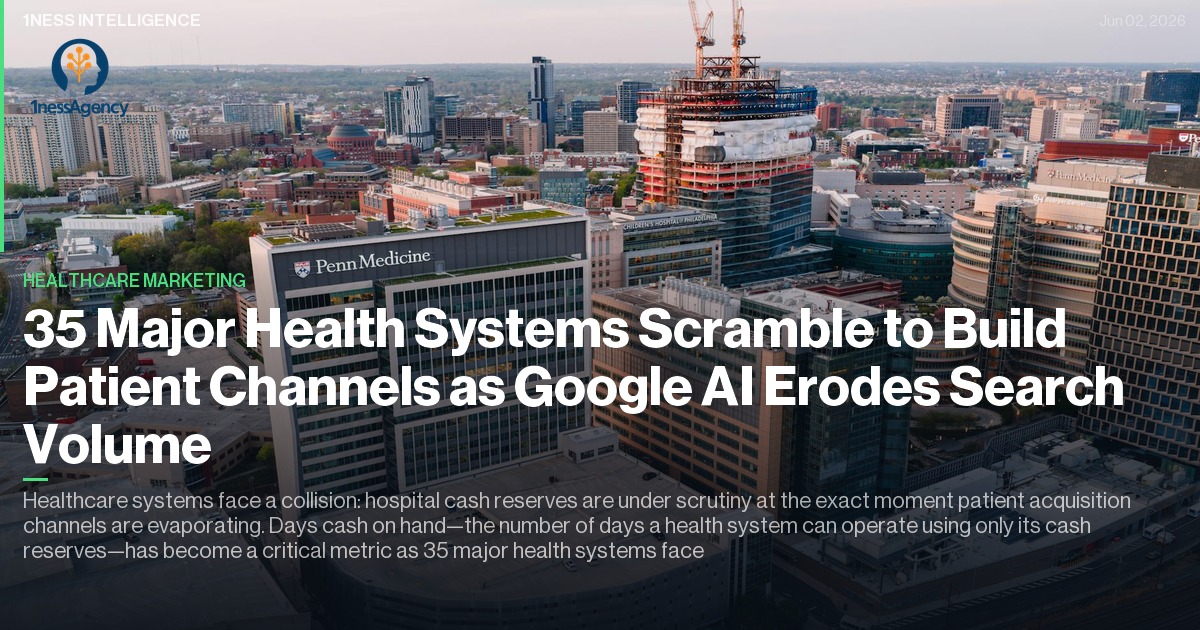
Healthcare systems face a collision: hospital cash reserves are under scrutiny at the exact moment patient acquisition channels are evaporating. Days cash on hand, the number of days a health system can operate using only its cash reserves, has become a critical metric as 35 major health systems face financial pressure in 2026. At the same moment, the digital channels these organizations rely on for patient volume are collapsing. Search traffic dropped 36% across publisher sites in the first half of 2026, with revenue falling 16% as AI-generated search results replace organic clicks . Healthcare marketers now operate in a world where executive leadership demands patient acquisition cost efficiency while the tools that delivered volume are breaking.
The problem is structural, not cyclical. When Google surfaces an AI Overview at the top of search results, organic click-through rates drop 61% . The service content healthcare organizations built to capture search volume (symptom checkers, condition information pages, provider directories) now generates answers without sending traffic. Media leaders surveyed expect search traffic to fall another 43% within three years, with one-fifth predicting losses above 75% . Meanwhile, Google began testing healthcare ads within AI Mode in June 2026, creating a paid channel where organic traffic once existed .
Michael Silberman, executive vice president of media strategy at Piano, identified the survival pattern: "The publishers that still grow revenue despite declining traffic use a few key tactics: they raise prices, focus on churn reduction and invest in channels they control" . Healthcare marketers face the same imperative, build owned channels or watch patient acquisition costs spike as paid advertising becomes the only path to visibility.
This matters beyond digital strategy teams. When a health system's days cash on hand shrinks, every marketing dollar faces CFO scrutiny. The traditional answer, drive more volume through search and paid channels, no longer works at historical efficiency. The organizations that stabilize patient volume and defend market share will be those that shift from renting attention on platforms to building direct relationships with patients. The window to make that transition while systems still have operating reserves is closing.
The Cash Pressure Context: Why Financial Metrics Now Drive Marketing Decisions
Days cash on hand measures liquidity, the cushion available when revenue drops or expenses spike. For healthcare systems, this metric determines everything from capital investments to staffing levels to marketing budgets. When cash reserves shrink, marketing shifts from a growth function to a cost center under immediate pressure to justify ROI.
The timing creates a trap. Health systems need patient volume to generate revenue, but the cost to acquire that volume through digital channels is rising exactly when budgets face cuts. The efficiency model that worked for the past decade, invest in SEO for organic traffic, supplement with paid search for high-intent keywords, retarget through display, assumes traffic volume remains stable and conversion rates hold. Neither assumption survives 2026.
Healthcare organizations that built elaborate content libraries for SEO now face a reality where that content generates AI answers instead of website visits. The investment in "10 signs you need a knee replacement" or "understanding your diabetes diagnosis" content paid dividends when it ranked and drove traffic. Now it trains the AI that answers questions without sending patients to your site.
From Traffic Volume to Known Patient Relationships: The Registration Imperative
The strategic response mirrors what publishers are implementing: make registration the priority, not a conversion goal saved for later in the patient journey. When search traffic was abundant, anonymous website visitors didn't matter, tomorrow would bring more traffic. In 2026, every patient who leaves your website without providing an email address or creating an account is someone you cannot reach when they're ready to schedule .
Advance Local launched 15 subscriber-exclusive newsletters across 10 markets in 2024. Subscribers who received those newsletters were retained at rates up to 40% higher than those who didn't . Healthcare applications are direct: appointment reminders, condition-specific education, physician introductions, pre-visit preparation guides. The newsletter list or patient portal user base belongs to the health system: it doesn't shrink when Google changes its algorithm.
The practical starting point: calculate what percentage of your current website visitors you can reach without a referral source. If 80% of your traffic is anonymous, you have no way to reach them when search traffic drops further, no email, no patient portal account, no app installation, no direct relationship. Registration walls, email capture on high-value content, patient portal enrollment prompts, and mobile app download incentives all serve the same purpose: converting one-time visitors into known patients you can reach again.
A major U.S. public media organization in Piano's client base found that search visitors converted to paid subscriptions at better rates than direct visitors, but the volume was falling and unpredictable. The publisher built personalized "For You" pages to give readers a reason to return directly, added app download prompts for mobile visitors, and used content recommendations to extend sessions. Exit-intent recommendations alone saved 3.6% of first-time visitors . Healthcare equivalents: personalized care plan pages, physician match tools, symptom trackers, appointment scheduling integrated throughout the experience rather than buried in navigation.
The Paid Channel Reality: When Organic Dies, Budgets Don't Grow to Replace It
Google's June 2026 testing of healthcare ads in AI Mode signals the business model shift . Where healthcare organizations once captured patients through organic search rankings, they'll now compete for ad placements within AI-generated answers. The cost structure changes immediately, impressions that once came from content investment now require media spend.
This creates a financial vise. CFOs see days cash on hand declining and ask marketing to reduce costs. Marketing sees organic traffic disappearing and knows paid advertising must increase to maintain volume. The math doesn't work unless conversion rates improve dramatically or the cost per acquisition from owned channels replaces platform-dependent traffic.
The organizations that maintain patient volume without proportional budget increases will do it through three mechanisms: owned email and app channels that drive direct scheduling, improved conversion rates from website visitors to known patients, and strategic use of paid advertising focused on high-lifetime-value service lines rather than volume-based traffic goals. The days of cheap patient acquisition through organic search are gone, the question is whether marketing budgets and financial reserves can absorb the transition before volume declines force service cuts.
The 1ness Take
Healthcare marketers must reframe the conversation with executive leadership now, before the next budget cycle locks in assumptions that no longer match reality. The traditional metrics (website traffic, search rankings, cost per click) measure a patient acquisition model that's breaking. The new framework starts with owned audience size: how many patients can we reach directly through email, app, or patient portal?
Build a 90-day sprint focused on known patient conversion:
Week 1-2: Audit current anonymous traffic. What percentage of website visitors provide any contact information before leaving? For most health systems, this number is below 5%. That's the gap. Week 3-6: Implement registration gates on high-value content. Not paywalls, value exchanges. "Get this symptom guide sent to your email." "Create an account to save your favorite physicians." "Download our app for one-tap scheduling." Use exit-intent technology to capture abandoning visitors. Test multiple offers across different service lines. Week 7-12: Build the retention architecture. Once you have an email address or app user, what brings them back? Advance Local proved 40% better retention with targeted newsletters . Healthcare applications: post-visit care instructions, medication reminders, preventive care prompts, health risk assessments that drive scheduling. The goal is not to send more emails: it's to create utility that makes your communication channel valuable enough that patients keep it.The financial pressure on health systems won't ease before your organic search traffic recovers, because that traffic isn't recovering. The AI Overview model is Google's product strategy, not a temporary test. Healthcare marketers who wait for traffic patterns to normalize will find themselves with shrinking budgets and disappearing volume. Those who build direct patient relationships now create an asset that doesn't depend on whether Google sends traffic, and that's the only acquisition channel that survives CFO scrutiny when days cash on hand becomes the metric that drives decisions.
The Takeaway
Healthcare financial pressure and digital channel disruption are simultaneous. Organizations that respond to budget cuts by reducing marketing investment while maintaining platform-dependent acquisition strategies will see accelerating volume declines. The path forward requires three immediate actions:
Measure what matters differently. Track known patient percentage (visitors who provide contact information), owned audience size (total reachable via email, app, portal), and direct traffic conversion rates. These metrics indicate resilience. Traffic and rankings measure dependency on channels you don't control. Make registration the goal, not a later conversion. Every content page, every tool, every physician directory should include a clear value exchange for patient contact information. Anonymous traffic has no value if you can't reach that patient tomorrow. Shift budget from rented to owned channels. Email marketing, app development, patient portal enhancement, and CRM sophistication deliver returns that compound over time and don't disappear when platforms change algorithms. Paid search and display advertising rent temporary attention. When CFOs scrutinize marketing spend, owned channels survive the cut, rented channels don't.The health systems that maintain patient volume while operating on tighter cash reserves will be those that built direct relationships before the traffic disappeared. That window is closing.
References
- Silberman, M. (2026, June 2). Amid falling traffic, publishers are investing in engagement, registration and citations. Digiday digiday.com
- Search Engine Land. (2026, June 2). Google begins testing healthcare ads in AI Mode searchengineland.com