- The Centers for Medicare & Medicaid Services finalized a federal framework in 2025 enabling states to impose work requirements on Medicaid enrollees aged 19-64.
- States implementing work requirements could begin disenrolling working-age adults within months, directly reducing the insured patient pools that health systems have relied on since the Affordable Care Act's expansion.
- The policy shift will have direct consequences for patient volume, service-line revenue, and community health marketing strategies at hospitals and health systems across the country.
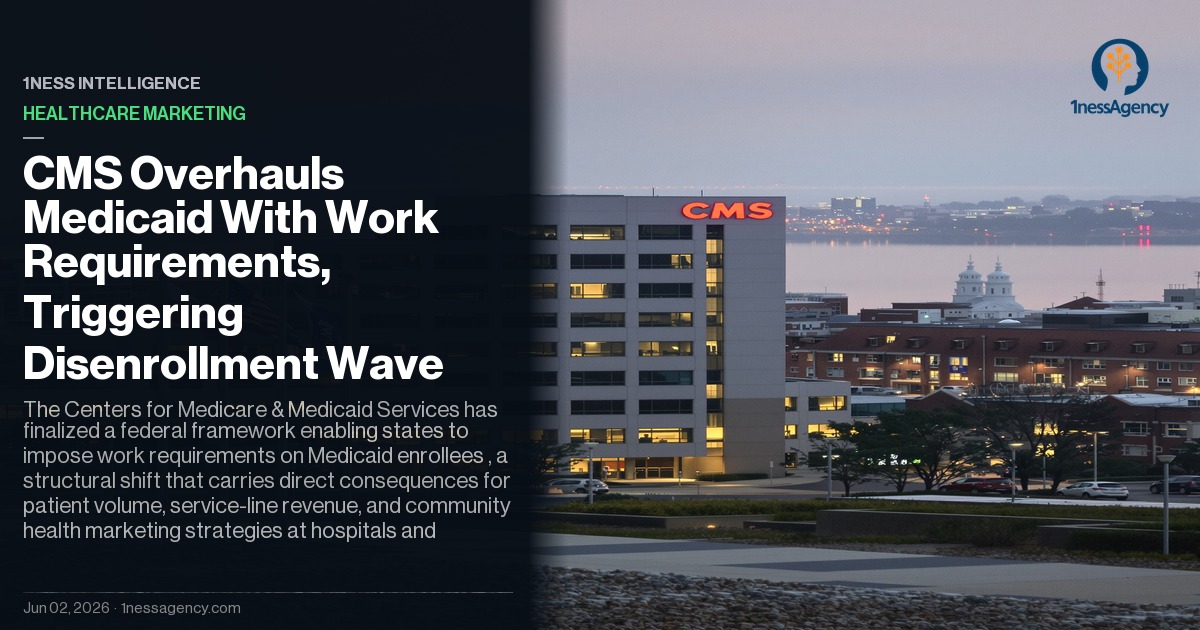
The Centers for Medicare & Medicaid Services has finalized a federal framework enabling states to impose work requirements on Medicaid enrollees , a structural shift that carries direct consequences for patient volume, service-line revenue, and community health marketing strategies at hospitals and health systems across the country . This is not a distant policy debate. States that move quickly to implement these rules could begin disenrolling working-age adults within months, shrinking the insured patient pools that health systems have built acquisition strategies around since the Affordable Care Act's expansion era.
CMS finalized the "community engagement" framework in 2025, establishing the regulatory scaffolding that allows states to require certain Medicaid beneficiaries , primarily non-disabled adults between the ages of 19 and 64 , to demonstrate employment, job training, education, or community service to maintain coverage . States must apply for Section 1115 waivers to activate requirements within their borders. As of early 2026, a growing number of Republican-led states are advancing or have filed waiver applications, with Georgia's existing Pathways program serving as the operational blueprint . Historical precedent is instructive here: the first wave of work requirement approvals under the first Trump administration (2018–2019) was reversed by federal courts, but the legal landscape has shifted, and CMS under the current administration has signaled it will defend these rules aggressively.
For healthcare marketers, the arithmetic is blunt. Medicaid covers roughly 80 million Americans as of 2026 . Even a modest disenrollment rate of 5 to 10 percent in states that implement requirements would translate to millions of patients losing coverage , and arriving at emergency departments, community health centers, and safety-net hospitals as uninsured or self-pay. That changes the conversation from patient acquisition to patient retention, financial counseling integration, and targeted outreach to at-risk populations before they lose coverage altogether.
The Revenue Erosion Risk Health Systems Cannot Ignore
Medicaid disenrollment is not an abstraction for hospital finance teams. The "unwinding" of pandemic-era continuous enrollment protections in 2023 and 2024 offers a documented preview. Between April 2023 and late 2024, states disenrolled more than 25 million people from Medicaid , a figure the KFF (Kaiser Family Foundation) tracked in real time , with a significant share losing coverage due to administrative failures rather than actual ineligibility . Many of those individuals cycled into uninsured status, inflating uncompensated care costs at safety-net systems.
Work requirements create a second, structurally similar wave. The Urban Institute estimated in prior research that work requirements in Arkansas , the only state to briefly implement them before courts intervened in 2019 , caused approximately 18,000 people to lose Medicaid coverage within months, with most of those individuals reporting they were already working but unable to navigate the documentation requirements . The coverage loss was not driven by non-compliance with work itself. It was driven by paperwork. Health systems that serve high volumes of Medicaid patients should treat that Arkansas data as a worst-case operational scenario, not a historical footnote.
Our recommendation: Health system marketing and finance teams should model a 10 to 20 percent Medicaid volume reduction scenario now, before waiver approvals arrive in their state. Build the financial case for proactive outreach investment before the revenue gap opens, not after.Patient Communication Is Now a Retention Instrument
The period between a state's waiver approval and the enforcement of work requirements is the most valuable window healthcare marketers have. That window , typically six to eighteen months for CMS review and state implementation , is when health systems can deploy targeted retention campaigns to Medicaid patients who may not understand the new requirements or know how to comply.
This is not charity marketing. It is a direct defense of patient volume and downstream revenue from established care relationships. A patient who loses Medicaid coverage and delays a follow-up appointment for a chronic condition is a patient who returns to the emergency department , the most expensive and least efficient point of care acquisition in any system.
The marketing toolkit here is well-established, but the urgency is new. CRM systems that segment patients by payer type, age, and engagement history can identify Medicaid enrollees in affected age ranges. SMS and app-based outreach campaigns , consistent with HIPAA's minimum necessary standard and state consent frameworks , can direct patients toward eligibility support resources, social workers, or state Medicaid agency portals. Health systems with patient navigators should position those staff members as front-line retention assets, not back-office support functions.
Our recommendation: Build a Medicaid-specific patient communication workflow now. The message is simple: "Here is what is changing, here is what you need to do, and here is how we can help." Systems that send this message six months before enforcement will retain more patients than those that send it after disenrollment notices arrive.Acquisition Strategy Must Shift Toward the Newly Uninsured
Work requirements will not eliminate the healthcare needs of disenrolled patients. They will reroute those patients toward self-pay, charity care, and federally qualified health centers (FQHCs). Health systems that operate community benefit programs, sliding-scale clinics, or FQHC partnerships have a marketing opportunity , and an obligation , to make those pathways visible before disenrollment creates care gaps.
From a patient acquisition standpoint, this means updating digital content and local search optimization to surface financial assistance programs, charity care applications, and sliding-scale fee information. A patient who loses Medicaid and searches "free clinic near me" or "hospital financial assistance" should find your system at the top of those results. Google's local search algorithms prioritize relevance and proximity; health systems that update their Google Business Profiles, FAQ pages, and service-line content to address coverage transitions will capture patients that competitors with stale web content will not.
Actionable Takeaways for Healthcare Marketers
- Segment your CRM today. Identify Medicaid patients in the 19–64 age band in states with active or pending 1115 waiver applications. This is your at-risk retention list.
- Build a coverage transition content hub. Create a dedicated landing page , optimized for search , that explains work requirements, links to state Medicaid eligibility tools, and promotes your financial assistance programs.
- Activate patient navigators as a marketing channel. Navigator outreach is measurable, targeted, and defensible under HIPAA. Track contact rates, appointments retained, and coverage maintenance as KPIs.
- Update paid search and local SEO. Bid on terms like "Medicaid work requirements [state name]" and "hospital financial assistance." These are low-competition, high-intent queries that will surge as implementation dates approach.
- Partner with FQHCs and community organizations. Referral relationships with trusted community organizations will route newly uninsured patients to your system rather than away from it.
Compliance Callout
Any outreach campaign targeting Medicaid enrollees must comply with HIPAA's Privacy Rule. Patient segmentation using payer data from your EHR is permissible for treatment-related communications and healthcare operations under 45 CFR §164.506, but marketing communications that promote a service for remuneration require explicit patient authorization . The line between "care coordination outreach" and "marketing" matters here. Work with your compliance and legal teams before launching any Medicaid retention campaign. The FTC's health privacy enforcement posture in 2026 has also intensified scrutiny of digital tracking tools on health system websites , review pixel and analytics configurations before any new campaign launch.
The 1ness Take
CMS's finalized framework is a countdown clock, not a distant warning. The health systems that treat this as a finance department problem will be reactive. The ones that treat it as a marketing and patient engagement problem will be ready.
The strategic insight most health system marketers are missing: work requirements are a patient communication failure waiting to happen at scale. The Arkansas data proves that most people who lose coverage under these rules are not non-compliant , they are uninformed and under-supported. That is a gap your marketing and patient engagement infrastructure exists to close.
Invest in Medicaid retention campaigns now, while the window is open. The cost of a targeted SMS or navigator outreach program is a fraction of the cost of losing an established patient to uninsured status, delayed care, and eventual emergency department presentation. Model it. The ROI will be obvious.
Build your content infrastructure for the newly uninsured today. Six months from now, when work requirement enforcement begins in the first wave of states, health systems with visible, search-optimized financial assistance pathways will acquire patients. Those without them will absorb uncompensated care without the relationship.
The Takeaway
1. This week: Pull your Medicaid patient volume by state and age band. Flag states with active 1115 waiver applications. Quantify your exposure.
2. This month: Develop a Medicaid coverage transition outreach workflow in your CRM. Coordinate marketing, social work, and compliance teams on messaging and channel selection.
3. This quarter: Launch a financial assistance content hub optimized for local search. Track inbound inquiries from newly uninsured patients as a leading indicator of campaign effectiveness.
References
- Centers for Medicare & Medicaid Services. Medicaid Community Engagement (Work Requirements) Overview. CMS.gov. 2026 cms.gov
- Becker's Hospital Review. CMS Finalizes Framework for Medicaid Work Rules: 8 Things to Know. 2026 beckershospitalreview.com
- Georgia Department of Community Health. Georgia Pathways to Coverage , Section 1115 Demonstration. DCH.Georgia.gov. 2025–2026 dch.georgia.gov
- KFF (Kaiser Family Foundation). Medicaid Enrollment and Unwinding Tracker. KFF.org. Updated 2024–2026 kff.org
- Garfield, Rachel, et al. Implications of Work Requirements in Medicaid: What Does the Data Say? KFF. August 2019. (Historical reference , cited for documented Arkansas program outcomes.) kff.org
- U.S. Department of Health and Human Services. HIPAA Privacy Rule: Marketing. HHS.gov. 45 CFR §164.501, §164.506, §164.508 hhs.gov