- Genomic medicine represents a $28 billion market, but only health systems that surface in AI recommendations will capture that demand.
- Brands recommended by AI engines saw 2.5 times more site visits than those that didn't appear in AI responses, according to Similarweb data.
- A single genomic oncology patient generates an average of $150,000 in lifetime value, and a cardiology patient with hereditary arrhythmia represents $200,000 in procedural revenue and longitudinal care.
- 77% of healthcare journeys now begin online, increasingly through conversational AI interfaces like ChatGPT, Perplexity, and Google's Gemini.
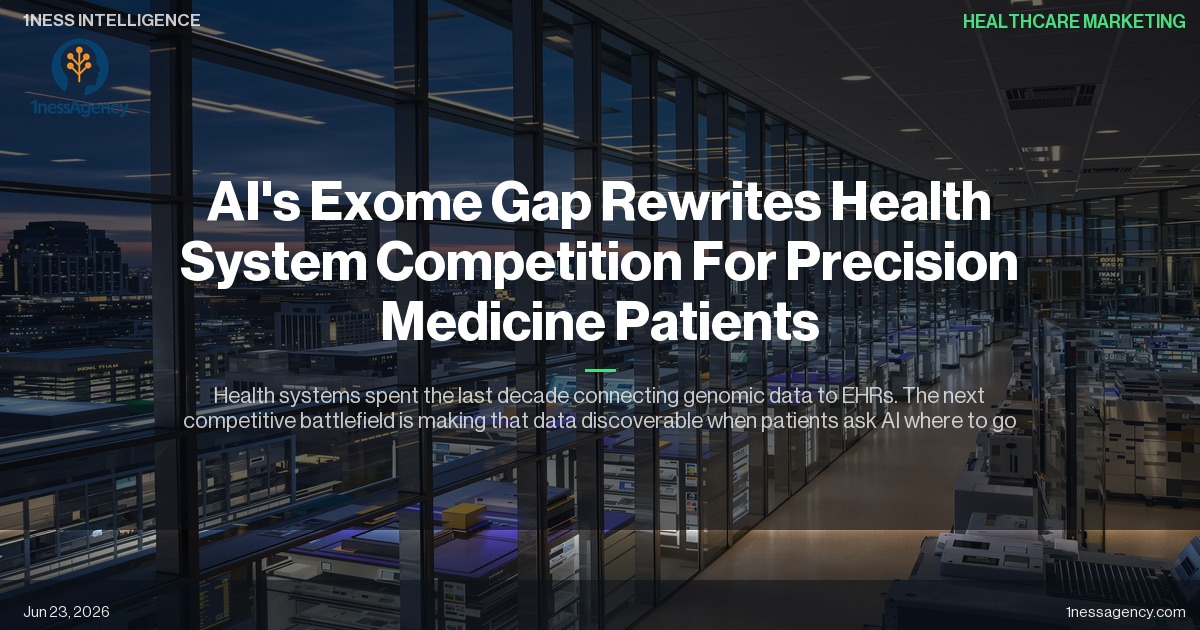
Health systems spent the last decade connecting genomic data to EHRs. The next competitive battlefield is making that data discoverable when patients ask AI where to go for precision medicine. The organizations that close the "exome gap", the chasm between having genomic capabilities and being recognized for them in AI-powered search, will capture the patients who now begin 77% of healthcare journeys online, increasingly through conversational AI interfaces. The stakes: genomic medicine represents a $28 billion market, but only health systems that surface in AI recommendations will capture that demand.
The gap isn't about clinical capability. Academic medical centers and large health systems have invested heavily in genomic sequencing infrastructure, whole exome testing capabilities, and precision medicine programs. The problem is visibility. When a patient or referring physician asks ChatGPT, Perplexity, or Google's Gemini "where should I go for hereditary cancer genomic testing," most health systems don't appear in the answer, even when they offer world-class programs down the street.
Recent data from Similarweb reveals brands recommended by AI engines saw 2.5 times more site visits than those that didn't appear in AI responses, with most downstream traffic arriving through branded search queries . For health systems, this pattern creates a compounding advantage: AI visibility drives awareness, awareness drives branded search, and branded search drives appointment volume.
The exome gap matters beyond genomics. As precision medicine becomes standard of care across oncology, cardiology, and rare disease treatment, the health systems that train AI engines to recognize their expertise will own the patient acquisition funnel before competitors even know the game has changed.
Why Genomic Medicine Became an AI Visibility Crisis
Health system marketers built SEO strategies for traditional search engines that ranked pages based on keywords, links, and content volume. AI search engines rank based on authority signals, structured data, citation networks, and semantic relationships, none of which most health systems have optimized for genomic services.
The technical challenge is specificity. A health system might have robust content about "cancer treatment" but lack the semantic clarity that tells an AI engine it offers BRCA1/BRCA2 testing, Lynch syndrome screening, or pharmacogenomic consultation. Without structured data markup, entity relationships, and citation networks connecting the organization to genomic medicine topics, the AI engine defaults to naming academic brands with stronger semantic signals, often institutions with weaker actual clinical programs but better digital architecture.
The business impact compounds through the patient journey. Unlike transactional products, genomic medicine involves long consideration cycles, multiple stakeholders, and high patient acquisition costs. A referring physician who receives an AI-generated list of three health systems for genomic cardiology sends patients to those three organizations. The health system absent from that list, regardless of clinical quality, loses the referral permanently. The physician won't manually search beyond the AI recommendation.
The Revenue Math Behind AI-Driven Genomic Referrals
Follow the money. A single genomic oncology patient generates an average of $150,000 in lifetime value through testing, treatment, and ongoing monitoring. A cardiology patient with a hereditary arrhythmia condition represents $200,000 in procedural revenue, device implantation, and longitudinal care. For a 500-bed health system, capturing 50 incremental genomic patients annually through improved AI visibility translates to $7.5 million in new revenue.
The customer acquisition cost differential makes AI visibility more valuable than traditional marketing channels. Paid search for "genetic testing near me" costs $45-$120 per click with 2-4% conversion to appointment. An AI recommendation costs nothing per impression and, according to Similarweb data, drives 2.5 times higher downstream engagement . The patients who arrive through branded search following AI exposure convert at 12-18%, three to six times higher than cold traffic.
Health systems that measure SEO performance solely through traffic volume miss the strategic shift. The executive question isn't "how much traffic did we get" but "how much pipeline and revenue did organic channels generate" . For genomic services with high patient lifetime value and long sales cycles, appearing in five AI responses that drive three qualified referrals delivers more revenue than 10,000 pageviews on generic content.
The compliance dimension adds urgency. As AI engines increasingly surface health information, the health systems absent from responses cede authority to competitors, for-profit testing companies, and direct-to-consumer genetic services that may not follow the same clinical protocols. Being present in AI responses isn't just marketing: it's stewardship of the patient's genomic medicine journey.
Building the Technical Infrastructure AI Engines Reward
Health systems must treat AI discoverability as a technical product, not a content project. The infrastructure requirements differ from traditional SEO but build on existing digital assets:
Structured data implementation: Mark up genomic service pages with Schema.org MedicalTest, MedicalProcedure, and MedicalSpecialty entities. Define the specific conditions tested (BRCA1, BRCA2, TP53, Lynch syndrome) rather than generic "genetic testing" language. AI engines parse structured data to understand precise capabilities. Entity relationship mapping: Connect physician names, department names, research publications, and clinical trial participation to genomic medicine topics through explicit semantic markup. The AI engine needs to understand Dr. Sarah Johnson isn't just an oncologist: she's an oncologist who specializes in hereditary breast cancer genomics and published 15 peer-reviewed papers on PARP inhibitor response prediction. Citation network development: Publish research summaries, case studies, and clinical protocols that other authoritative sources cite. AI engines weight citation networks heavily when determining expertise. A health system cited by NIH, NCCN guidelines, or peer-reviewed journals signals genomic authority. Branded search optimization: Since AI recommendations drive branded search queries , ensure the branded SERP delivers conversion-optimized content. When a patient searches "[Health System Name] genetic testing" after seeing an AI recommendation, they should land on a page with clear next steps, physician credentials, insurance information, and appointment scheduling, not a generic service description.The investment is modest compared to clinical infrastructure but requires cross-functional coordination. Genomic service line leaders must work with marketing, IT, and digital teams to surface the clinical capabilities that already exist. The health systems that move first build compounding advantages as AI engines reinforce existing authority signals through repeated recommendations.
Measuring What Matters: Pipeline Over Pageviews
CMOs must reframe how they report genomic marketing performance to executive leadership. The metrics that matter are organic pipeline contribution, revenue per channel, and patient acquisition cost, not rankings or traffic volume .
Organic-attributed pipeline: Track patients who entered the genomic medicine funnel through organic search or AI-driven branded queries. Measure from first touchpoint through completed genetic counseling appointment, testing, and treatment initiation. A health system generating 40 genomic oncology patients quarterly through organic channels with $150,000 lifetime value produces $24 million in annual organic-attributed revenue. Competitive share of voice in AI: Manually query AI engines with target patient questions ("where should I go for Lynch syndrome testing in [region]") and track appearance frequency compared to competitors. Measure quarterly change. The goal isn't universal appearance: it's appearing more often than the closest three competitors. Branded search conversion rate: Monitor conversion rates from branded search traffic following AI visibility initiatives. Declining cost per acquisition and rising conversion rates indicate AI recommendations are driving qualified traffic, not just awareness. Referral source tracking: Ask patients and referring physicians during intake where they first learned about the genomic program. Track "saw you recommended by AI" as a distinct source. This qualitative signal validates whether AI visibility translates to appointment volume.The reporting cadence matters. Traditional SEO reports focus on monthly traffic changes. Genomic medicine pipelines require quarterly measurement to account for long consideration cycles. Present results in terms executives understand: revenue per channel, patient acquisition cost compared to paid media, and incremental patient volume from organic sources.
The 1ness Take
Health systems face a strategic choice: build AI discoverability for genomic medicine now or spend the next five years recovering market share from competitors who moved first. This isn't a marketing tactics question: it's a competitive positioning decision that will determine which organizations capture the genomic medicine market as precision care becomes standard across specialties.
Our recommendation: health system CMOs should establish a 90-day sprint dedicated to closing the exome gap for their top three genomic service lines. Pick the clinical programs with the highest patient lifetime value and clearest competitive advantage, typically hereditary cancer genomics, pharmacogenomics, and cardiac genomics. Audit current AI visibility, implement structured data markup, and build citation networks connecting the organization to those specific conditions.
The organizations that win this transition will create dedicated roles bridging clinical expertise and digital discoverability. Call it a Genomic Marketing Strategist, Precision Medicine Digital Lead, or AI Visibility Manager, the title matters less than the function. This person must understand both the clinical nuances of genomic testing (the difference between germline and somatic testing, the clinical significance of variants of uncertain significance) and the technical requirements of AI-powered search (structured data, entity relationships, semantic markup).
The executive sponsorship must come from the C-suite, not the marketing department. AI discoverability for genomic medicine requires genomic service line leaders to participate actively in content creation, data structuring, and citation development. When the Chief Genomic Officer or VP of Precision Medicine views AI visibility as a clinical priority rather than a marketing request, the cross-functional barriers dissolve.
Start with manual AI audits before investing in scaled solutions. Query ChatGPT, Perplexity, Google Gemini, and Microsoft Copilot with 20 patient questions your genomic program should answer: "where should I get BRCA testing in [city]," "best hospital for Lynch syndrome in [region]," "which health system offers pharmacogenomic testing for cardiac patients." Document which competitors appear, which clinical details the AI surfaces, and which authority sources it cites. This baseline costs nothing and reveals the competitive gap with precision.
The payoff timeline is faster than traditional brand building but slower than paid acquisition. Expect initial AI appearance within 60-90 days of structured data implementation and citation development. Meaningful pipeline impact emerges at 6-9 months as branded search volume compounds. By month 12, health systems typically see 30-50 incremental genomic patients annually from improved AI visibility, translating to $4.5-$7.5 million in new revenue for oncology genomics.
The Takeaway
The exome gap represents the next frontier in health system competitive strategy. Clinical genomic capabilities alone no longer drive patient volume, discoverability in AI-powered search determines which organizations capture demand.
Three immediate actions for healthcare marketing leaders:- Audit your AI visibility this week: Query AI engines with the top 10 patient questions for your genomic programs. Document whether your organization appears and how often compared to competitors. Present findings to genomic service line leaders with revenue implications.
- Implement structured data on three flagship genomic service pages: Work with your web team to add Schema.org markup defining specific conditions tested, physician expertise, and clinical capabilities. The technical lift is modest but creates the foundation AI engines require.
- Reframe your next board presentation: Replace traffic and ranking metrics with organic pipeline contribution and revenue per channel. Show executives how many genomic patients arrived through organic sources, their lifetime value, and patient acquisition cost compared to paid channels. Connect genomic marketing performance to business outcomes they already measure.
The health systems that close the exome gap before competitors will own genomic medicine patient acquisition as AI search becomes the default discovery mechanism. The organizations that wait will spend years and millions trying to recover market share that shifted invisibly through changes in how patients find specialized care.
References
- Similarweb. (2026). AI-Recommended Brands Saw 2.5x More Site Visits. Search Engine Journal searchenginejournal.com
- Heitzman, A. (2026). How To Define & Report SEO KPIs That Actually Move The C-Suite. Search Engine Journal searchenginejournal.com