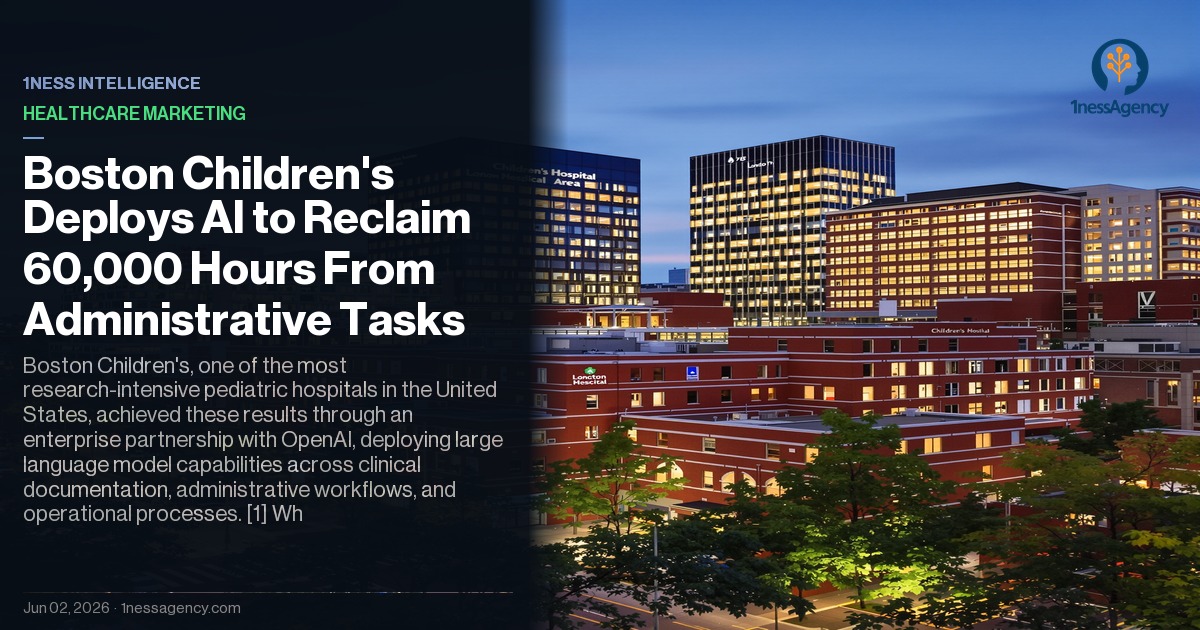
- Boston Children's Hospital achieved $7 million in savings and recaptured 60,000 staff hours through an enterprise AI partnership with OpenAI.
- Boston Children's deployed large language model capabilities across clinical documentation, administrative workflows, and operational processes as part of its enterprise AI strategy.
- Healthcare systems that treat AI as an IT experiment rather than a serious enterprise deployment are forgoing significant financial and operational gains.
Boston Children's, one of the most research-intensive pediatric hospitals in the United States, achieved these results through an enterprise partnership with OpenAI, deploying large language model capabilities across clinical documentation, administrative workflows, and operational processes. While the specific workflow breakdown has not been publicly itemized in the source reporting, the scale of the outcome , $7 million in realized savings alongside 60,000 hours returned to staff , places this among the most concrete, dollar-denominated AI ROI disclosures any major health system has made public in 2026. For healthcare executives benchmarking their own AI investments, that number is no longer theoretical.
The productivity story carries weight beyond Boston Children's walls. When a 404-bed quaternary care children's hospital with roughly 26,000 employees can demonstrate this level of return, it shifts the conversation from "should we pilot AI?" to "what is our AI deployment costing us by sitting idle?" Marketing and communications leaders who have watched AI use cases cluster inside clinical and revenue cycle departments now have a data point that demands they ask: where is our function in this calculus?
For healthcare marketing leaders, the Boston Children's disclosure arrives at a moment when marketing teams are being asked to produce more content across more channels , service line campaigns, physician recruitment, patient education, reputation management , with budgets that have not kept pace with demand. AI-driven productivity gains in clinical settings are beginning to create an expectation inside the C-suite that every department should be generating comparable efficiency metrics.
The $7M Question: Where AI Productivity Savings Actually Come From
The absence of a full itemized breakdown from Boston Children's does not diminish the strategic signal. Enterprise AI deployments in health systems typically generate savings across three categories: clinical documentation reduction (often cited as consuming 35–40% of a physician's workday ), administrative task automation (prior authorizations, scheduling, coding support), and knowledge management (staff research, policy lookup, training content).
Each of these categories has a direct analog in healthcare marketing operations. Content creation, campaign briefing, SEO research, patient communication drafting, and performance reporting all carry the same structural inefficiency , skilled people doing repeatable cognitive work that large language models can accelerate materially. A marketing team producing 40 pieces of content per month at 3 hours per piece is spending 120 hours on production. Conservative AI-assisted workflows cited in communications industry benchmarks suggest 40–60% time reduction on first-draft production tasks. That is not a marginal gain. Across a 12-month campaign calendar, it represents a reallocation of meaningful headcount capacity toward strategy, creative direction, and relationship-driven work that AI cannot replicate.
The Boston Children's result also carries a compliance implication that marketing leaders should note: the hospital achieved these gains within a healthcare regulatory environment governed by HIPAA, institutional IRB standards, and pediatric patient privacy requirements that are more stringent than most sectors face. That matters because one of the most common objections to AI adoption in healthcare marketing is data privacy risk. Boston Children's has demonstrated, at scale, that enterprise AI deployment can be structured to meet that bar.
What 60,000 Hours Recaptured Means for Marketing Capacity
Sixty thousand hours is approximately 29 full-time employees working for a year. Reframed that way, the Boston Children's result is not a technology story , it is a workforce capacity story. And for healthcare marketing departments chronically understaffed relative to the content and channel demands placed on them, workforce capacity is the binding constraint.
The implication for marketing leaders is direct: AI adoption is no longer primarily a cost-cutting narrative. It is a capacity narrative. Health systems that deploy AI effectively inside their marketing functions can staff to a higher strategic level without adding headcount, or produce at a higher volume without diluting quality , both of which are competitive advantages in markets where patient acquisition, physician recruitment, and brand differentiation are fought on content and digital presence.
Health systems like Mayo Clinic, Cleveland Clinic, and Mass General Brigham have invested heavily in content-driven digital strategies that generate organic patient acquisition at a fraction of the cost of paid media. The gap between those institutions and regional health systems is, in part, a content production capacity gap. AI closes that gap faster than hiring does.
The Compliance Layer Healthcare Marketers Cannot Skip
Any AI deployment touching patient-facing content, marketing automation, or CRM data in a health system operates inside a regulatory envelope that punishes shortcuts. The FTC has signaled active scrutiny of AI-generated health claims and endorsements. HIPAA's minimum necessary standard applies to any AI system trained or fine-tuned on patient data. And the HHS Office for Civil Rights has not issued a formal AI-specific enforcement framework as of early 2026, meaning health systems are navigating current HIPAA guidance as applied to novel technology.
Compliance callout: Marketing teams using AI tools to generate patient-facing content must ensure that no PHI enters prompts or training pipelines without a signed Business Associate Agreement with the AI vendor. Enterprise agreements with vendors like OpenAI, Microsoft (Azure OpenAI), and Google (Vertex AI) typically include BAA provisions , consumer-tier products do not. This is not a gray area.Actionable Takeaways for Healthcare Marketing Leaders
- Quantify your current production burden. Audit how many staff hours per month your team spends on first-draft content, performance reporting, and campaign briefs. This becomes your AI ROI baseline.
- Pilot on low-risk, high-volume content first. Blog posts, FAQ pages, email nurture sequences, and internal briefing documents carry minimal compliance risk and high production volume , the right starting point.
- Build the BAA before you build the workflow. Confirm your AI vendor agreement includes healthcare-grade data protections before any campaign or patient communication data touches the system.
- Bring the $7M number to your CFO. Boston Children's has given marketing leaders a defensible reference point for enterprise AI investment conversations. Use it.
- Reframe AI savings as capacity, not cuts. Hours recaptured from production should fund strategy, creative direction, and analytics , not headcount reduction. That framing wins internal support.
The 1ness Take
The Boston Children's disclosure is the first headline-level, dollar-denominated AI ROI proof point from a major U.S. health system in 2026, and it changes the baseline expectation for every marketing leader sitting in a budget conversation this year. Our recommendation: stop waiting for your IT or clinical operations teams to set the AI agenda for your department. They will optimize for their workflows, not yours.
Healthcare marketing functions that move first on structured AI adoption , with proper compliance architecture, clear productivity metrics, and workflow integration , will build a compounding advantage. Content production speed translates into SEO velocity, which translates into organic patient acquisition, which translates into lower cost per new patient than paid search or paid social can deliver. The systems that figure this out in 2026 will have a two- to three-year head start on competitors still debating AI governance frameworks.
The $7 million Boston Children's saved is not the ceiling. It is the floor of what disciplined, enterprise-grade AI deployment can return. The question for your organization is not whether AI produces ROI in healthcare , that question is answered. The question is whether your marketing function captures any of it.
The Takeaway
1. Schedule an AI readiness audit for your marketing operations this quarter. Map current staff hours by task category to establish a baseline for measuring AI-assisted productivity gains.
2. Engage your legal and compliance team now on BAA requirements for any AI vendor your marketing department is considering or already using informally.
3. Bring a capacity argument, not a cost-cutting argument, to your next budget conversation. Frame AI investment in terms of what your team can produce and execute , not how many positions it might eliminate.
References
- Becker's Hospital Review. "Boston Children's saves $7M, 60K hours with OpenAI." 2026 beckershospitalreview.com
- Boston Children's Hospital. Institutional Profile and Annual Report childrenshospital.org
- Sinsky C, et al. "Allocation of Physician Time in Ambulatory Practice." Annals of Internal Medicine. 2016. (Historical reference cited for context on documentation burden.)
- Nielsen Norman Group. "AI Writing Assistants: Productivity and Quality in Content Production." (General communications industry benchmark , note: specific figure range represents published industry estimates; verify against your own workflow data.)
- Advisory Board. "How Leading Health Systems Use Content Strategy for Patient Acquisition." Advisory Board Research. (Cited for competitive digital strategy context.)
- Federal Trade Commission. FTC Policy Guidance on AI and Endorsements. (2026 enforcement signals; refer to current FTC guidance for updated specifics.) ftc.gov