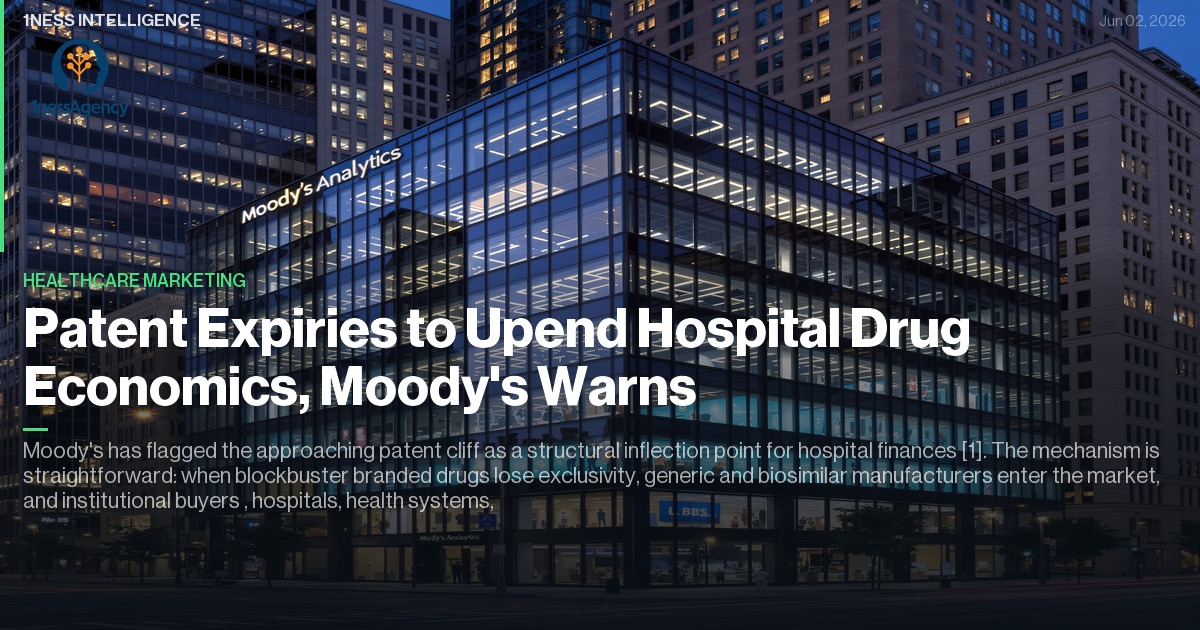
- Moody's projects that patent expirations on drugs worth an estimated $300 billion will flood the hospital market with lower-cost generics and biosimilars over the next several years.
- When drug costs drop, hospital CFOs are expected to redirect savings toward technology, service line expansion, and competitive positioning rather than retain the cost reductions.
- Healthcare organizations that position themselves before the patent cliff hits will be better positioned to capture redirected capital dollars compared to those responding after the shift occurs.
The Scale of the Shift , and What It Frees Up
Moody's has flagged the approaching patent cliff as a structural inflection point for hospital finances . The mechanism is straightforward: when blockbuster branded drugs lose exclusivity, generic and biosimilar manufacturers enter the market, and institutional buyers , hospitals, health systems, integrated delivery networks , gain leverage to renegotiate formulary costs downward. Across a $300 billion drug portfolio facing patent expiration, even modest price compression across a hospital's therapeutic mix translates into millions in recoverable margin at the facility level.
Historically, previous patent cliff cycles have demonstrated this pattern clearly. The early 2010s biosimilar wave , driven by expirations of drugs like infliximab and adalimumab , preceded measurable shifts in health system capital deployment toward digital infrastructure and facility investment. The 2026 cycle is projected to be larger in absolute dollar terms, affecting oncology, immunology, and cardiovascular drug categories simultaneously .
What makes this cycle different is the financial pressure context it arrives in. Health systems are simultaneously fighting payer denials, underpayments, and claims delays that drain revenue before it ever reaches the balance sheet. Anomaly Insights, which secured an additional $17 million in funding in June 2026, is building AI-powered payer intelligence tools specifically to address what it describes as a structural knowledge gap that disadvantages providers in every contract negotiation and claims interaction . The round, led by Sound Ventures and joined by Alumni Ventures, brings Anomaly's total raised to $34 million , a signal that investors see provider-side revenue integrity as a growth category precisely because margin pressure is acute .
The Budget Reallocation Window Healthcare Marketers Cannot Miss
When drug savings materialize on a health system's income statement, they don't disappear. They move. CFOs reallocate freed margin toward strategic priorities , service line growth, technology infrastructure, workforce retention, and increasingly, patient acquisition and brand investment.
Our recommendation: Healthcare marketers should begin building the internal business case now for capturing a share of the capital that patent cliff savings will free up. The argument is quantifiable. If a mid-sized health system reduces annual drug spend by even 5% across a formulary segment hitting patent expiration, that can represent $10 million to $30 million in recoverable margin depending on system size. A marketing budget ask framed against that specific financial event lands differently than a generic ROI argument.The window for this conversation is 2026 and 2027 , before the savings are already committed to other capital projects. Marketers who wait until the CFO's budget cycle closes will compete against line items that are already defended.
Payer Dynamics Are Shifting Too , And That Changes the Acquisition Equation
The patent cliff doesn't just affect drug costs. It reshapes payer negotiations. As biosimilars and generics reduce the cost basis for high-volume therapeutic categories, payers will adjust formulary structures, prior authorization criteria, and reimbursement benchmarks. Health systems that lack real-time visibility into how payer behavior is shifting will find themselves negotiating blind.
Anomaly's $17 million raise is a direct response to this problem . The company's platform is designed to detect patterns in payer denials, underpayments, and contract deviations , giving providers intelligence they currently lack when sitting across the table from payers. That capability becomes more valuable, not less, as drug cost dynamics shift and payers recalibrate their own financial models.
What this means for your patient acquisition strategy: Service lines that depend on high-cost biologics , oncology, rheumatology, gastroenterology , will see their payer coverage profiles change as biosimilar substitution accelerates. Marketing campaigns built around those service lines need to account for potential formulary shifts that could affect patient access and referral patterns. A rheumatology campaign that drives patient volume into a service line experiencing active prior authorization friction will underperform regardless of creative quality.Service Line Marketing in a Generics-Heavy Environment
The patent cliff creates a category-specific marketing opportunity that most health systems are not yet positioning around. As biosimilars become available in oncology and immunology, the clinical conversation shifts from "which branded drug" to "which institution has the protocols, the expertise, and the care coordination to manage biosimilar transitions safely." That is a differentiable position , and it belongs in the marketing brief.
Health systems like Cleveland Clinic, Mayo Clinic, and large regional IDNs that have invested in pharmacy and therapeutics committee infrastructure and biosimilar transition programs have a credible story to tell referring physicians and patients. The patent cliff is the news hook that makes that story timely.
Our recommendation: Build a content strategy around biosimilar transition competency targeted at referring physicians in high-impact specialties. A white paper, a CME-eligible webinar series, or a direct outreach campaign to rheumatologists and oncologists in your referral network , framed around the patent cliff timeline , positions your system as the destination for complex patients navigating formulary change.Actionable Takeaways for Healthcare Marketers
- Build the CFO case now. Patent cliff savings will create capital reallocation events in 2026–2027. Frame your marketing budget request against that specific financial release , not against abstract ROI benchmarks.
- Audit your service line campaigns for payer friction. Any service line dependent on high-cost biologics faces formulary disruption as biosimilars enter. Add payer prior authorization data to your campaign performance dashboard before investing in volume growth.
- Develop biosimilar transition content for referring physicians. This is an underserved information gap. The health system that owns the education narrative owns the referral relationship.
- Monitor payer behavior in real time. Tools like Anomaly's AI-powered payer intelligence platform are moving from nice-to-have to table stakes as payer contract complexity increases. Marketing and revenue cycle need to share intelligence on where patient access friction is highest.
- Map your marketing calendar to patent expiration timelines. Specific drugs losing exclusivity in 2026–2028 are publicly trackable through FDA Orange Book data . Build your service line content calendar around those dates.
Compliance Callout
Any marketing content making clinical claims about biosimilar equivalence or therapeutic substitution must comply with FDA biosimilar labeling regulations and FTC guidelines on truthful advertising . Health systems promoting biosimilar transition programs should ensure all physician-facing materials are reviewed by legal and clinical affairs before distribution. Patient-facing content should avoid implying clinical equivalence beyond what FDA-approved labeling supports.
The 1ness Take
Most healthcare marketing teams will read the Moody's patent cliff story as a finance story and move on. That is a strategic error. The patent cliff is a budget event disguised as a pharmacy event , and budget events are marketing opportunities.
The organizations that win the next three years will be the ones that connected the financial dots early: drug savings free capital, freed capital funds growth, and growth requires marketing to activate. The marketing teams that show up to the capital conversation with a specific, quantified ask , tied to a named financial event the CFO already has on their radar , will get funded. The teams that show up with last year's ROI deck will not.
Beyond budget positioning, the deeper opportunity is differentiation. Biosimilar transition is complex, clinically sensitive, and poorly understood by most patients and many referring physicians. The health system that builds genuine expertise in managing that transition , and markets that expertise clearly and early , owns a defensible position in high-value service lines for the next decade.
The patent cliff is not a threat to health system marketing. It is a reason to invest in it.
The Takeaway
1. Start the CFO conversation in Q3 2026. Patent cliff savings will begin materializing in formulary budgets over the next 18 months. The window to link marketing investment to that financial release is now , not at the next annual budget cycle.
2. Integrate payer intelligence into your campaign planning. Before you spend on volume growth in any service line touching high-cost biologics, know where the payer friction points are. Revenue cycle and marketing alignment is no longer optional.
3. Own the biosimilar education narrative in your market. Develop physician-facing content , not patient advertising , that establishes your system as the clinical authority on biosimilar transition. This is a referral development strategy with a five-year compounding return.
References
- Becker's Hospital Review. "$300B patent cliff could reshape hospital drug spending: Moody's." Becker's Hospital Review, 2026 beckershospitalreview.com
- Healthcare IT Today. "Anomaly Secures an Additional $17M to Fundamentally Change How Health Systems Engage With Payers." Healthcare IT Today, June 2, 2026 healthcareittoday.com
- U.S. Food and Drug Administration. FDA Orange Book: Approved Drug Products with Therapeutic Equivalence Evaluations. accessdata.fda.gov
- Federal Trade Commission. FTC Policy Statement on Deceptive Acts or Practices in the Advertising of Over-the-Counter Drugs. ftc.gov