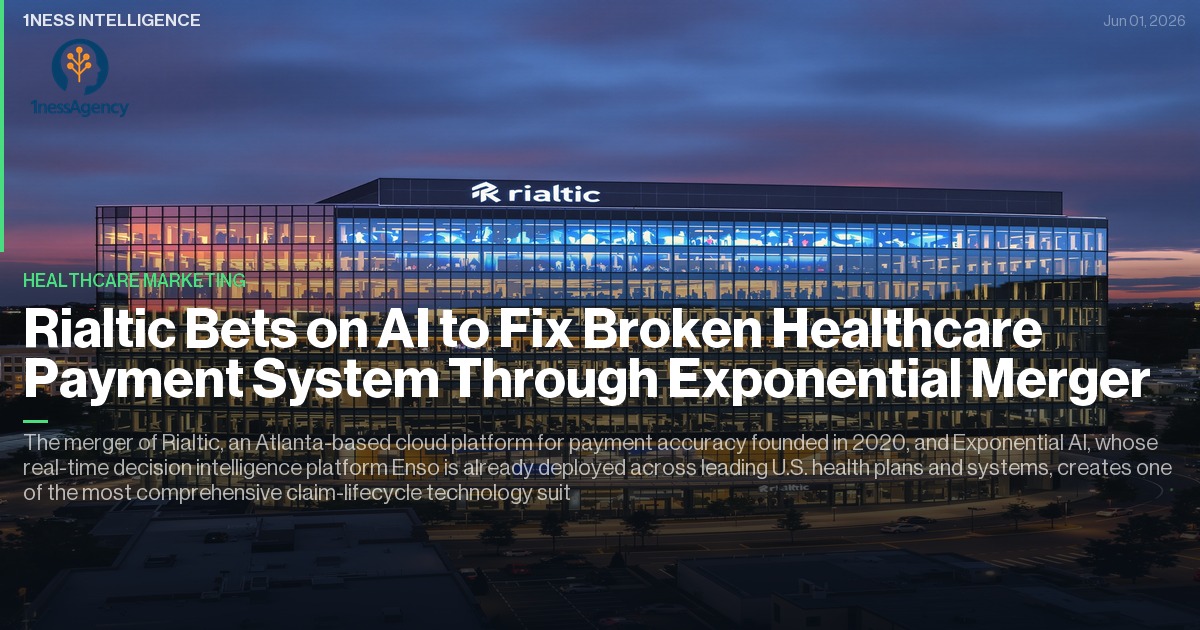
- Rialtic and Exponential AI announced a merger on June 1, 2026, combining Rialtic's cloud payment accuracy platform with Exponential AI's real-time decision intelligence platform Enso.
- The combined entity will integrate prepay editing, real-time prior authorization decisions, pend resolution, clinical quality workflows, and audit functions into a single platform, consolidating multiple vendor relationships.
- Rialtic was founded in 2020 as an Atlanta-based cloud platform, while Exponential AI's Enso is already deployed across leading U.S. health plans and systems.
The merger of Rialtic, an Atlanta-based cloud platform for payment accuracy founded in 2020, and Exponential AI, whose real-time decision intelligence platform Enso is already deployed across leading U.S. health plans and systems, creates one of the most comprehensive claim-lifecycle technology suites available to payers and providers today . The combined entity will cover prepay editing, real-time prior authorization decisions, pend resolution, clinical quality workflows, and audit functions,collapsing what were previously multiple vendor relationships into a single integrated platform. Paul Roma assumes the CEO role upon close; Doug Williams, the former Rialtic CEO, moves to Executive Chairman.
"While Rialtic provides the rules-based precision to prevent improper spend, Exponential's AI technology allows our customers to go live quickly with specific workflows, significantly accelerating their time-to-value," said Doug Williams, Executive Chairman at Rialtic .
For healthcare marketers, the strategic message embedded in this merger is the one that matters most: the buyer in healthcare technology,whether a payer CMO, a health system CFO, or a revenue cycle director,is no longer tolerating fragmented vendor stacks. Affordability pressure on American families and employers, cited explicitly by Rialtic and Exponential AI as the market condition driving this merger, is now the organizing principle of procurement conversations. Any vendor, agency, or health system that cannot speak directly to cost reduction and operational efficiency in its go-to-market messaging is speaking the wrong language.
The Consolidation Signal: What This Merger Tells Payer and Provider Marketers
The Rialtic-Exponential AI deal is not an isolated event. It reflects a structural shift in how healthcare technology buyers evaluate vendors in 2026: total platform value over point solutions, speed-to-implementation over feature lists, and demonstrable ROI over theoretical capability.
The combined platform's stated design priorities,"faster to implement, ROI-positive, and easy to blend into existing workflows", are not product specs. They are the verbatim objections that payer and provider procurement teams raise when rejecting AI vendors. The companies built their merger rationale around removing those objections before a sales conversation starts.
For marketing leaders at health systems and payer organizations evaluating technology partners, this consolidation means the vendor landscape for claims intelligence will shrink. Fewer, larger platforms with end-to-end coverage will replace the ecosystem of niche point solutions that characterized the prior decade. Procurement cycles will shorten because vendor evaluation now involves fewer parties. Marketing teams that have built content and demand-generation strategies around category-specific messaging,"our prior auth tool," "our prepay editing solution",will need to reframe around integrated outcomes.
Agentic AI Is Now a Procurement Criterion, Not a Differentiator
The specific technology architecture at the center of this merger is agentic AI,systems that embed decision agents directly into live workflows to resolve exceptions and guide human review in real time, as Paul Roma described . Exponential AI's Enso platform is built on reusable, prebuilt Decision Agents that integrate into legacy systems without full replacement.
This matters for healthcare marketers because "agentic AI" is crossing from vendor differentiator into buyer requirement. Health plans and providers evaluating revenue cycle technology in 2026 are asking whether AI systems can act autonomously within defined parameters,not just surface recommendations for a human to execute. The distinction has direct financial implications: agentic systems reduce the labor required to resolve claims exceptions, which directly lowers administrative cost per claim.
Marketing teams at competing vendors, health IT companies, or consulting firms that have not yet updated their messaging frameworks to address agentic AI capability are already behind the procurement conversation. The Rialtic-Exponential AI merger locks in a positioning claim,comprehensive agentic claims intelligence from prepay through audit,that competitors will need explicit counter-positioning to challenge.
The Affordability Narrative Is the Marketing Brief
Both Williams and Roma framed the merger's purpose in terms of making healthcare affordable for American families and employers . This is a deliberate positioning choice, not corporate boilerplate. In a year when employer healthcare costs and patient cost-sharing continue to define the political and economic environment, vendors that connect their technology to the affordability outcome,not just the operational efficiency outcome,gain access to a different and more senior buying conversation.
Health system and payer marketing leaders should read this framing as a template. The affordability narrative connects payment accuracy technology to board-level priorities. It moves the vendor conversation from IT procurement to strategic partnership. Vendors and health systems alike that can quantify their contribution to cost reduction,in dollars per member, per claim, or per episode,own the highest-value positioning in the current market.
Actionable Takeaways for Healthcare Marketing Leaders
- Audit your messaging for procurement-readiness. If your AI or technology solution's marketing content cannot answer "how fast can we go live?" and "what is the ROI timeline?", revise it before your next sales cycle. The Rialtic-Exponential AI merger was built around eliminating those objections.
- Replace category messaging with outcome messaging. Buyers in 2026 are not searching for "prepay editing" or "prior auth tools." They are searching for solutions that reduce improper spend and administrative cost. Reframe content around those financial outcomes.
- Build an affordability narrative. Quantify your solution's contribution to cost reduction in terms that resonate with CFOs and benefits directors, not only revenue cycle managers. Connect operational metrics to patient and employer affordability.
- Track consolidation in your vendor ecosystem. This merger signals category compression. Update your competitive landscape analysis and adjust positioning before a competitor's expanded platform makes your point-solution messaging look narrow.
- Create content for the agentic AI conversation. Buyers are asking about agentic capabilities now. Produce educational content,white papers, webinars, case studies,that defines the term on your terms before your competitors define it first.
Compliance Callout
AI systems embedded in claims adjudication, prior authorization, and clinical quality workflows operate at the intersection of HIPAA data privacy requirements and CMS coverage determination rules. Health plans deploying agentic AI in prior authorization workflows must ensure their systems comply with CMS interoperability and prior authorization final rules that established electronic prior authorization timelines and transparency requirements. Any marketing of AI-driven prior auth or claims solutions to payer clients should explicitly address compliance architecture,buyers will ask, and the answer must be concrete, not general.
The 1ness Take
The Rialtic-Exponential AI merger is a masterclass in merger positioning,and a direct instruction manual for healthcare marketers who want to win in an affordability-first buying environment.
Here is what most healthcare technology marketers get wrong: they lead with capability and follow with outcomes. The Rialtic-Exponential AI announcement inverts that sequence. The first thing both CEOs say is what the market needs,affordability, speed, workflow integration,and only then do they explain how their technology delivers it. That structure is not accidental. It reflects a sophisticated understanding that in 2026, the buyer's first question is not "what does your platform do?" but "what problem does it solve for my members, my employers, and my board?"
Our recommendation: restructure every piece of demand-generation content for AI and technology solutions around the buyer's problem statement, not your product architecture. Lead with the cost of inaction,improper claims spend, administrative drag, implementation timelines that delay ROI,and position your solution as the removal of that cost. The vendors who will win the next procurement cycle are the ones whose marketing mirrors the affordability language their buyers are already using in the boardroom.
This merger also signals that the window for point-solution positioning is closing. Healthcare marketing leaders who serve technology vendors should begin scenario-planning now for how their clients' messaging holds up in a market where integrated platforms own the "comprehensive" claim. Niche solutions survive by going deeper on a specific outcome, not broader on feature count.
The Takeaway
1. Rewrite your AI solution's positioning around the affordability and speed-to-value criteria that the Rialtic-Exponential AI merger identified as the defining buyer requirements of 2026. If your messaging doesn't answer those questions in the first two sentences, it won't survive a procurement review.
2. Develop a competitive response to platform consolidation. Identify where your solution fits in an increasingly integrated claim-lifecycle stack and build marketing content that articulates that fit,or that makes the case for why a best-in-class point solution outperforms an integrated platform for your specific use case.
3. Invest in agentic AI education content now. Buyers are learning what agentic AI means from vendors. The organization that publishes the clearest, most credible explanation of how agentic decision intelligence improves claims accuracy and reduces administrative cost will own the category narrative heading into 2027 procurement cycles.
References
- "Rialtic and Exponential AI Announce Strategic Merger to Transform Healthcare Payment Accuracy and Decision Intelligence." Healthcare IT Today, June 1, 2026 healthcareittoday.com
- Exponential AI. "Enso Platform Overview." Exponential AI corporate website, 2026 exponential.ai
- CMS. "Interoperability and Prior Authorization Final Rule (CMS-0057-F)." Centers for Medicare & Medicaid Services cms.gov