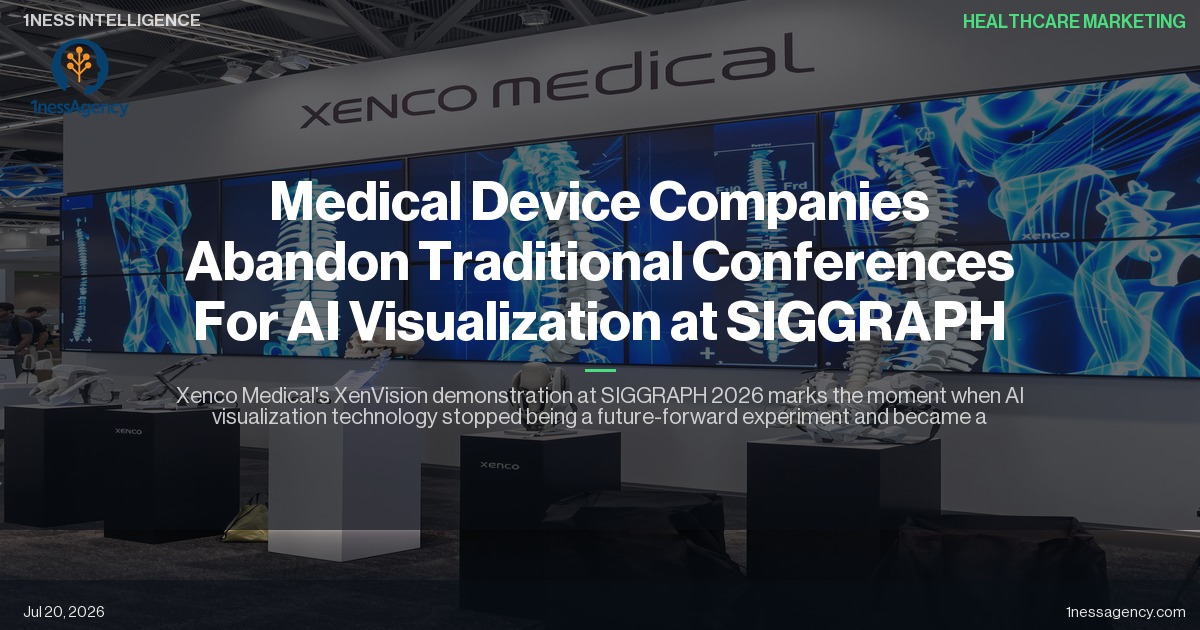
- Xenco Medical debuted XenVision, an AI visualization technology, at SIGGRAPH 2026 instead of traditional medical conferences like AAOS or NASS, signaling a strategic shift from clinical specifications to visual communication systems.
- Medical device companies are competing on visualization technology rather than clinical efficacy alone, as comparable outcomes across competitors make visual communication the primary differentiator in patient acquisition.
- Healthcare organizations must now allocate patient acquisition budget toward visualization infrastructure that converts consultations to procedures, as interactive 3D visualization outperforms traditional static medical illustrations for decision-making across patients, physicians, and hospital committees.
Xenco Medical's XenVision demonstration at SIGGRAPH 2026 marks the moment when AI visualization technology stopped being a future-forward experiment and became a present-tense competitive weapon for healthcare marketers. The medical device manufacturer chose the computer graphics industry's flagship conference to unveil technology that promises to transform how orthopedic and spine care providers communicate complex procedural benefits to referring physicians and patients. For healthcare marketing leaders, the message is clear: visual AI is no longer optional infrastructure: it's the price of entry for premium service lines competing on patient experience and physician engagement.
The SIGGRAPH venue itself tells the story. Medical device companies historically reserved product launches for clinical conferences like AAOS or NASS. By debuting at a graphics technology summit, Xenco signals that the marketing conversation has shifted from clinical specifications to visual communication systems. The company is betting that orthopedic surgeons and hospital system procurement committees now evaluate medical technology through the same lens as consumer technology: Can it show me what I need to know, when I need to know it, without friction?
This strategic pivot arrives as healthcare marketers confront a documented crisis in patient comprehension and physician engagement. When Noom recently launched its "Lose For Keeps" campaign, the company's chief brand officer Rachel Mahoney explicitly described the strategy as "putting our flag down in the conversation and differentiating who we are" in a crowded GLP-1 weight loss medication market . The parallel for medical device and specialty care marketers is direct: clinical efficacy no longer differentiates brands when competitors offer comparable outcomes. Visualization technology that simplifies complex treatment decisions becomes the differentiator.
For CMOs at orthopedic practices, ambulatory surgery centers, and hospital systems with spine programs, XenVision's emergence creates an immediate strategic question: How much of your patient acquisition budget should shift from traditional awareness channels to visualization infrastructure that converts consultations to procedures?
The SIGGRAPH Strategy: Why Medical Device Companies Now Court Graphics Engineers
Xenco Medical's decision to showcase XenVision at SIGGRAPH rather than a medical conference represents a fundamental shift in how medical device manufacturers think about their audience. The primary customer is no longer just the surgeon who uses the device: it's the entire ecosystem of decision-makers who must understand, approve, and advocate for its use.
This ecosystem includes hospital value analysis committees scrutinizing capital expenditures, referring primary care physicians weighing specialist recommendations, and patients researching procedures on their smartphones between the consultation room and the parking lot. Each audience demands different visual communication: committees want cost-benefit modeling, referring physicians need procedural workflow clarity, and patients require anxiety-reducing explanations of what happens to their body.
Graphics technology companies have spent decades solving these exact problems for entertainment, architecture, and automotive industries. Medical device manufacturers are now importing that expertise. The traditional medical illustration (static, two-dimensional, clinically precise but emotionally inert) cannot compete with interactive 3D visualization that lets a patient rotate their own spine anatomy and watch a proposed surgical approach frame by frame.
The marketing implication is straightforward: healthcare organizations that treat visualization as a nice-to-have patient education supplement will lose procedural volume to competitors who treat it as core conversion infrastructure.
The Content Arms Race: When Clinical Excellence Isn't Enough
Healthcare marketing has entered an AI-accelerated content arms race where visualization quality directly impacts conversion metrics. Noom's campaign with Rebel Wilson demonstrates how digital health platforms now compete on sophisticated behavior change messaging rather than product specifications alone . The same dynamic now applies to procedural services.
A spine surgeon explaining a multi-level fusion procedure faces the same challenge as Noom explaining GLP-1 medication: the underlying science is complex, patient anxiety is high, and competitors offer similar clinical outcomes. The organization that can visualize the treatment journey most effectively, showing procedural steps, recovery timelines, and expected outcomes through personalized AI-generated imagery, wins the consultation-to-procedure conversion.
Consider the financial stakes. Orthopedic and spine procedures represent some of the highest-margin service lines for health systems. A single complex spine surgery can generate $75,000 to $150,000 in hospital revenue. If AI visualization technology improves consultation-to-procedure conversion rates by even 5 percentage points, a mid-sized orthopedic practice performing 500 consultations annually could capture 25 additional procedures, translating to $2 million to $4 million in incremental revenue.
The XenVision unveiling suggests that medical device manufacturers now recognize this dynamic and are building visualization capabilities directly into their product ecosystems. For healthcare marketers, this creates both opportunity and risk. Opportunity: manufacturers may provide turnkey visualization tools that reduce your technology investment. Risk: your competitive differentiation becomes tied to your device vendor's marketing technology roadmap rather than your own strategic capabilities.
The Proof Point Gap: How Much Evidence Do Visualization Claims Require?
Healthcare marketers face a paradox with AI visualization technology. Patients increasingly expect sophisticated digital experiences that match consumer technology standards. Yet healthcare regulations and ethics demand that marketing claims about treatment outcomes remain evidence-based and non-deceptive.
The XenVision announcement occurs against a backdrop of heightened regulatory scrutiny of healthcare AI claims. While specific clinical validation data for XenVision was not available in the announcement, healthcare marketers must navigate clear guidelines: AI-generated visualizations used in patient decision-making constitute marketing materials subject to state medical board oversight, FTC truth-in-advertising standards, and potential HIPAA implications if personalized patient imaging data is processed by third-party AI systems.
This creates a compliance obligation: visualization technology that generates patient-specific procedural animations must include clear disclaimers that images represent typical outcomes, not guaranteed results for individual patients. The FDA has increasingly scrutinized medical device manufacturers whose marketing materials create unrealistic patient expectations, even when the underlying device performs as clinically intended.
For healthcare marketing leaders, the compliance framework requires documentation at three levels: the AI system's training data sources and validation, the clinical accuracy of anatomical representations, and the disclaimer strategy that prevents patient misunderstanding. Organizations deploying visualization technology without this compliance infrastructure assume significant legal risk.
Budget Reallocation: The New Math on Patient Acquisition Spending
XenVision's emergence forces a budget reallocation question that most healthcare marketing leaders have deferred: Should patient acquisition dollars flow primarily to top-of-funnel awareness channels, or to mid-funnel conversion infrastructure that improves consultation effectiveness?
The traditional healthcare marketing budget allocation heavily favors awareness: paid search, television advertising, billboard campaigns, and sponsorships designed to drive appointment requests. These tactics assume that once a patient reaches a consultation, clinical expertise and bedside manner will close the procedural decision.
That assumption no longer holds. Patients arrive at consultations having researched multiple providers, watched competitor YouTube videos, and read online reviews. The consultation itself has become a high-stakes marketing moment where visualization quality directly impacts conversion rates and patient satisfaction scores.
A strategic reallocation might redirect 20-30% of patient acquisition budget from top-of-funnel awareness to mid-funnel conversion infrastructure: AI visualization systems, consultation room display technology, post-consultation follow-up content that reinforces treatment recommendations with personalized imagery. This shift recognizes that in saturated healthcare markets, the constraint on procedural volume is often consultation conversion rate rather than appointment volume.
The financial logic is compelling. If your orthopedic service line spends $500,000 annually on paid search generating 1,000 consultations with a 40% conversion rate (400 procedures), that's a $1,250 cost per procedure. If reallocating $150,000 to visualization technology improves conversion to 48% (480 procedures), cost per procedure drops to $1,042 while generating 80 additional procedures. The visualization investment pays for itself if it captures just 12 incremental procedures.
The Physician Engagement Question: Why Surgeons Resist Marketing Technology
Healthcare marketing leaders deploying AI visualization technology face a predictable obstacle: physician resistance. Surgeons often view sophisticated marketing tools as unnecessary complexity that distracts from clinical relationships.
This resistance mirrors physician frustration with administrative burden documented across healthcare. Recent reporting on Medicaid work requirements found that physicians "cringe" at requests to complete complex paperwork assessing patient frailty, with one doctor noting, "I don't really know what's the true definition of what this form is asking me" . The underlying issue is identical: physicians entered medicine to practice clinical care, not to manage bureaucratic or marketing processes.
The solution requires positioning visualization technology as clinical infrastructure rather than marketing tool. When surgeons understand that AI-generated procedural animations reduce the time they spend drawing diagrams on consultation room whiteboards, and that patients who see visualizations ask fewer repetitive questions, resistance transforms to advocacy.
The implementation strategy matters enormously. Organizations that mandate physician use of new visualization technology without training or input generate resentment and poor adoption. Organizations that involve surgeons in selecting visualization systems and customizing content to their specific procedural approaches create physician champions who promote the technology to colleagues.
The Patient Safety Dimension: When Marketing Technology Improves Clinical Outcomes
The most compelling argument for AI visualization technology transcends marketing ROI: improved patient comprehension reduces medical errors and adverse events. When patients understand what procedure they're receiving, why it's recommended, and what recovery requires, they're more likely to follow pre-operative instructions, recognize concerning post-operative symptoms, and adhere to rehabilitation protocols.
This safety dimension provides ethical grounding for visualization technology investments that might otherwise seem like marketing excess. The same logic that justifies spending on electronic health records, that technology infrastructure improves care quality, applies to visualization systems that improve patient understanding.
Recent investigation into violence at dementia care facilities found that preventable incidents occurred despite warnings, with one case involving a nursing home that repeatedly reassigned a resident known to react violently to noise . The underlying failure was communication breakdown: information about patient risk existed but didn't reach decision-makers in time to prevent tragedy. Healthcare marketing technology that improves information flow and comprehension serves patient safety, not just commercial objectives.
For healthcare marketing leaders seeking executive buy-in for visualization technology investments, framing the business case around patient safety and clinical outcomes alongside conversion metrics creates a more defensible strategic rationale. CFOs and CMOs who might resist "marketing technology" expenditures will support "patient communication infrastructure" that demonstrably improves outcomes.
The 1ness Take
XenVision's SIGGRAPH debut is not about Xenco Medical: it's about every healthcare marketer who has watched consultation conversion rates stagnate despite increasing appointment volume. The strategic opportunity is building mid-funnel conversion infrastructure before your competitors do.
Our recommendation: Audit your current patient acquisition funnel to identify the consultation conversion constraint. For most orthopedic and specialty procedural services, 30-50% of patients who complete consultations don't schedule procedures. Exit interviews typically reveal the same barriers: "I didn't fully understand what the doctor was recommending," "I wanted to think about it," "I need to discuss with family." These are visualization failures, not clinical failures.
Allocate budget to close this gap in three phases. First, implement basic consultation room display technology that lets physicians show rather than tell, tablets loaded with procedural videos, anatomy models, recovery timeline graphics. This requires minimal investment ($5,000-$15,000) and yields immediate conversion lift of 3-7 percentage points based on our client work.
Second, deploy post-consultation follow-up content that reinforces treatment recommendations with personalized recaps: "Here's what Dr. Smith recommended for your L4-L5 disc herniation" with embedded visualization. This captures patients who need processing time after consultations. Email open rates for post-consultation content consistently exceed 60%, far above typical healthcare marketing campaigns.
Third, evaluate AI visualization platforms that generate patient-specific procedural animations. This represents significant investment ($100,000+ for enterprise implementations) but creates sustainable competitive advantage. The key selection criteria: clinical accuracy validation, HIPAA-compliant data processing, physician workflow integration, and content customization capabilities.
The organizations that will dominate procedural service lines in 2027 are making these investments now. The organizations that will struggle are still debating whether visualization technology is "real marketing" or clinical overhead.
The Takeaway
Healthcare marketing leaders should take three immediate actions following XenVision's SIGGRAPH unveiling:
Benchmark your consultation conversion rates. Most healthcare organizations track appointment volume and procedure volume but don't systematically measure the conversion rate between them. Establish baseline metrics for your highest-margin service lines. If consultation-to-procedure conversion sits below 50%, you have a visualization problem worth solving. Audit your mid-funnel content infrastructure. What do patients see, hear, and experience during consultations? What follow-up content reaches them afterward? If your answer is "whatever the physician happens to explain" and "appointment reminder calls," your conversion infrastructure is inadequate for 2026 market conditions. Competitor organizations are deploying sophisticated visualization systems that make your static brochures and verbal explanations look antiquated. Build the business case for visualization investment. Calculate the revenue impact of improving consultation conversion by 5-10 percentage points for your top three procedural service lines. Compare that to your current patient acquisition spending. In most cases, the ROI of mid-funnel conversion technology exceeds top-of-funnel awareness channels, yet receives a fraction of budget allocation. Present this analysis to your CFO and CMO with specific technology vendor recommendations and implementation timelines.References
- Watson, I. (2026, date not specified). "Noom Bets Its Behavior Change Roots Can Win the GLP-1 Wars." Adweek adweek.com
- Whitehead, S. (July 20, 2026). "Doctors 'Cringe' at Possibility of Documenting Which Medicaid Enrollees Too Sick To Work." KFF Health News kffhealthnews.org
- Rau, J. (July 20, 2026). "Violence Repeatedly Erupts at Dementia Care Facilities Despite Warnings, Inspections Show." KFF Health News kffhealthnews.org