- The FDA blocked approval of melanoma drug RP1 in May 2026 despite data showing tumors shrank or disappeared in a third of 140 trial participants, citing absence of a control arm.
- FDA Commissioner Marty Makary resigned after 13 months in May 2026 following a tenure marked by senior officials suppressing or accelerating drug approvals at the behest of President Trump or HHS Secretary Robert F. Kennedy Jr.
- Replimune announced plans to cut more than half its staff and close operations following the RP1 denial, leaving patients enrolled in trials facing treatment discontinuation.
- Merck's Keytruda gained FDA melanoma approval 12 years prior based on a single-arm trial, establishing precedent that made RP1's rejection appear inconsistent with prior regulatory standards.
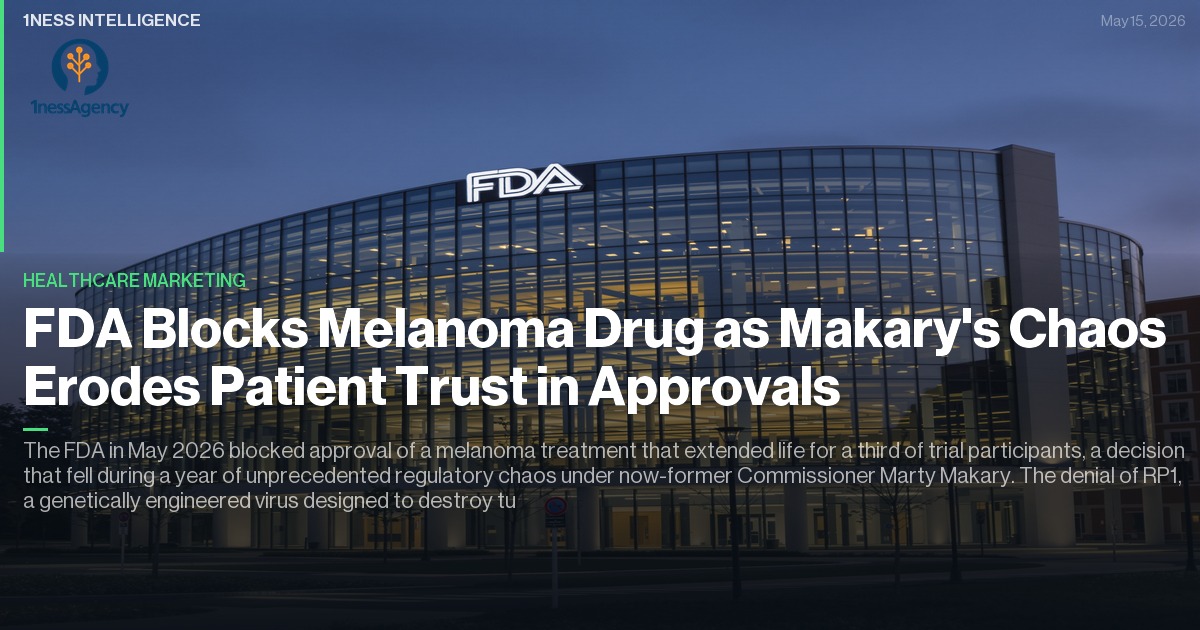
The FDA in May 2026 blocked approval of a melanoma treatment that extended life for a third of trial participants, a decision that fell during a year of unprecedented regulatory chaos under now-former Commissioner Marty Makary. The denial of RP1, a genetically engineered virus designed to destroy tumor cells, angered oncologists who had patients responding to the drug and pharmaceutical analysts who saw the rejection as emblematic of a larger trust crisis at an agency regulating 20% of U.S. consumer spending . For healthcare marketers, the immediate challenge is not the science—it's managing patient confusion when regulatory standards become unpredictable and the FDA commissioner accuses drug manufacturers of "corruption" on CNBC .
The FDA rejected Replimune's application despite data showing tumors shrank or disappeared in a third of 140 trial participants. The agency cited the absence of a control arm comparing RP1 to approved treatments, though the company argued such a design would be unethical since all enrolled patients had already failed on standard immunotherapy . Melanoma kills approximately 8,500 Americans annually, and if RP1 matched trial performance, as many as 2,500 patients could benefit, according to Eric Whitman, medical director of Atlantic Health System's oncology service . Replimune responded to the denial by announcing plans to cut more than half its staff and close operations .
Steven Grossman, a regulatory consultant and former Health and Human Services official, captured the marketing crisis: "People have to speculate about the standards and processes by which the agency makes decisions. And that uncertainty is bad for everybody—patients and sponsors and investors" . When patients cannot trust that FDA approvals follow consistent scientific standards, healthcare organizations face a credibility vacuum. Marketing messages about FDA-approved treatments carry less weight. Patient education campaigns require additional layers of explanation. And referring physicians demand more evidence before changing prescribing patterns.
The Regulatory Whipsaw: When FDA Messaging Contradicts Clinical Evidence
Makary resigned in May 2026 after 13 months leading the FDA, a tenure marked by senior officials suppressing or accelerating drug approvals "at the behest of President Donald Trump or HHS Secretary Robert F. Kennedy Jr., ignoring the advice of agency professionals" . Kennedy defended Makary's RP1 decision during a congressional budget hearing, though he mistakenly claimed trial patients had also received chemotherapy—an error that underscores how political intervention distorts technical review .
The RP1 rejection represents a "recalibration of how confident sponsors can be with similar studies," according to Paul Kim, a former FDA staffer now working as a pharmaceutical industry consultant . This matters for healthcare marketers because uncertainty in approval pathways translates directly into patient anxiety. When the FDA warned Replimune in July 2025 that it risked denial without design changes, the company proceeded anyway, believing its single-arm trial matched precedent . Keytruda, Merck's best-selling cancer drug, gained melanoma approval 12 years earlier based on a single-arm trial .
The dollar impact is immediate. Replimune needed FDA accelerated approval to secure investor funding for a larger confirmatory trial . Without that approval, the company collapses, and patients enrolled in trials face treatment discontinuation. For health systems marketing oncology services, this creates a nightmare scenario: explaining to patients why a treatment their physician believed in is no longer available, not because it failed scientifically but because regulatory processes shifted mid-stream.
The Patient Trust Tax: Marketing in an Era of Regulatory Volatility
Healthcare marketers now operate in an environment where regulatory decisions carry political overtones that patients read about in mainstream media. A Wall Street Journal editorial warned that the RP1 rejection "will have a chilling effect on drug development" . Trisha Wise-Draper, a University of Cincinnati dermatologist with patients in the RP1 trial, called the denial "devastating news" and noted some of her patients no longer have evidence of melanoma after treatment .
This creates three immediate marketing challenges. First, explaining clinical trial participation becomes harder when patients fear the FDA will reject promising treatments for reasons unrelated to efficacy. Second, managing expectations for patients already enrolled in trials requires more sophisticated communications that acknowledge regulatory uncertainty without undermining hope. Third, differentiating your organization's treatment approach requires evidence that transcends FDA approval status—real-world outcomes data, quality metrics, and patient testimonials become more valuable than regulatory checkmarks.
The financial stakes are clear. Melanoma represents 112,000 new U.S. cases annually . An organization marketing melanoma services must now educate patients on treatment options while navigating questions about why certain therapies are unavailable. This requires content marketing that explains trial designs, regulatory pathways, and the difference between accelerated and standard approval—concepts that were previously relegated to informed consent documents.
The trust erosion extends beyond oncology. When regulatory standards become unpredictable, patients question all FDA oversight. This places additional burden on healthcare marketers to validate safety and efficacy claims through independent sources: peer-reviewed publications, professional society guidelines, and institutional review board approvals.
Follow the Money: When Reimbursement Meets Regulatory Chaos
RP1 was not the only medication caught in Makary's tenure. The article references Vinay Prasad, an oncologist who "was fired then rehired last summer and held various leadership roles at the agency" and "repeatedly intervened in approval processes" . This leadership instability creates downstream effects for payer coverage policies. Insurance companies make coverage decisions based on FDA approval status, and when that status depends on shifting political winds rather than consistent scientific standards, medical necessity determinations become harder to predict.
For healthcare marketers, this means patient acquisition campaigns must now factor in coverage uncertainty. Advertising an innovative melanoma program carries less value if patients discover their insurance will not cover the featured treatment. The solution requires closer coordination between marketing, revenue cycle, and clinical teams to ensure promoted services align with current coverage policies—and building contingency messaging when coverage changes unexpectedly.
The financial distress is not limited to pharmaceutical companies. Recent data shows 31 Minnesota hospitals meet the state's definition of financial distress, having lost money on operations in four of the last eight years . Hennepin County Medical Center faces a $205 million state bailout to prevent closure while simultaneously providing $88 million in charity care, consuming more than 3% of its operating budget . When hospitals struggle financially, they reduce service lines and limit charity care—creating a vicious cycle where patients face higher out-of-pocket costs and delayed treatment for conditions like melanoma.
What Healthcare Marketers Must Do Differently
Build regulatory resilience into service line marketing. When promoting oncology services, clinical trials, or innovative treatments, create messaging frameworks that acknowledge regulatory uncertainty without undermining clinical confidence. Develop patient education content explaining FDA approval pathways, trial design considerations, and how your organization selects treatments based on evidence beyond regulatory status. Invest in outcomes transparency. As FDA approval status becomes a less reliable quality signal, real-world outcomes data becomes more valuable. Build marketing campaigns around institutional quality metrics, patient-reported outcomes, and comparative effectiveness data. Make this data accessible through digital channels—website dashboards, patient portals, and social media—so patients can evaluate treatment options based on your organization's actual results rather than regulatory approvals that may shift unpredictably. Prepare physicians for patient skepticism. Arm referring physicians and employed clinicians with talking points addressing regulatory uncertainty. When patients ask why a treatment they read about online is unavailable, physicians need clear, concise explanations that preserve trust without undermining the FDA entirely. Marketing should partner with medical affairs to develop these materials. Segment messaging by health literacy level. Regulatory complexity requires different messaging approaches for different audiences. High-literacy patients may appreciate detailed explanations of trial design and FDA review processes. Lower-literacy patients need simplified messaging focused on what treatments are available, why they work, and how to access them. Patient confusion increases when marketing content assumes universal understanding of clinical trial methodology.Compliance Callout
Marketing communications referencing FDA approval status must be updated immediately when regulatory decisions change. Promotional materials claiming "FDA-approved" status for treatments become misleading if approvals are withdrawn or modified. Legal and compliance teams should review all oncology service line marketing monthly during periods of regulatory volatility. Under FTC guidelines, healthcare marketers must substantiate all efficacy claims and cannot rely solely on pending FDA applications as proof of treatment value.
The 1ness Take
The Makary era exposed a fragility in healthcare marketing's dependence on regulatory stability as a trust signal. For decades, marketers could shorthand clinical legitimacy with "FDA-approved," confident that patients understood this stamp meant safety and efficacy had been rigorously vetted. That shorthand no longer works when commissioners accuse manufacturers of corruption on cable news and political appointees override career scientists.
Our recommendation: Shift from approval-dependent messaging to evidence-dependent messaging. This requires heavier investment in outcomes measurement, data transparency, and patient education—but it builds a more durable competitive advantage. When your melanoma program can demonstrate five-year survival rates, patient-reported quality of life scores, and time-to-treatment metrics that exceed regional benchmarks, you have created differentiation that persists regardless of who leads the FDA.
Build content libraries explaining how your organization evaluates new treatments before they gain FDA approval. Explain your institutional review board process, your pharmacy and therapeutics committee standards, and your clinical effectiveness protocols. When patients understand your organization applies rigorous evidence standards independent of regulatory status, they trust you more—not less—when regulatory decisions seem arbitrary.
Tactically, this means redirecting marketing budget from awareness campaigns centered on "latest treatments" toward thought leadership demonstrating clinical judgment. Replace "now offering FDA-approved X" messaging with "how we select the right melanoma treatment for you" content that walks patients through decision-making frameworks. Partner with medical staff to create video content showing tumor boards in action, explaining how multidisciplinary teams evaluate treatment options using evidence hierarchies that include but do not solely depend on FDA status.
The organizations that thrive in this environment will be those that build trust through transparency rather than regulatory credential-dropping. That trust, once earned, proves more resilient to external shocks than any agency approval.
The Takeaway
Audit all service line marketing materials for regulatory dependency. Identify every instance where messaging relies on FDA approval status as the primary value proposition. Develop alternative messaging frameworks based on clinical outcomes, professional society guidelines, and institutional quality metrics. Create a rapid-response protocol for regulatory changes. When FDA decisions shift unexpectedly, you need a same-day process for updating digital content, pausing campaigns referencing affected treatments, and briefing patient-facing staff on how to address questions. This requires pre-established workflows connecting medical affairs, legal, compliance, and marketing. Invest in patient education content that builds health literacy. Develop resources explaining clinical trial phases, study design considerations, regulatory pathways, and how to evaluate treatment evidence. Position your organization as a trusted guide helping patients navigate an increasingly complex healthcare landscape. In an era of regulatory uncertainty, the organizations that help patients understand the evidence win the patient's trust—and their loyalty.References
- Allen, A. (May 15, 2026). "FDA Blocked Melanoma Drug as Confusion Reigned Under Makary." KFF Health News kffhealthnews.org
- Olson, J. (May 15, 2026). "Minnesota Lawmaker Proposes Using Hospital Tax To Fill Charity Care Gap." KFF Health News and The Minnesota Star Tribune kffhealthnews.org
This report is for informational purposes only and does not constitute investment advice or an offer to buy or sell any security. Content is based on publicly available sources believed reliable but not guaranteed. Opinions and forward-looking statements are subject to change; past performance is not indicative of future results. 1ness Strategies and its affiliates may hold positions in securities discussed herein. Readers should conduct independent due diligence and consult qualified advisors before making investment decisions.
© 2026 1ness Strategies. All rights reserved.