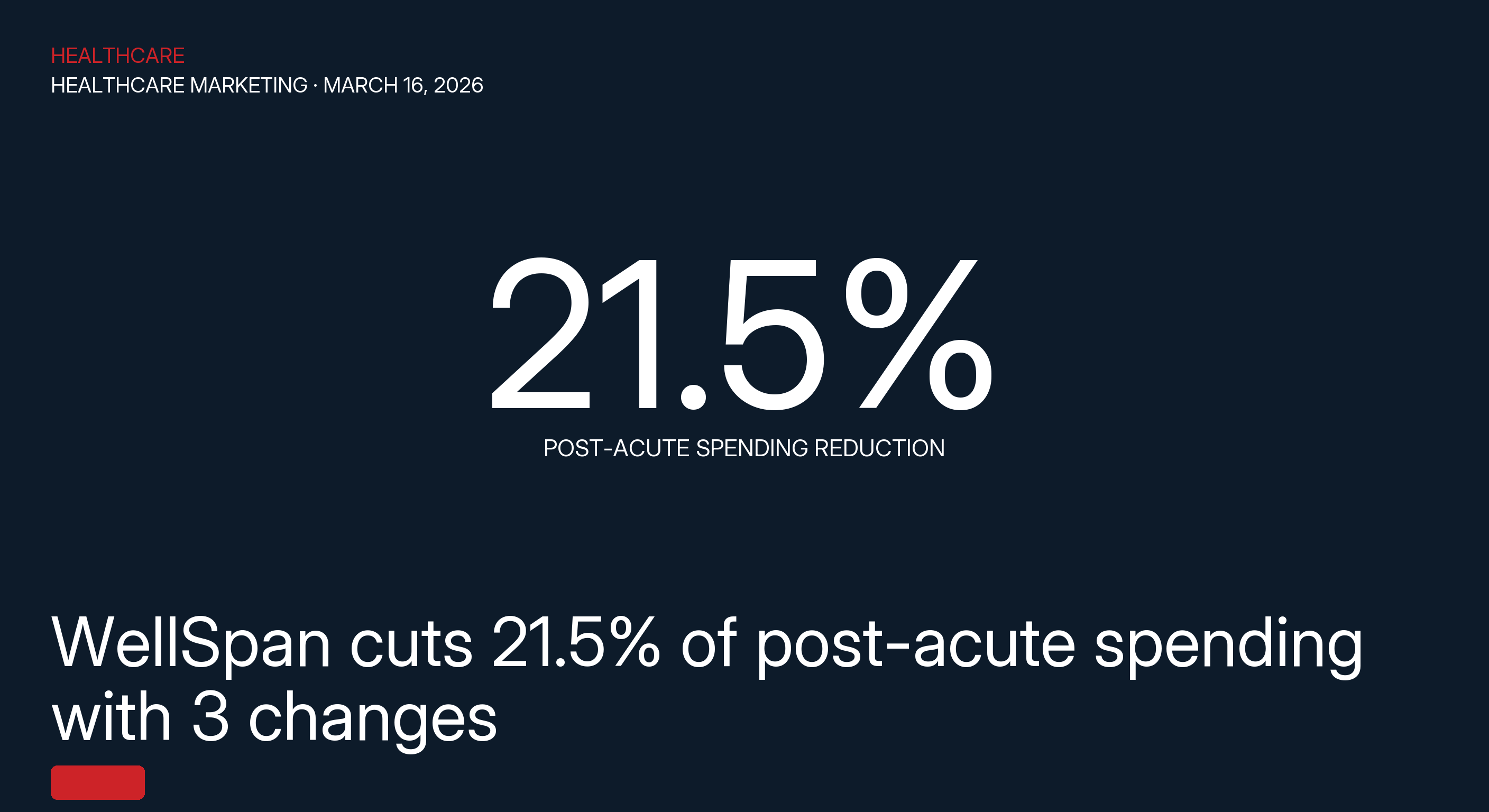
WellSpan's reported 21.5% reduction in post-acute spending signals more than operational efficiency: it exposes a fundamental vulnerability in most healthcare marketing strategies. While health systems obsess over patient acquisition at the front door, they're hemorrhaging revenue and continuity through poorly marketed post-acute transitions. For healthcare marketers, this isn't just a finance story. It's a patient retention crisis disguised as a cost problem, and it's costing your organization millions in lifetime value while degrading patient outcomes.
The Post-Acute Blind Spot in Healthcare Marketing Budgets
Most healthcare marketing leaders allocate 80-90% of their budget toward new patient acquisition, primary care campaigns, service line advertising, physician recruitment promotion. Post-acute care marketing, if it exists at all, gets relegated to a PDF discharge packet and a forgotten page on the website buried three clicks deep.
This misallocation has measurable consequences. Industry data consistently shows that 30-40% of Medicare patients discharged to skilled nursing facilities are readmitted within 90 days. Each readmission represents not just a CMS penalty, but a patient experience failure that erodes trust and increases the likelihood of network leakage when that patient needs care again.
WellSpan's achievement, slashing post-acute spending by more than a fifth, almost certainly involved directing patients to preferred post-acute partners through better care coordination. From a marketing perspective, this represents a massive opportunity: health systems that control the post-acute narrative control the entire patient journey, reduce leakage to competitors, and create annuity revenue streams that extend far beyond the acute episode.
The strategic question: Are you marketing your post-acute network as aggressively as you market your emergency department or orthopedic service line?
Three Strategic Changes Healthcare Marketers Should Implement Now
While the specific tactics WellSpan employed aren't detailed in available reporting, cost reductions of this magnitude in post-acute care typically stem from three operational changes, each with direct marketing implications:
Network Optimization and Preferred Partner Marketing: Health systems that reduce post-acute costs invariably narrow their networks to high-performing partners. But narrowing without patient buy-in creates discharge delays and satisfaction issues. Marketers must build trust in preferred partners before the discharge conversation. This means co-branded campaigns with skilled nursing facilities, home health agencies, and rehab providers that position them as extensions of the health system brand, not afterthoughts. Create content that showcases outcomes data, patient testimonials, and facility tours for your post-acute partners with the same production value you'd use for a new surgical pavilion. Technology-Enabled Care Navigation as a Retention Tool: Significant post-acute cost reductions require care navigators who guide patients to appropriate, cost-effective post-acute settings. Most health systems treat this as purely operational. Smart marketers recognize care navigation is a premium service differentiator. Position your care transition program as concierge-level support, a competitive advantage worth marketing. Develop patient-facing campaigns that emphasize "We don't just treat you and send you home: we guide your complete recovery." This messaging appeals to both commercial patients seeking premium experiences and value-based contract lives where you carry financial risk. Data-Driven Patient Segmentation for Post-Acute Placement: Cutting post-acute costs by 21.5% requires sophisticated analytics to match patients with optimal post-acute settings, preventing both over-utilization (sending patients to SNFs who could manage with home health) and under-utilization (premature discharges leading to readmissions). Healthcare marketers should leverage this same predictive data for personalized pre-admission education. If your analytics suggest a joint replacement patient will need post-acute SNF care, begin marketing your preferred partners during pre-surgical education, not during the discharge chaos.The Patient Experience Imperative: Post-Acute as Brand Extension
Here's what most healthcare executives miss: patients don't distinguish between "acute" and "post-acute" care. A patient discharged from your hospital to a substandard skilled nursing facility views that SNF experience as your brand failure. Online reviews regularly blame hospitals for poor post-acute experiences they don't directly control.
Research from patient experience platforms shows that transitions of care generate disproportionate complaint volume relative to their brief duration. A patient may spend three days in your hospital and 14 days in post-acute care, but if the post-acute experience is poor, that colors perception of the entire episode.
Marketing implication: Your brand extends as far as your discharge transitions reach. This requires:
- Co-branded environmental design with post-acute partners that reinforces continuity
- Unified digital patient engagement across settings using your health system's patient portal and app
- Consistent communication cadence with the same tone and visual identity from pre-admission through post-acute recovery
- Success stories and testimonials that span the complete care journey, not just the acute episode
Compliance and Regulatory Considerations for Post-Acute Marketing
Healthcare marketers venturing into post-acute partnership promotion must navigate meaningful regulatory constraints. The Anti-Kickback Statute and Stark Law restrict how hospitals can incentivize referrals to post-acute providers. Any marketing arrangement with post-acute partners must be structured at fair market value and documented properly.
Key compliance guardrails:
- Patient choice must remain paramount: All marketing materials must reinforce the patient's right to choose any qualified provider, even while highlighting preferred partners
- No steering prohibited by payer contracts: Review managed care agreements for any restrictions on preferred network promotion
- Quality data must be substantiated: Any comparative quality claims about post-acute partners require valid data sources
- Avoid per-referral arrangements: Marketing co-op arrangements with post-acute providers should be fixed-fee, not volume-based
Consult healthcare counsel before launching co-branded campaigns with post-acute partners to ensure compliance with federal and state referral laws.
The Takeaway: Three Actions for This Quarter
WellSpan's results demonstrate that post-acute care represents one of healthcare's last major efficiency opportunities, and by extension, one of marketing's most overlooked channels. Health systems that market the complete care continuum, not just acute episodes, will differentiate on experience while capturing lifetime patient value.
Immediate action steps:1. Audit your current post-acute marketing investment: Calculate what percentage of your marketing budget addresses post-acute care transitions. If it's under 10%, you have a strategic gap that's likely contributing to network leakage and readmissions.
2. Identify your top 3-5 post-acute partners by volume and initiate co-marketing discussions. Propose joint patient education content, facility video tours, and outcomes transparency that builds patient confidence before discharge.
3. Integrate post-acute messaging into pre-admission marketing: For high-volume procedural service lines (orthopedics, cardiac, oncology), develop complete patient journey content that addresses post-acute recovery as proactively as you address the procedure itself.
The health systems that crack the post-acute marketing code won't just reduce costs: they'll own patient loyalty through the entire recovery journey, creating sustainable competitive advantage while competitors still obsess over first appointments.
References
- Becker's Hospital Review. "WellSpan cuts 21.5% of post-acute spending with 3 changes." Available at beckershospitalreview.com
This report is for informational purposes only and does not constitute investment advice or an offer to buy or sell any security. Content is based on publicly available sources believed reliable but not guaranteed. Opinions and forward-looking statements are subject to change; past performance is not indicative of future results. 1ness Strategies and its affiliates may hold positions in securities discussed herein. Readers should conduct independent due diligence and consult qualified advisors before making investment decisions.
© 2026 1ness Strategies. All rights reserved.