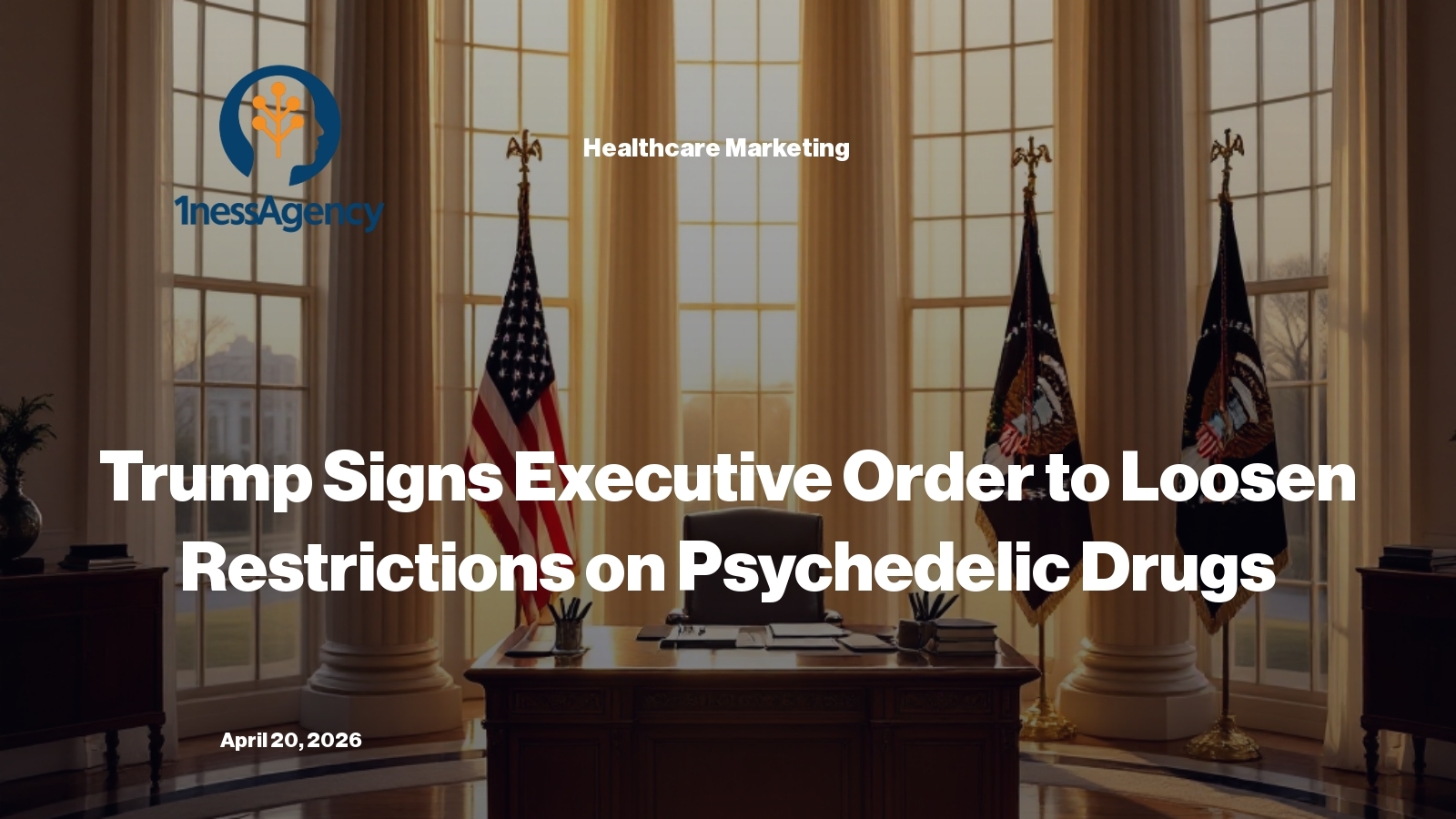
A presidential executive order in April 2026 loosening restrictions on psychedelic drugs creates the first legitimate marketing opportunity for a substance class that has lived in regulatory limbo for half a century. Healthcare organizations and pharmaceutical companies now face a market with millions of potential patients suffering from treatment-resistant depression, PTSD, and addiction disorders,but no established playbook for patient education, provider outreach, or compliant digital advertising in a category that carries both clinical promise and cultural baggage.
The executive order arrives as the FDA continues reshaping drug and device development pathways under Commissioner Marty Makary, M.D., M.P.H. In March 2026, the FDA issued guidance streamlining biosimilar development that could save manufacturers up to $20 million per product and cut clinical pharmacokinetic study costs by 50% [1]. In February 2026, the agency approved Optune Pax, the first non-invasive electrical field device for pancreatic cancer that patients use at home [2]. These moves signal a regulatory environment prioritizing speed-to-market and patient access over traditional development protocols,a shift that extends to psychedelics.
"Streamlining biosimilar development reflects our ongoing commitment to lowering drug costs for everyday Americans," Commissioner Makary stated in the March announcement, adding that the FDA is "embracing more precise analytical testing approaches than have been used in the past" [1]. The same efficiency-first philosophy appears to underpin the psychedelics order.
Healthcare marketers should care about this development even if psychedelics seem distant from their current portfolio. The order establishes precedent for executive action reshaping drug classification and market access overnight. It demonstrates how political winds can instantly create multi-billion-dollar therapeutic categories that require patient education campaigns, provider training programs, and brand positioning strategies,all within a regulatory framework that remains partially undefined. Organizations that move first to establish patient trust and clinical credibility in emerging categories typically capture outsized market share as competitors catch up.
The Regulatory Gap Creates Marketing Risk and Opportunity
The executive order loosens restrictions but does not provide complete regulatory clarity. Psychedelic substances including psilocybin, MDMA, and ibogaine remain controlled substances under federal law until the Drug Enforcement Administration revises scheduling,a process that typically requires months. The FDA maintains authority over clinical trials and eventual new drug applications, meaning products still need traditional approval pathways before reaching patients legally outside research settings.
This gap between executive direction and regulatory implementation creates immediate challenges for healthcare marketers. Digital advertising platforms including Google, Facebook, and Instagram maintain strict policies against promoting Schedule I substances, even if executive orders suggest future legal status. Search engine marketing campaigns for psychedelic therapy clinics risk account suspension. Content marketing must navigate the line between patient education and promotion of not-yet-approved treatments.
Organizations entering this market need compliance frameworks that anticipate rather than react to regulatory evolution. The FDA's February 2026 approval of Optune Pax for home use,a device delivering tumor treating fields through adhesive patches patients apply themselves,illustrates the agency's willingness to move therapeutic delivery outside clinical settings when safety data supports it [2]. Psychedelic-assisted therapy could follow similar pathways, transitioning from tightly controlled clinical administration to at-home or telehealth-supported treatments. Marketing strategies built around in-clinic experiences may quickly become obsolete.
Patient Education Precedes Product Launch
The psychedelics market differs from typical pharmaceutical launches because patient awareness substantially exceeds clinical understanding. Decades of cultural discourse have created strong opinions,both positive and negative,about substances most patients have never used in therapeutic contexts. A 2023 Johns Hopkins survey found 61% of Americans support legal access to psilocybin for mental health treatment, but only 23% felt confident they understood how psychedelic therapy actually works.
This awareness-understanding gap demands content marketing strategies focused on clinical mechanism, treatment protocols, and realistic outcome expectations rather than brand differentiation. Organizations that establish themselves as credible education sources before products reach market will control patient referral patterns once approvals come.
Educational content should address specific clinical questions: How does psilocybin differ from SSRIs in treating depression? What qualifies someone as treatment-resistant? What happens during a guided therapy session? What are documented adverse events? Healthcare marketers accustomed to promoting product benefits must shift to building category credibility,a longer timeline but one that establishes market position before competitors enter.
The FDA's $20 million cost reduction for biosimilar development demonstrates how regulatory streamlining impacts market entry dynamics [1]. If psychedelic drug development follows similar pathways, multiple manufacturers could bring competing psilocybin or MDMA products to market simultaneously rather than through sequential approvals. First-mover advantage will come from education and trust-building during the regulatory transition period, not from being first to market.
Provider Education Determines Prescription Patterns
Most physicians and psychiatrists completed medical training when psychedelics remained firmly in Schedule I classification with "no accepted medical use." A cardiologist who graduated medical school in 2015 received zero hours of instruction on psychedelic pharmacology, therapeutic protocols, or patient selection criteria. The executive order does not change that knowledge gap.
Healthcare marketers must build provider education programs comparable to specialty pharmaceutical launches,speaker bureaus, continuing medical education, peer-reviewed publication strategies, and key opinion leader development. The challenge exceeds typical product education because it requires establishing an entire treatment paradigm, not just differentiating one medication from alternatives within an existing category.
Optune Pax approval required extensive provider training on device application, treatment schedules, and patient monitoring despite the device being designed for home use [2]. Patients still need trained clinicians to prescribe, fit, and monitor treatment. Psychedelic therapy will demand similar or greater clinical oversight, particularly given safety concerns about adverse psychological reactions, patient screening for psychotic disorders, and integration therapy following psychedelic experiences.
Digital marketing strategies should target psychiatrists, addiction medicine specialists, and integrative medicine practitioners through channels including Doximity, Medscape, and specialty medical associations. Content must address clinical efficacy data, safety protocols, patient selection criteria, and practice workflow integration. A psychiatrist considering adding psychedelic-assisted therapy needs answers to operational questions: How long does a treatment session last? What staffing is required? How does this integrate with existing patient panels? What are reimbursement pathways?
The Reimbursement Question Shapes Market Viability
Executive orders do not create insurance coverage. The Centers for Medicare & Medicaid Services and private payers make independent determinations about covering experimental treatments based on clinical evidence, cost-effectiveness, and medical necessity criteria. Psychedelic therapy sessions lasting six to eight hours with multiple clinicians present could cost thousands of dollars per treatment,comparable to transcranial magnetic stimulation or electroconvulsive therapy for treatment-resistant depression.
Healthcare marketers must build parallel strategies for cash-pay and insurance-covered pathways. Cash-pay marketing resembles elective medical procedures,emphasizing outcomes, patient experience, and financing options. Insurance-covered marketing focuses on medical necessity, prior authorization support, and care coordination with existing treatment plans.
The FDA's emphasis on lowering drug costs through biosimilar streamlining reflects broader affordability pressures across healthcare [1]. Psychedelic therapy marketers should anticipate similar scrutiny. Positioning should emphasize total cost of illness,lost productivity, disability costs, suicide risk,rather than treatment cost alone. Depression costs the U.S. economy approximately $326 billion annually in medical costs and lost productivity. If psychedelic therapy demonstrates durable remission in treatment-resistant patients, the cost-effectiveness case strengthens despite high per-treatment costs.
Compliance Framework for Emerging Substance Categories
The psychedelics executive order creates immediate compliance challenges that healthcare marketers must address before launching campaigns:
Digital Advertising Restrictions: Major platforms prohibit promoting controlled substances regardless of executive guidance. Marketing strategies must rely on organic content, email marketing to opted-in audiences, and owned media channels until platform policies evolve. State-Federal Conflicts: Several states including Oregon, Colorado, and California have passed psychedelic decriminalization or legalization measures independent of federal action. Others maintain strict prohibition. Multi-state campaigns require state-specific compliance review. Medical Claims Substantiation: FDA enforcement of disease treatment claims continues regardless of scheduling changes. Marketing claiming psychedelics "cure" or "treat" specific conditions without approved New Drug Applications risks warning letters and injunctive action. HIPAA Considerations: Patient testimonials and case studies require standard healthcare privacy protections. The cultural sensitivity around psychedelic use may make patients particularly cautious about public identification. Professional Practice Acts: State medical boards regulate scope of practice for physicians and other providers. Marketing psychedelic therapy requires verifying providers hold appropriate licenses and that treatment protocols align with state medical practice standards.The 1ness Take
The psychedelics executive order represents the first major test of healthcare marketing agility in the new regulatory environment. Organizations that succeed will recognize this is not a traditional pharmaceutical launch,it is category creation requiring simultaneous patient education, provider training, regulatory navigation, and cultural repositioning.
Our recommendation: Build your content infrastructure now during the regulatory transition period before products reach market. Develop clinical education assets, patient journey maps, provider training curricula, and compliance frameworks while competitors wait for final approval pathways. The organizations that establish clinical authority and patient trust during this ambiguous period will control market access when approvals arrive.
Specifically, healthcare marketers should:
Invest in long-form educational content that addresses clinical mechanisms, not just outcomes. Patients and providers need to understand how psychedelic-assisted therapy works, what distinguishes it from both traditional psychopharmacology and recreational use, and what realistic expectations look like. Video content showing therapy session structure (without active drug administration) demystifies the process. Develop clinical decision support tools that help providers identify appropriate candidates. Treatment-resistant depression has specific diagnostic criteria,patients must fail adequate trials of multiple antidepressants. PTSD requires formal diagnosis through structured assessment. Create screening tools, patient selection algorithms, and contraindication checklists that make provider adoption frictionless. Build regional market strategies that acknowledge state-level variation. Oregon's psilocybin services program creates different marketing opportunities than states without specific psychedelic legislation. Content, advertising approaches, and partnership strategies should reflect regional regulatory and cultural contexts. Establish Key Opinion Leader relationships now while the field remains small. The dozen psychiatrists and psychologists who have led psychedelic research for the past two decades will shape treatment guidelines, insurance coverage decisions, and clinical adoption patterns. Organizations that partner with these experts as advisors and educators gain credibility that paid advertising cannot purchase. Prepare for cultural backlash by developing crisis communication protocols. Opposition to psychedelic medicalization will come from both traditional drug control advocates and psychedelic community members concerned about corporate commodification. Media training, stakeholder engagement strategies, and response frameworks should anticipate criticism from multiple directions.The parallel with the FDA's streamlining efforts is instructive. The agency's March 2026 guidance reducing biosimilar development costs by $20 million does not guarantee biosimilar success,it removes barriers [1]. Similarly, the psychedelics executive order removes federal obstacles but does not create automatic market adoption. Healthcare marketers must build the clinical evidence, provider confidence, and patient education infrastructure that translates regulatory access into therapeutic adoption.
The Takeaway
The April 2026 executive order on psychedelics creates immediate action items for healthcare marketing leaders:
Audit your organization's digital marketing compliance frameworks to identify how current policies address emerging and rescheduled substance categories. Work with legal counsel to develop guidelines for content marketing, search advertising, and social media that protect against platform violations while maximizing reach. Document decision frameworks for when marketing can begin based on specific regulatory milestones. Develop stakeholder education programs that begin before product approval. Create grand rounds presentations, CME modules, and clinical summaries that establish your organization as a knowledge source for providers considering psychedelic therapy. Build patient education websites and screening tools that capture demand during the regulatory transition. Organizations that wait for final approvals will enter markets where competitors have already shaped provider and patient understanding. Monitor state-level regulatory developments and tailor marketing strategies to regional legal frameworks. The patchwork of state psychedelic policies will require localized approaches to advertising, provider partnerships, and patient access programs. Build regional marketing plans that can activate quickly as state regulations clarify.The organizations that will succeed in this new therapeutic category are those that recognize the current moment as a brief window where strategic positioning precedes product availability. By the time competitors launch traditional marketing campaigns around approved products, market leaders will have already established themselves as the clinical authorities patients and providers trust.
References
[1] FDA Takes Further Steps to Streamline Biosimilar Development and Make Medicines More Affordable. U.S. Food and Drug Administration Press Release. March 9, 2026. https://www.fda.gov/news-events/press-announcements/fda-takes-further-steps-streamline-biosimilar-development-and-make-medicines-more-affordable [2] FDA Approves First-of-Its-Kind Device to Treat Pancreatic Cancer. U.S. Food and Drug Administration Press Release. February 12, 2026. https://www.fda.gov/news-events/press-announcements/fda-approves-first-its-kind-device-treat-pancreatic-cancerThis report is for informational purposes only and does not constitute investment advice or an offer to buy or sell any security. Content is based on publicly available sources believed reliable but not guaranteed. Opinions and forward-looking statements are subject to change; past performance is not indicative of future results. 1ness Strategies and its affiliates may hold positions in securities discussed herein. Readers should conduct independent due diligence and consult qualified advisors before making investment decisions.
© 2026 1ness Strategies. All rights reserved.