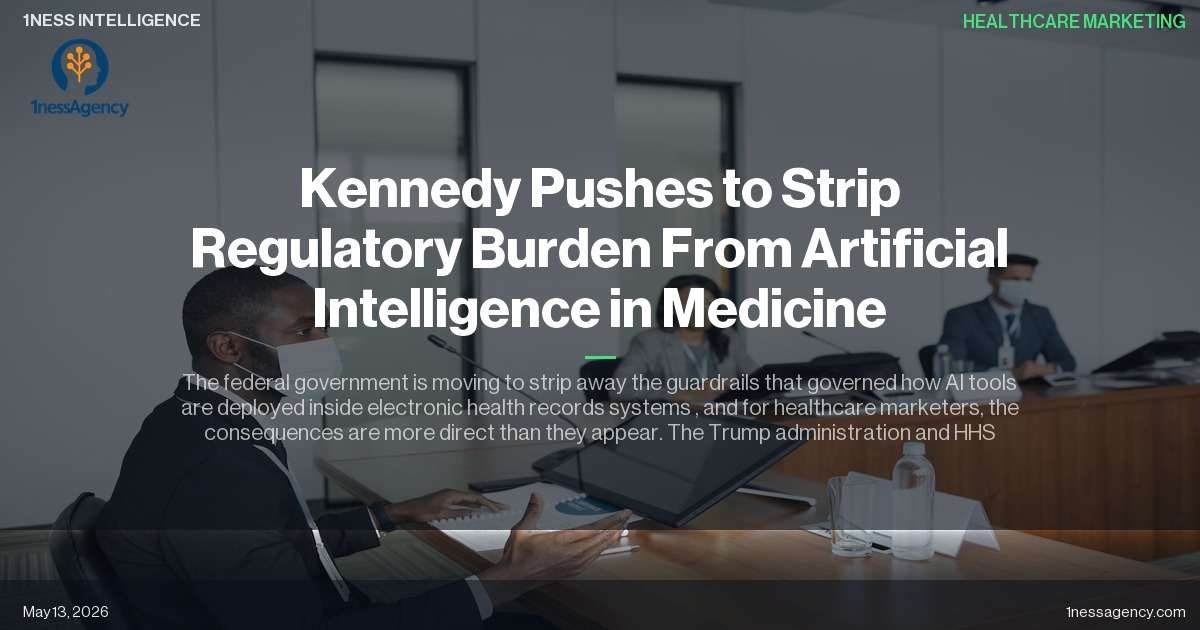
- The Trump administration and HHS Secretary Robert F. Kennedy Jr. are advancing proposed rules that would eliminate user-testing requirements and AI transparency mandates for health IT products, including ambient scribes in hospital systems.
- The Office of the National Coordinator for Health IT (ONC) is proposing to end Obama-era requirements governing how AI tools are deployed in electronic health records systems.
- The deregulation push will directly reshape how patients experience care, how clinicians document it, and how health systems market adopted AI technology.
The federal government is moving to strip away the guardrails that governed how AI tools are deployed inside electronic health records systems , and for healthcare marketers, the consequences are more direct than they appear. The Trump administration and HHS Secretary Robert F. Kennedy Jr. are advancing proposed rules that would eliminate user-testing requirements and AI transparency mandates for health IT products, including the ambient scribes now spreading across hospital systems nationwide . This is not a distant regulatory abstraction. It is a live deregulation push that will reshape how patients experience care, how clinicians document it, and how health systems market the technology they've adopted.
The proposed rules from the Office of the National Coordinator for Health IT (ONC) , the body that governs electronic health records , would end two specific Obama-era requirements: "user-centered design" testing, in which developers must demonstrate their products work as intended on actual clinicians, and AI transparency "model cards," a Biden-era mechanism that let clinicians examine the data used to train AI advisory tools . Public comment on the proposal closed in February 2026. The rule has not yet been finalized. The American Hospital Association, the American College of Physicians, and MedStar Health researcher Raj Ratwani have all raised public objections to the rollback .
"Historically, hospitals and health systems have been challenged by the black box nature of certain AI tools," Jennifer Holloman of the American Hospital Association told KFF Health News . That concern is especially pointed now: a recent study comparing 11 ambient AI scribes for potential use in the Veterans Health Administration found the software performed worse than human-authored documentation across five simulated clinical scenarios, with information omission cited as a particular patient safety risk .
If AI tools are deployed broadly without mandated transparency or usability testing, health systems will be marketing capabilities they cannot fully verify , to patients, to payers, and to referring physicians. That gap between the marketed promise and the clinical reality is where reputational risk compounds fastest.
The Safety Gap Is Already Measurable , and Getting Wider
Kaiser Permanente psychotherapist Paul Boyer, working in Oakland, California, is correcting AI-generated notes rather than saving time with them. Boyer says the ambient scribe deployed by KP , built by healthcare AI company Abridge , "is not good at picking up on clinical nuance, at picking up on the emotional tone" required in mental health settings . Boyer's experience stands alongside the clinical evidence: a JAMA study published in April 2026, analyzing five hospitals, found that the doctors who used AI scribes most intensively saved more than half an hour of work daily after a year , a real productivity gain . But the VA study found the opposite quality picture: AI-generated notes that omit clinical detail in ways that could affect follow-up care .
The market pushing these tools is consolidating fast. A 2022 study found Epic and Oracle Health together controlled more than 70% of the hospital EHR market . When the dominant platforms integrate AI scribes, the tools reach every clinician on those systems , regardless of whether the AI performs equally well in psychiatry, oncology, or primary care. That scale is the marketing pitch. It is also the liability.
Removing the requirement that developers report user-testing results to federal regulators , the administration's current proposal , means health systems will have less independent verification to rely on when evaluating vendor claims. Leigh Burchell of Altera Digital Health, an EHR developer, notes that under the proposed "enforcement discretion" framing, companies are still technically required to conduct user testing but no longer required to disclose the results to the government . Marketers who have been leading with AI capability claims should understand that the evidentiary floor beneath those claims is about to get thinner, not thicker.
Deregulation as a Market Signal , and a Marketing Risk
Abridge's general counsel Tim Hwang told KFF Health News that his company "broadly supports" the proposed rules as "necessary modernization" that accommodates the speed at which AI is evolving . Ryan Howells of Leavitt Partners, which consults for digital health companies, called federal regulations "the single biggest inhibitor to true clinical innovation" . The deregulatory argument is that fewer rules mean more competition and faster development , a straightforward pro-innovation framing.
For health system marketing leaders, that framing carries a hidden cost. When transparency requirements disappear, the burden of establishing AI credibility shifts from regulators to health systems themselves. Patients and referring physicians will not stop asking whether the AI tools their providers use are safe and effective. They will simply have fewer public disclosures to consult. Health systems that fail to fill that vacuum with clear, proactive communication , on their websites, in patient portals, in clinician-facing messaging , will leave a trust gap that competitors can exploit.
The American College of Physicians warned in its comment letter to ONC that reduced transparency could "undermine clinician trust, increase liability expense, and erode the patient-physician relationship" . Each of those outcomes carries a direct marketing consequence: lower physician engagement scores, harder specialist referral pipelines, and patient retention challenges in a market where health system switching is already at historic levels.
What AI Transparency Now Means for Patient Acquisition
Health systems are actively marketing their AI investments. Press releases announcing ambient scribe deployments, telehealth AI integrations, and predictive analytics tools are a standard part of hospital communications in 2026. The deregulation push does not change the marketing impulse , it changes the risk calculus behind it.
Our recommendation: Health systems that choose to market AI capabilities should build what regulators are removing: internal transparency documentation that can be shared with patients and clinical staff. This is both a patient trust strategy and a liability hedge.Specific actions that separate credible AI marketing from hollow capability claims:
- Publish AI use disclosures in plain language on patient-facing web pages and in new patient intake materials. Describe which tools are in use, what decisions they inform, and what human oversight is in place.
- Segment AI messaging by service line. The JAMA productivity data is compelling in high-volume primary care settings. It is not the right message for behavioral health, where Boyer's experience at Kaiser Permanente illustrates a documented quality gap. Match the claim to the clinical evidence.
- Create clinician-facing AI accountability frameworks. If your health system is deploying ambient scribes from vendors like Abridge, Nuance (Microsoft), or Suki, establish internal review cycles and publish aggregate accuracy metrics. This builds physician trust and gives your marketing team defensible data.
- Position transparency as a differentiator. As competitors rush to claim AI leadership without independent verification, health systems that publish testing results and disclose AI limitations will build the credibility that neither regulators nor competitors are currently requiring.
- Monitor the ONC rulemaking timeline. The proposed rule is still in process as of May 2026 . Healthcare marketing and compliance teams should track finalization and adjust their AI communications policies within 90 days of any final rule publication.
Compliance Callout: Even as ONC's proposed rules would relax transparency requirements for EHR-integrated AI, HIPAA's privacy and security rules remain in force. AI tools that process protected health information are subject to existing HIPAA obligations regardless of what the new ONC rules do or do not require. FTC guidelines on deceptive advertising also apply to health system marketing claims about AI performance. Marketing any AI capability as clinically validated without supporting evidence carries regulatory exposure under both FTC and CMS truthfulness standards.
The 1ness Take
The deregulation story is being covered as a patient safety story , and it is. But it is also a healthcare marketing inflection point that most health system CMOs are not yet treating as strategic.
Here is the position we'd take: the health systems that win the AI era will not be the ones that deploy the most tools. They will be the ones that explain their tools most clearly.
Patients in 2026 are reading about AI errors, watching policymakers debate AI oversight, and forming opinions about which providers they trust to use technology responsibly. That trust gap is a patient acquisition opportunity. The health systems and practices that proactively disclose how their AI works, what it does well, and where a human clinician remains in the loop will differentiate on transparency in a market where transparency is becoming scarce.
The marketing strategy is not "we have AI." It is "we use AI this way, we test it this way, and here is who is accountable." That message converts anxious patients into engaged ones , and converts one-time visits into long-term relationships.
The ONC deregulation push also signals something deeper about the next two years: health IT vendors will face less mandatory oversight, which means health systems become the de facto quality gatekeepers for the AI tools they purchase and deploy. Marketing leaders need to be in those procurement conversations , not because they are clinical experts, but because the claims they are expected to make externally depend on the verification their systems do internally.
The Takeaway
1. Audit your current AI marketing claims against available clinical evidence. If your communications team is promoting ambient scribes or AI diagnostic tools, verify that the supporting data covers your specific patient population and clinical context , not just aggregate studies from different care settings.
2. Draft a patient-facing AI disclosure page now, before regulatory requirements force a reactive response. Frame it as a transparency commitment, not a compliance checkbox. Include which tools are deployed, how accuracy is monitored, and how patients can raise concerns.
3. Build an internal AI performance review cadence. Quarterly reviews of clinician feedback, note accuracy rates, and patient outcome correlations give your marketing team the real-world data to back up capability claims , and give your compliance team the documentation trail they will eventually need.
References
- Tahir, Darius. "Trump and Kennedy Seek To Relax Safeguards for AI Healthcare Tools." KFF Health News, May 13, 2026 kffhealthnews.org
- American Hospital Association. Comment Letter to ONC on Proposed Health IT Rules, 2026. Referenced in KFF Health News reporting, May 13, 2026.
- American College of Physicians. Comment Letter to ONC on Proposed Health IT Rules, 2026. Referenced in KFF Health News reporting, May 13, 2026.
- Andrews, Michelle. "Doctors Increasingly See AI Scribes in a Positive Light. But Hiccups Persist." KFF Health News, January 27, 2026 kffhealthnews.org