- Tennessee Governor Bill Lee signed legislation in May 2026 requiring vertically integrated companies to choose between operating as a PBM or owning pharmacies, with a January 1, 2027 divestment deadline.
- CVS Health operates 134 Tennessee pharmacy locations alongside its Caremark PBM and warned the law could eliminate roughly 2,000 jobs in the state.
- PBMs and allies spent over $7 million with 60+ lobbyists to defeat the Tennessee legislation, which failed despite the unprecedented lobbying effort.
- A 2024 Tennessee audit found CVS Caremark used spread pricing, charging health plans more for medications than it reimbursed pharmacies, prompting the legislative action.
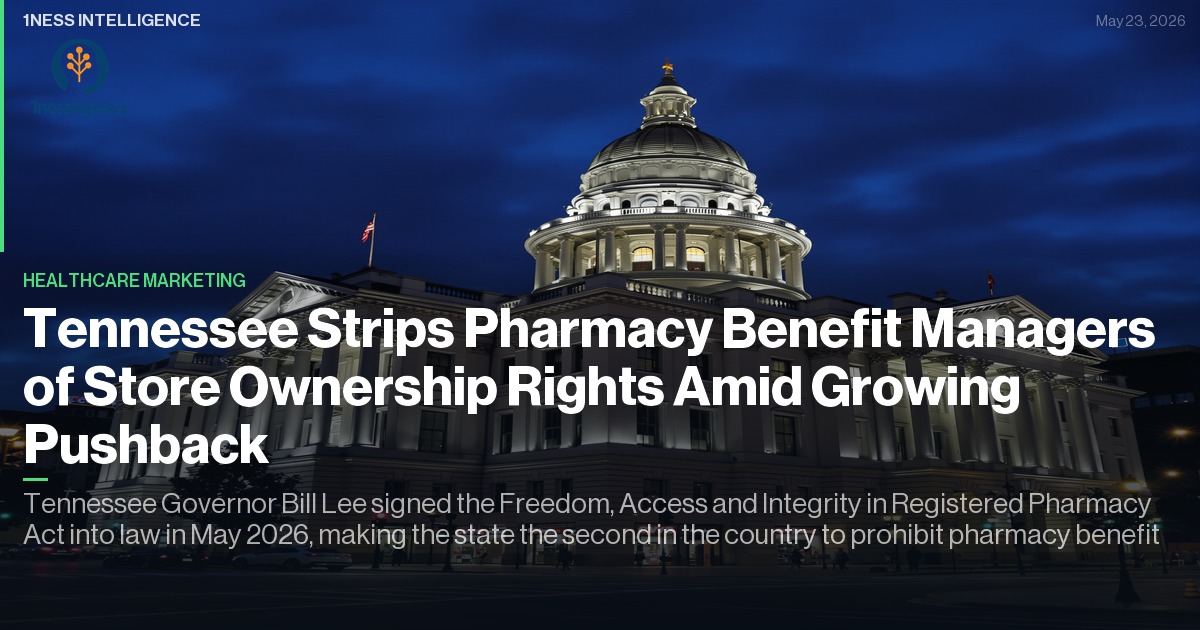
Tennessee Governor Bill Lee signed legislation in May 2026 that forces vertically integrated healthcare giants to choose: operate as a pharmacy benefit manager or own pharmacies, but not both. The Freedom, Access and Integrity in Registered Pharmacy Act makes Tennessee the second state to sever the integration that has defined the pharmaceutical supply chain for two decades, and the move arrives at what Optum Rx's newly appointed CFO Jon Bosland calls "an inflection point" for the PBM industry, one marked by "rising utilization, accelerating cost pressures," and regulatory scrutiny that healthcare marketers can no longer afford to ignore .
The law requires affected companies to divest or restructure by January 1, 2027. CVS Health, which operates 134 Tennessee pharmacy locations and the Caremark PBM, warned the legislation could eliminate roughly 2,000 jobs in the state. But lawmakers moved forward after a 2024 Tennessee Department of Commerce and Insurance audit found CVS Caremark used spread pricing, charging health plans more for medications than it reimbursed pharmacies .
B. Douglas Hoey, CEO of the National Community Pharmacists Association, framed the conflict starkly: "An enormous conflict of interest exists when a giant corporate PBM or insurance plan owns and operates its own pharmacy. This legislation simply gives these health care giants a choice: you can be a PBM or you can be a pharmacy but you can't be both" .
The Tennessee decision matters beyond state lines because it accelerates a multi-front assault on PBM business models that directly affects where patients fill prescriptions, how healthcare systems negotiate drug costs, and which pharmacy partners will survive the next 24 months. For healthcare marketers building patient access programs, specialty pharmacy networks, or prescription support services, the ground is shifting faster than compliance teams can map it.
The $7 Million Lobbying War That Failed
PBMs and their allies deployed more than 60 lobbyists and spent over $7 million attempting to kill the Tennessee legislation, according to the National Community Pharmacists Association . The lobbying blitz failed, signaling that the political calculus around pharmacy benefit managers has fundamentally changed.
Arkansas passed the first state-level PBM ownership ban, but that law remains tied up in federal court after CVS Caremark, Express Scripts, and OptumRx sued to block it on Commerce Clause grounds. The case now sits before the 8th Circuit Court of Appeals . Tennessee's law is expected to face similar legal challenges, setting up a years-long battle that will determine whether states can force vertical disintegration of healthcare companies.
Federal momentum compounds state action. Congress reintroduced legislation on May 13, 2026, that would require companies owning health insurers or PBMs to divest their pharmacy businesses nationwide. The Consolidated Appropriations Act of 2026, signed in February, included the first major PBM reforms to Medicare Part D in nearly 20 years . The convergence of state and federal pressure suggests PBM business models face structural disruption, not temporary regulatory friction.
The financial stakes are enormous. PBMs control drug access for more than 270 million Americans and generate revenue through spread pricing, rebate retention, and pharmacy network steering. When states prohibit vertical integration, they dismantle the economics that allow PBMs to profit from owning both the pharmacy and the benefit manager, the classic conflict Hoey described.
What This Means for Patient Access and Pharmacy Networks
Healthcare marketers must rethink pharmacy partnerships as the PBM landscape fractures. If Tennessee's law survives legal challenge, CVS must either close 134 pharmacies or sell its Caremark PBM. Either scenario creates market disruption that affects patient access to medications, specialty drug programs, and chronic disease management initiatives that rely on integrated pharmacy services.
For health systems operating patient assistance programs, the implications are immediate. Patients enrolled in Caremark plans may lose in-network access to CVS pharmacies in Tennessee by January 2027. Specialty pharmacies embedded in PBM structures face uncertain futures. Prescription adherence programs that depend on PBM data sharing and pharmacy coordination will need alternative infrastructure.
Independent and community pharmacies gain market share as vertically integrated competitors exit or restructure. The Tennessee Pharmacists Association championed the legislation precisely because it removes competitors who could steer patients to their own pharmacies while controlling reimbursement rates . For healthcare marketers, this creates partnership opportunities with independent pharmacies that have been priced out of narrow networks.
The spread pricing practice flagged in Tennessee's 2024 audit, where PBMs charge health plans more than they reimburse pharmacies, has become a flashpoint for reform . As states scrutinize PBM pricing transparency, healthcare organizations must audit their own pharmacy contracts to identify hidden costs that inflate patient out-of-pocket expenses and erode medication adherence.
The Compliance and Competitive Landscape Through 2027
Tennessee's January 1, 2027 divestiture deadline creates a 19-month window of market uncertainty. Healthcare marketers should expect:
Pharmacy Network Volatility: CVS and other vertically integrated players will negotiate, litigate, and potentially divest. Monitor pharmacy network adequacy for your patient populations, particularly in specialty drug programs where narrow networks dominate. State-by-State Fragmentation: Tennessee and Arkansas represent a regulatory patchwork that will expand as other states consider similar legislation. Multi-state health systems must manage compliance across jurisdictions with conflicting pharmacy benefit rules. Federal Preemption Risk: The ongoing 8th Circuit case could determine whether federal law preempts state PBM ownership bans . A ruling that strikes down Arkansas's law would undermine Tennessee's legislation and stall state-level reform. PBM Pricing Transparency: The trend extends beyond ownership bans. Federal Medicare Part D reforms in the Consolidated Appropriations Act of 2026 signal broader scrutiny of PBM pricing practices . Expect increased disclosure requirements that affect how healthcare organizations negotiate pharmacy contracts.The Justice Department's announcement in May 2026 that it charged 15 individuals in Minnesota with more than $90 million in alleged healthcare fraud, including the largest Medicaid autism fraud case ever charged in that district, demonstrates heightened federal enforcement across healthcare sectors . While the Tennessee PBM law addresses structural conflicts, federal prosecutors are pursuing fraud wherever vertical integration creates opportunities for abuse.
The 1ness Take
Healthcare marketers should treat the Tennessee PBM ban as an early signal of pharmacy infrastructure disruption that will reshape patient access strategies over the next three years. The immediate action is to audit pharmacy partnerships and patient support programs for dependency on vertically integrated PBM structures that may not survive legal and regulatory pressure.
Build optionality into your pharmacy networks now. For specialty drug programs, particularly high-cost biologics and GLP-1 medications where PBM steering is most aggressive, establish relationships with independent specialty pharmacies that won't face divestiture mandates. For patient assistance programs that rely on PBM data, invest in alternative data infrastructure that doesn't depend on vertical integration.
Position your organization as a transparency leader. As PBM pricing practices face scrutiny, healthcare organizations that proactively disclose pharmacy costs and eliminate spread pricing gain competitive advantage. Patients increasingly understand that pharmacy benefit managers inflate drug costs, offer programs that bypass the middleman.
The strategic opportunity extends to partnership positioning. Independent pharmacies gaining market share need sophisticated marketing support to scale patient acquisition and chronic disease management programs. Health systems that partner with independent pharmacies now, before PBM divestiture forces a fire sale, can negotiate favorable terms and build exclusive networks that differentiate patient access.
Watch the 8th Circuit. If the court upholds Arkansas's ownership ban, expect rapid adoption in Republican-led states where pharmacy independence aligns with small business advocacy. If the court strikes it down on Commerce Clause grounds, state-level reform stalls and focus shifts to federal legislation. Either outcome creates market volatility that requires scenario planning.
The Takeaway
Tennessee's PBM ownership ban is not an isolated regulatory event: it's the leading edge of pharmacy infrastructure disruption that will force healthcare marketers to rebuild patient access strategies over the next 24 months.
Immediate actions for healthcare marketing leaders:- Audit pharmacy dependencies: Map which patient programs rely on CVS/Caremark, Express Scripts/Cigna, or Optum Rx/UnitedHealth vertical integration. Identify exposure to Tennessee-style divestiture mandates in your key markets.
- Build independent pharmacy partnerships: Establish relationships with independent and community pharmacies now, before PBM divestiture forces rushed transitions. Negotiate data sharing agreements and patient support program infrastructure that doesn't depend on PBM ownership.
- Monitor the 8th Circuit Arkansas case: The legal outcome will determine whether state ownership bans survive Commerce Clause challenges. Prepare contingency scenarios for both outcomes and adjust pharmacy network strategy accordingly.
References
- Jeffries, E. (2026, May 22). Tennessee becomes 2nd state to ban PBMs from owning pharmacies. Becker's Hospital Review beckershospitalreview.com
- Emerson, J. (2026, May 22). UnitedHealth's PBM names CFO. Becker's Hospital Review beckershospitalreview.com
- Casolo, E. (2026, May 21). Justice Department charges 15 for $90M+ in alleged healthcare fraud, expands strike force. Becker's Hospital Review beckershospitalreview.com