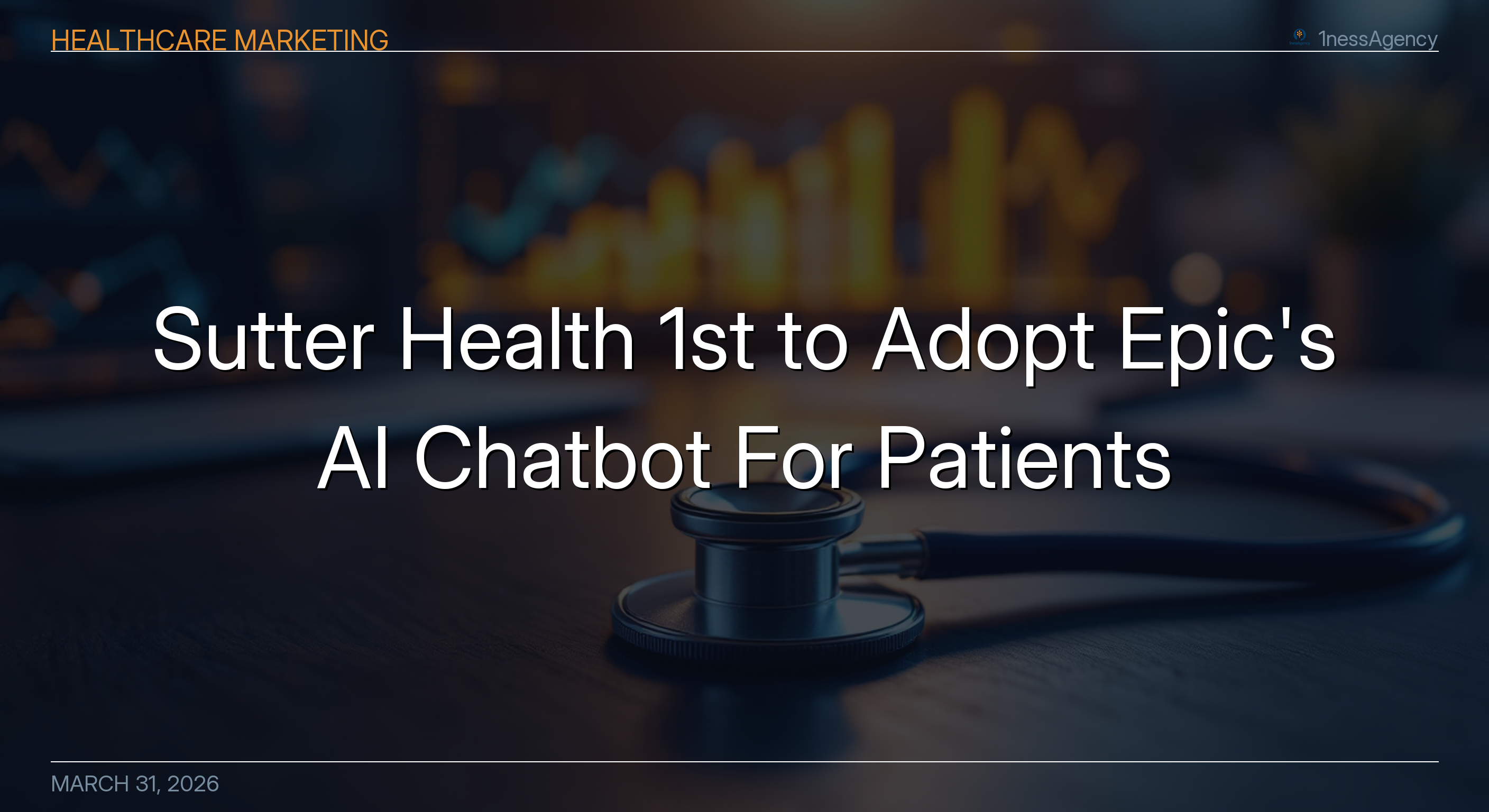
Sutter Health became the first health system to implement Epic's AI-powered patient chatbot in 2026, marking a shift in how large integrated delivery networks handle the digital front door. The deployment comes as healthcare systems face mounting pressure to reduce call center costs while meeting consumer expectations shaped by retail and banking experiences. For marketing and patient experience leaders, this represents the convergence of two forces: AI automation moving from back-office operations into patient-facing channels, and the EHR vendor as competitive differentiator in digital patient access.
Epic's entry into conversational AI for patient engagement changes the vendor landscape for healthcare marketers evaluating chatbot and virtual assistant technologies. The integration with Epic's EHR infrastructure creates a technical moat, patient data, appointment availability, and clinical workflows unified in a single platform. Sutter Health's adoption signals that enterprise health systems see AI chatbots not as experimental technology but as core infrastructure for patient acquisition and retention.
The regulatory backdrop matters. While FDA has moved aggressively on clinical AI approvals, approving the first gene therapy for severe Leukocyte Adhesion Deficiency Type I on March 26, 2026 [1] and Avlayah for neurologic manifestations of Hunter Syndrome on March 25, 2026 [2], the agency has yet to establish guardrails specific to consumer-facing healthcare AI that influences care-seeking behavior. This creates both opportunity and compliance risk for marketing teams deploying conversational AI.
For healthcare marketers beyond Sutter's footprint, the strategic question is not whether to adopt AI chatbots but which vendor ecosystem to commit to. Epic's move forces a decision: build flexibility with best-of-breed point solutions, or accept tighter integration with the EHR vendor that already controls scheduling, referral management, and clinical documentation. That choice determines patient acquisition costs, conversion rates, and data ownership for the next contract cycle.
The Technical Advantage Epic Brings to Patient Engagement
Epic's chatbot leverages direct access to appointment inventory, patient medical records, and billing systems without the middleware that third-party vendors require. This eliminates a persistent friction point in healthcare digital marketing: the gap between what a patient sees on a website or app and what the system can actually deliver. When a prospective patient asks about specialist availability or whether their insurance is accepted, Epic's AI can pull real-time data rather than offering generalized responses that require callback verification.
The technical architecture matters for conversion optimization. Third-party chatbots typically hand off to a call center or patient portal for transaction completion. Each hand-off introduces abandonment risk, industry benchmarks show 40-60% drop-off rates between chatbot inquiry and completed appointment booking across healthcare vendors. Epic's unified platform collapses those steps, allowing the chatbot to complete scheduling, trigger reminder workflows, and update the patient's EHR record in a single interaction.
For marketing teams managing patient acquisition costs, this integration translates to measurable ROI. The cost per acquired patient includes not just advertising spend but also call center labor, no-show rates, and the percentage of inquiries that never convert to appointments. AI chatbots that can complete transactions reduce variable costs per lead while improving conversion rates. Sutter Health's deployment provides the first real-world test of whether Epic's technical advantage produces better financial outcomes than best-of-breed competitors.
What Marketers Should Watch: Data Access and Personalization
The strategic value in Epic's chatbot lies in data, both what it collects and what it can access. Unlike standalone chatbots that operate on a narrow data set, Epic's AI can reference a patient's longitudinal health record, previous appointment history, and service line utilization. This enables personalization at scale: recommending relevant specialists based on diagnosis codes, surfacing preventive care opportunities tied to clinical guidelines, and routing high-value patients to concierge scheduling paths.
This personalization capability creates competitive separation in service lines where patient choice matters, orthopedics, cardiovascular care, women's health, and oncology. Patients comparing health systems increasingly expect the convenience layer they experience in other industries. A chatbot that remembers their last visit, knows their preferred location, and proactively suggests next steps in a care pathway delivers a materially different experience than generic FAQs and scheduler hold times.
The compliance consideration for marketing leaders is data governance. Epic's chatbot operates inside the HIPAA-compliant EHR environment, but patient interactions blur the line between marketing communication and clinical advice. When an AI chatbot suggests a specialist referral or recommends a screening test, is that care coordination or marketing? The distinction determines liability exposure, required disclaimers, and whether the interaction falls under FTC advertising rules or clinical practice guidelines. Healthcare marketing teams need legal review of chatbot scripts, escalation protocols for clinical questions, and clear disclaimers about the AI's role and limitations.
The Competitive Pressure on Call Centers and Digital Front Door Vendors
Sutter Health's adoption of Epic's chatbot pressures standalone vendors in the patient access technology market, companies like Artera, Hyro, and Orbita that sell chatbot and patient engagement platforms to health systems. Epic's installed base gives it distribution advantage: any health system running Epic can deploy the chatbot without procurement process, vendor integration projects, or additional contracts. This commoditizes features that digital front door vendors have monetized, appointment scheduling, symptom checking, and FAQ automation.
For marketing leaders, this vendor consolidation trend has budget implications. If core chatbot functionality comes bundled with the EHR, justifying separate spend on best-of-breed point solutions requires proving differentiated value, better natural language processing, superior conversion rates, or capabilities Epic does not offer. The bargaining position shifts. Marketing technology budgets face pressure to consolidate around the EHR vendor ecosystem or demonstrate measurable ROI advantage for standalone tools.
The counterargument for best-of-breed vendors is flexibility and innovation speed. Epic develops features on a release cycle governed by a large, complex product portfolio and risk-averse healthcare CIOs. Standalone vendors can iterate faster, experiment with newer AI models, and customize for specific service line marketing strategies. An orthopedic practice might deploy a specialized chatbot optimized for joint replacement patient education and pre-qualification, while Epic's chatbot serves general patient access use cases. For health systems with aggressive patient acquisition goals in competitive markets, that specialization may justify separate spend.
The Regulatory Gap in Patient-Facing Healthcare AI
While FDA accelerated approvals for gene therapies in rare diseases, Kresladi for severe LAD-I on March 26, 2026 [1] and Avlayah for Hunter syndrome neurologic manifestations on March 25, 2026 [2], the agency has not clarified oversight of AI tools that influence patient behavior but do not diagnose or treat. Epic's chatbot answers clinical questions, suggests care pathways, and routes patients to services. None of these functions meet FDA's traditional definition of a medical device, yet they shape healthcare utilization and outcomes.
The regulatory vacuum creates risk for healthcare marketers. If a chatbot provides inaccurate information that delays care or directs a patient to an inappropriate service, liability questions arise. Is the health system responsible for validating every AI-generated response? Does the EHR vendor share liability for algorithmic errors? Marketing teams deploying AI chatbots need documented oversight processes: regular audits of chatbot transcripts, escalation protocols when the AI cannot answer confidently, and clear disclaimers that the chatbot does not replace clinical judgment.
The FTC's focus on deceptive advertising extends to AI-generated content. If a chatbot overstates a health system's capabilities, makes unsupported clinical claims, or fails to disclose limitations, the health system faces enforcement risk. Marketing compliance teams should treat chatbot scripts with the same rigor as website copy and advertising claims, review by legal counsel, clinical validation of health information, and documentation that marketing claims align with evidence.
The 1ness Take
Sutter Health's deployment of Epic's AI chatbot forces a strategic choice for healthcare marketing leaders in 2026: commit to the EHR vendor's ecosystem or maintain flexibility with best-of-breed tools that may offer differentiation but require integration overhead.
Our recommendation depends on your competitive position and patient acquisition strategy. If your health system competes primarily on access and convenience, reducing friction in appointment scheduling, minimizing hold times, and delivering consumer-grade digital experience, Epic's integrated chatbot delivers ROI through operational efficiency. The value is in cost reduction and conversion rate improvement, not competitive differentiation. Every Epic client will have the same capability.
If your strategy depends on service line differentiation, specialized care pathways, high-touch patient navigation, or clinical programs where education and engagement drive volume, best-of-breed AI tools justify separate investment. A cardiology service line competing for TAVR and EP procedures benefits from a specialized chatbot that pre-qualifies patients, explains complex procedures, and integrates with service line-specific CRM workflows. Epic's general-purpose chatbot cannot deliver that level of specialization without significant customization that negates the plug-and-play advantage.
The hidden strategic risk is data ownership and portability. As EHR vendors expand into patient engagement, marketing automation, and CRM functions, health systems cede control over patient interaction data and analytics. If you decide to switch platforms or add complementary tools, extracting data from Epic's ecosystem becomes difficult. Marketing leaders should negotiate data access rights, ensure chatbot transcripts and patient interaction logs can export to your marketing data warehouse, and retain flexibility to layer analytics tools on top of Epic's reporting.
We also recommend establishing governance now for AI-generated patient communications. Create a cross-functional review team (marketing, legal, compliance, clinical leadership) that audits chatbot performance quarterly. Monitor metrics beyond conversion rates: patient complaints about inaccurate information, clinical escalations where the chatbot failed to recognize urgency, and demographic patterns in chatbot utilization that might indicate access barriers. AI tools improve with feedback loops, but only if someone owns the responsibility to monitor, measure, and adjust.
The Takeaway
Healthcare marketing leaders should take three immediate actions in response to Epic's patient-facing AI chatbot and Sutter Health's adoption:
Audit your current patient access technology stack. Map every tool that touches appointment scheduling, patient inquiry handling, and digital front door functions. Identify redundancies with Epic's chatbot capabilities and calculate the cost of maintaining separate vendors versus consolidating. If you are not on Epic, evaluate whether your EHR vendor has comparable AI chatbot plans or whether you need a standalone solution. Establish compliance and governance protocols for AI patient interactions. Draft policies for chatbot oversight, clinical validation of AI-generated health information, and escalation procedures when the technology cannot confidently answer a patient question. Ensure your legal team reviews marketing claims the chatbot makes and that disclaimers meet FTC advertising standards and HIPAA privacy requirements. Test, measure, and optimize for conversion, not just containment. Most health systems deploy chatbots to reduce call center volume, a cost containment goal. The strategic opportunity is conversion optimization: turning more digital inquiries into booked appointments, completed care episodes, and retained patients. Instrument your chatbot with analytics that track conversion rates by service line, patient demographics, and inquiry type. Use that data to refine scripts, improve handoffs, and identify where human intervention improves outcomes.---
References
- U.S. Food and Drug Administration. "FDA Approves First Gene Therapy for Severe Leukocyte Adhesion Deficiency Type I." Press Release, March 26, 2026 fda.gov
- U.S. Food and Drug Administration. "FDA Approves Drug to Treat Neurologic Manifestations of Hunter Syndrome." Press Release, March 25, 2026 fda.gov