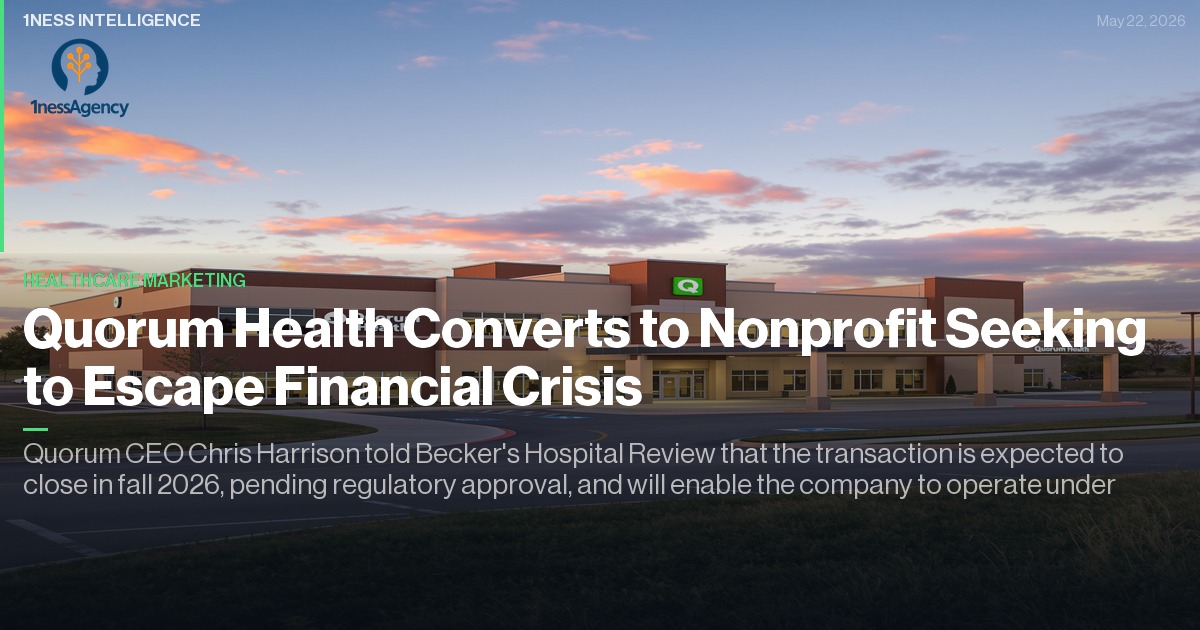
- Quorum Health, a 11-hospital system across nine states, is converting from for-profit to nonprofit status by fall 2026 to access capital and rebuild community trust after emerging from $500 million in Chapter 11 bankruptcy in 2020.
- The nonprofit conversion will enable a planned $300 million capital investment through 2029 for infrastructure upgrades, outpatient facilities, and technology modernization that rural CMOs must translate into community messaging.
- Approximately 75% of Quorum's facilities are sole community providers or critical access hospitals, making this conversion a survival strategy that signals broader financial pressure across rural healthcare systems nationwide.
Quorum Health's planned shift from for-profit to nonprofit status in fall 2026 signals a survival tactic that CMOs and marketing leaders at rural hospitals must watch closely, because the tax designation on your organizational charter now determines whether you can access capital, compete for talent, and message your mission to communities that increasingly distrust corporate healthcare.
The Brentwood, Tennessee-based system signed a definitive agreement with nonprofit Healthside Partners to convert its 11-hospital, nine-state portfolio to tax-exempt status. CEO Chris Harrison framed the move bluntly: "All those decisions, and even this decision, are about survival and how to keep the company viable and keep the company going." The transaction closes fall 2026 pending regulatory approval.
The numbers tell the story Harrison won't say outright: Quorum emerged from $500 million in Chapter 11 bankruptcy restructuring in 2020, shed nearly half its hospitals since then, and now operates a geographically dispersed footprint that delivers no economies of scale. The nonprofit conversion eliminates leverage costs and frees cash flow for a planned $300 million capital investment through 2029, funding that marketing teams will need to translate into community trust and patient volume.
This matters beyond Quorum's specific circumstances. Approximately 75% of Quorum's facilities are sole community providers or critical access hospitals, the exact profile of hundreds of rural facilities nationwide facing identical margin pressure, reimbursement gaps, and the question of whether a for-profit structure still serves rural healthcare delivery. When a system this size publicly declares that nonprofit status is a survival strategy, every rural CMO should audit whether their current brand positioning still aligns with their community's expectations and their organization's financial reality.
The Capital-to-Community Trust Equation Just Changed
Quorum's $300 million capital commitment through 2029 includes infrastructure upgrades, outpatient facilities, freestanding emergency departments, and technology modernization. For marketing leaders, this investment roadmap creates a messaging opportunity, but only if the nonprofit designation reinforces rather than contradicts existing brand equity.
Rural communities historically view nonprofit hospitals as mission-driven and for-profit facilities as margin-driven. That perception gap affects patient choice, physician recruitment, and local government support. Quorum's Harrison acknowledged the geographic dispersion problem: "We're geographically dispersed and spread out, so we don't really get economies of scale and market economies of scale like a lot of operators do." Translation: the for-profit model's financial advantages disappeared, but the reputational disadvantages remained.
Marketing teams at converting systems face a specific challenge: how to message the change without implying the previous structure failed patients. The answer lies in forward-looking investment storytelling. Quorum's capital plan gives marketing a concrete narrative (new ORs, expanded outpatient access, modernized EHRs) that demonstrates nonprofit status as an enabler of clinical expansion rather than an admission of financial distress.
The alternative, staying silent about the conversion, allows competitors and community skeptics to control the narrative. In rural markets where hospital choice is limited but distrust of corporate ownership runs high, a proactive campaign that ties nonprofit status directly to capital investment and service expansion can reset brand perception before the transaction closes.
Geographic Dispersion Is a Marketing Asset If You Reframe It
Harrison described Quorum's nine-state footprint as a liability that prevents economies of scale. Marketing leaders should see it differently: geographic dispersion means each facility can own its local market identity without cross-market brand interference.
The rural hospital marketing playbook differs fundamentally from urban academic medical center strategies. Rural patients choose hospitals based on proximity, physician relationships, and community embeddedness, not brand prestige or specialty rankings. A dispersed portfolio allows each facility to message as "your community hospital" without corporate brand baggage undermining local trust.
Quorum's 2025 launch of a management services organization focused on IT and revenue cycle support for rural hospitals reveals another marketing opportunity. Systems that position themselves as rural healthcare infrastructure partners, not just facility operators, can market B2B services alongside B2C patient acquisition. That dual revenue stream matters as traditional fee-for-service volume declines.
For marketing teams at other rural systems watching Quorum's conversion, the lesson is clear: if your portfolio lacks geographic density, stop trying to build system-wide brand recognition. Instead, invest in hyperlocal campaigns that treat each facility as its own brand, unified only by a back-end support infrastructure that improves clinical quality and financial sustainability.
The Bankruptcy-to-Nonprofit Pipeline Is Now a Proven Path
Quorum filed Chapter 11 in 2020, emerged under private equity control through GoldenTree Asset Management, divested nearly half its hospitals, and now converts to nonprofit status six years later. That timeline establishes a template for distressed rural systems: restructure debt through bankruptcy, stabilize operations under private equity discipline, then convert to nonprofit status once the balance sheet supports long-term investment.
Marketing implications: if your system recently emerged from bankruptcy or operates under private equity ownership, community perception likely positions you as financially unstable or profit-extracting. The nonprofit conversion offers a clean break from that narrative, but only if marketing treats it as a transformation story rather than a technical tax status change.
Quorum's capital commitment provides the proof point that makes the transformation credible. Without tangible investment announcements (facility expansions, service line additions, technology upgrades) the nonprofit conversion reads as financial maneuvering rather than strategic repositioning. Marketing teams should insist that leadership pair any conversion announcement with a multi-year capital plan that gives the story forward momentum.
The playbook: announce the conversion and capital plan simultaneously, frame nonprofit status as unlocking investment capacity, and launch a community listening tour that asks local stakeholders what services they need most. That approach transforms a defensive narrative (we had to convert to survive) into an offensive one (nonprofit status allows us to expand in ways our previous structure prevented).
The 1ness Take
The Quorum conversion reveals a truth that healthcare marketing leaders must internalize: organizational structure is no longer a back-office finance decision that marketing simply announces. In rural markets, tax status directly affects brand trust, capital access, and competitive positioning. Marketing must have a seat at the table when systems evaluate structural changes, not to craft the press release after the fact, but to assess community perception implications before leadership commits to a path.
Our recommendation: audit your organization's current structure against three questions. First, does your for-profit or nonprofit status align with your community's expectations for how a local hospital should operate? Second, does your structure enable or constrain the capital investment your facilities need to remain competitive? Third, can you credibly message your current status as serving patient and community interests, or does it create ongoing skepticism that undermines other marketing efforts?
If the answers reveal misalignment, initiate a leadership conversation about whether structural change should be part of your strategic plan. That conversation should include finance, operations, and marketing, because the communities you serve will evaluate any change through three lenses simultaneously: financial sustainability, clinical capability, and mission integrity. Marketing owns the third lens and should inform the first two.
For systems that proceed with conversions, the marketing strategy must begin months before the transaction closes. Rural communities need time to process major changes. A 90-day sprint from announcement to close leaves no room for community engagement, physician input, or employee buy-in. Start the narrative shift early: position the current structure as a phase that served its purpose, frame the conversion as unlocking a new growth phase, and anchor every message in tangible investments that improve local care access.
The organizations that navigate this transition successfully will treat it as a rebrand with legal and financial implications, not a legal transaction with brand implications. That distinction determines whether the conversion strengthens or weakens market position.
The Takeaway
The Quorum conversion is a leading indicator of structural shifts rippling through rural healthcare. Marketing leaders should act on three fronts immediately:
Assess structural alignment. Survey community stakeholders, employees, and medical staff to gauge whether your current for-profit or nonprofit status aligns with local expectations. If perception gaps exist, quantify them and present findings to leadership with strategic options. Build conversion playbooks now. If your system faces margin pressure, operates under private equity ownership, or recently emerged from restructuring, develop a draft marketing plan for potential nonprofit conversion. That plan should include community messaging, physician engagement, employee communication, and capital investment storytelling. Having the framework ready allows rapid execution if leadership pursues conversion. Reframe geographic dispersion. If your system operates facilities across multiple markets without geographic density, stop investing in system-wide brand campaigns. Redirect that budget to hyperlocal initiatives that strengthen individual facility brands while building a B2B reputation as a rural infrastructure partner.The systems that treat organizational structure as a strategic marketing variable, not just a financial one, will enter the next phase of rural healthcare consolidation with stronger community trust and clearer competitive positioning than those that view structure as irrelevant to brand.
References
- Gooch, K. (2026, May 22). Quorum Health to go nonprofit: CEO says it's about 'survival'. Becker's Hospital Review beckershospitalreview.com