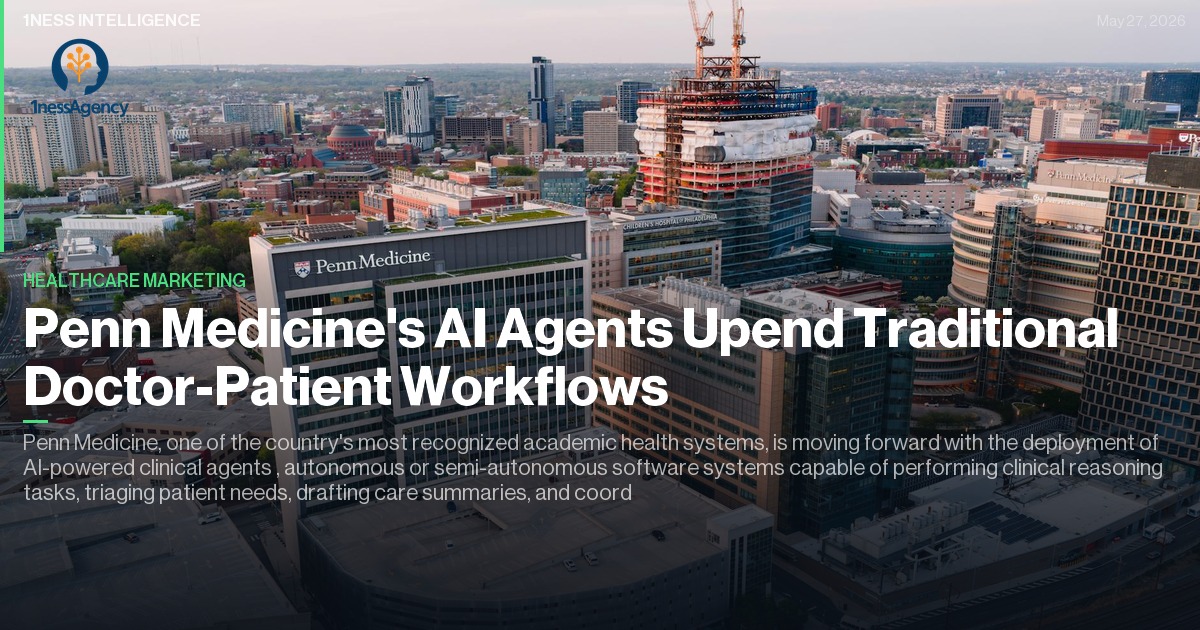
- Penn Medicine will deploy AI clinical agents in 2026, positioning it among the earliest large academic health systems to operationalize this capability at scale.
- AI clinical agents will perform autonomous tasks including clinical reasoning, patient triage, care summary drafting, and care workflow coordination without constant human intervention.
- Penn Medicine's AI deployment represents the most significant operational shift in healthcare since the EHR mandate, creating new brand equity opportunities that most marketing leaders are unprepared to capture.
Penn Medicine, one of the country's most recognized academic health systems, is moving forward with the deployment of AI-powered clinical agents, autonomous or semi-autonomous software systems capable of performing clinical reasoning tasks, triaging patient needs, drafting care summaries, and coordinating care workflows without constant human intervention . The deployment timeline places Penn Medicine among the earliest large academic health systems to operationalize this capability at scale. While the full technical specifications of their implementation have not been publicly disclosed as of this writing, the strategic signal is clear: AI clinical agents are transitioning from pilot programs into production environments, and the health systems that deploy them first will define the patient experience benchmark for the next decade.
The broader market context sharpens the urgency. The global healthcare AI market is projected to exceed $45 billion by 2026, with clinical decision support and autonomous agent technologies representing the fastest-growing category . Health systems that lag in adoption risk not only operational disadvantage but a measurable patient acquisition gap, patients increasingly select providers based on digital experience quality, and AI-driven responsiveness is becoming table stakes in high-competition markets like Philadelphia, where Penn competes directly with Jefferson Health and Main Line Health.
What AI Clinical Agents Actually Do, and Why the Branding Opportunity Is Enormous
AI clinical agents are not chatbots. Positioning them as such is a strategic error that health system marketing leaders must avoid. These systems operate across the care continuum: scheduling optimization, pre-visit intake, real-time clinical documentation, post-discharge follow-up, and chronic disease monitoring. When deployed at the level Penn Medicine is pursuing, they reduce the administrative friction that patients associate with poor healthcare experiences.
That friction is expensive. Research published prior to 2026 consistently showed that administrative burden accounts for a substantial share of patient churn, patients who miss follow-up appointments, fail to re-engage after a poor intake experience, or simply switch providers after one frustrating phone call. AI clinical agents address this at the system level, not the individual encounter level. The marketing implication: Penn Medicine now has the foundation to promise, and deliver, a materially faster, more responsive, more personalized care experience.
This is a brand differentiator with a measurable ROI tail. Health systems that improve patient experience scores (HCAHPS, for instance) by a single percentile point have historically seen meaningful gains in elective procedure volume and specialist referral rates. Penn Medicine's leadership is not deploying AI clinical agents because of a technology mandate. They are doing it because operational excellence and brand reputation compound over time, and the compounding starts now.
The Patient Communication Channel Is the New Battleground
AI clinical agents fundamentally restructure which channel owns the patient relationship. Before this technology, the primary patient communication touchpoints were the call center, the patient portal, and the care team. AI clinical agents add a fourth touchpoint, proactive, always-on, and personalized at scale, that operates between scheduled encounters.
For marketing leaders, this is a permission-based communication channel unlike any that existed before. When a patient interacts with an AI clinical agent post-discharge, receives a medication reminder, or gets a care gap notification, the health system is creating a touchpoint that is simultaneously clinical and relational. That touchpoint builds loyalty without a single marketing dollar attached to it.
Our recommendation: Marketing and IT must co-own the patient experience design of AI clinical agent interactions. The language, tone, cadence, and escalation pathways of AI agents are brand decisions, not just technical configurations. Health systems that let IT alone design these interactions will deploy agents that are clinically functional but brand-neutral at best, brand-damaging at worst. Penn Medicine's marketing leadership should be in the room when agent conversation design is finalized, and at every other health system preparing to follow their lead, the same principle applies.Compliance, Trust, and the FTC's Expanding Scrutiny of AI Health Claims
AI in healthcare operates under an increasingly watchful regulatory environment in 2026. The Federal Trade Commission has signaled continued scrutiny of health technology companies making unsubstantiated performance claims about AI tools . HIPAA's Privacy and Security Rules apply fully to AI clinical agents that access, process, or transmit protected health information, and the Office for Civil Rights has made clear that automated systems are not exempt from breach notification obligations.
For marketing leaders, this creates a narrow but navigable compliance corridor. Health systems can, and should, promote their AI capabilities as competitive differentiators. The risk is overclaiming: promising diagnostic accuracy, care outcome improvements, or response time guarantees that the deployed system cannot consistently deliver. The FTC and state attorneys general have demonstrated willingness to act against health organizations that market AI capabilities in ways that mislead patients about the nature or reliability of AI-generated clinical guidance.
Compliance callout: Any patient-facing marketing materials describing AI clinical agent capabilities should be reviewed by legal counsel familiar with both FTC guidelines and state-level health advertising standards before publication. Claims about AI-assisted care should be specific, verifiable, and scoped to actual system capabilities, not aspirational. HIPAA Business Associate Agreements must be in place with all AI vendors accessing PHI.Actionable Takeaways for Healthcare Marketing Leaders
- Audit your current patient communication map. Identify where AI clinical agents will intersect with existing marketing touchpoints, email campaigns, portal messaging, post-visit surveys. Gaps and overlaps create confusion and erode trust.
- Position early, position accurately. Penn Medicine will generate significant earned media from this deployment. Competitors should prepare category-level messaging that contextualizes their own AI roadmap without overclaiming or waiting until they are perceived as followers.
- Build a patient education content layer. Patients are skeptical of AI in clinical settings. A proactive content strategy, blog posts, video explainers, FAQ pages, that explains what AI clinical agents do and do not do builds informed consent and reduces churn driven by AI anxiety.
- Create a cross-functional AI experience team. Marketing, IT, clinical operations, and compliance must align on every patient-facing AI touchpoint. Name a lead and set a quarterly review cadence.
- Track the right metrics. Patient satisfaction scores tied to AI-assisted encounters, portal engagement rates, no-show reduction rates, and call center deflection rates are the KPIs that connect AI deployment to marketing performance.
The 1ness Take
Penn Medicine is not just deploying software. They are staking a brand position: that the future of academic medicine is proactive, intelligent, and frictionless. Every health system watching this deployment should ask one question: What is our AI story, and do our patients know it?
The health systems that win patient acquisition in the next three years will not win on price or geography. They will win on perceived intelligence, the sense patients have that their provider understands them, anticipates their needs, and responds before they have to ask. AI clinical agents are the operational engine behind that perception. Marketing is what makes patients aware of it.
The mistake most marketing teams will make is waiting for full deployment before building the narrative. By the time Penn Medicine's AI agents are fully operational and the outcomes data exists, the brand story will already be written, by journalists, by patients on social media, and by Penn Medicine's own communications team. Competitors who are not building their own AI narrative now will spend the next two years playing catch-up in a brand category they could have shaped.
Start the content calendar today. Commission the patient FAQs. Schedule the joint meeting with your CIO. The technology window is open. The brand window is shorter.
The Takeaway
1. Schedule a cross-functional meeting this quarter between marketing, IT, and clinical operations to map where AI clinical agents will touch patient communications, and define who owns the brand voice in those interactions.
2. Develop a patient-facing AI transparency page on your website that explains your health system's AI strategy, what AI does and does not do in your care delivery, and how patient data is protected. Publish it before your competitors do.
3. Build competitive intelligence on Penn Medicine's rollout. Monitor their press releases, patient portal updates, and earned media coverage. Their deployment will generate public data about patient response and operational outcomes that every health system can learn from, and position against.
References
- Becker's Hospital Review. "Penn Medicine to Deploy AI Clinical Agents." 2026 beckershospitalreview.com
- Statista / Grand View Research. Healthcare Artificial Intelligence Market Size and Forecast. Market projections as of 2025–2026 vintage grandviewresearch.com
- Federal Trade Commission. "FTC Actions and Policy Statements on Artificial Intelligence and Automated Systems." FTC.gov ftc.gov