The slowdown in National Institutes of Health grant awards accelerating into 2026 is doing more than shrinking research budgets , it is restructuring the competitive landscape for academic medical centers, community hospitals, and specialty practices that built patient acquisition strategies around clinical trial enrollment, research prestige, and physician recruitment pipelines funded by federal dollars. Systems that treat this as a finance problem rather than a marketing problem will lose ground to those that pivot now.
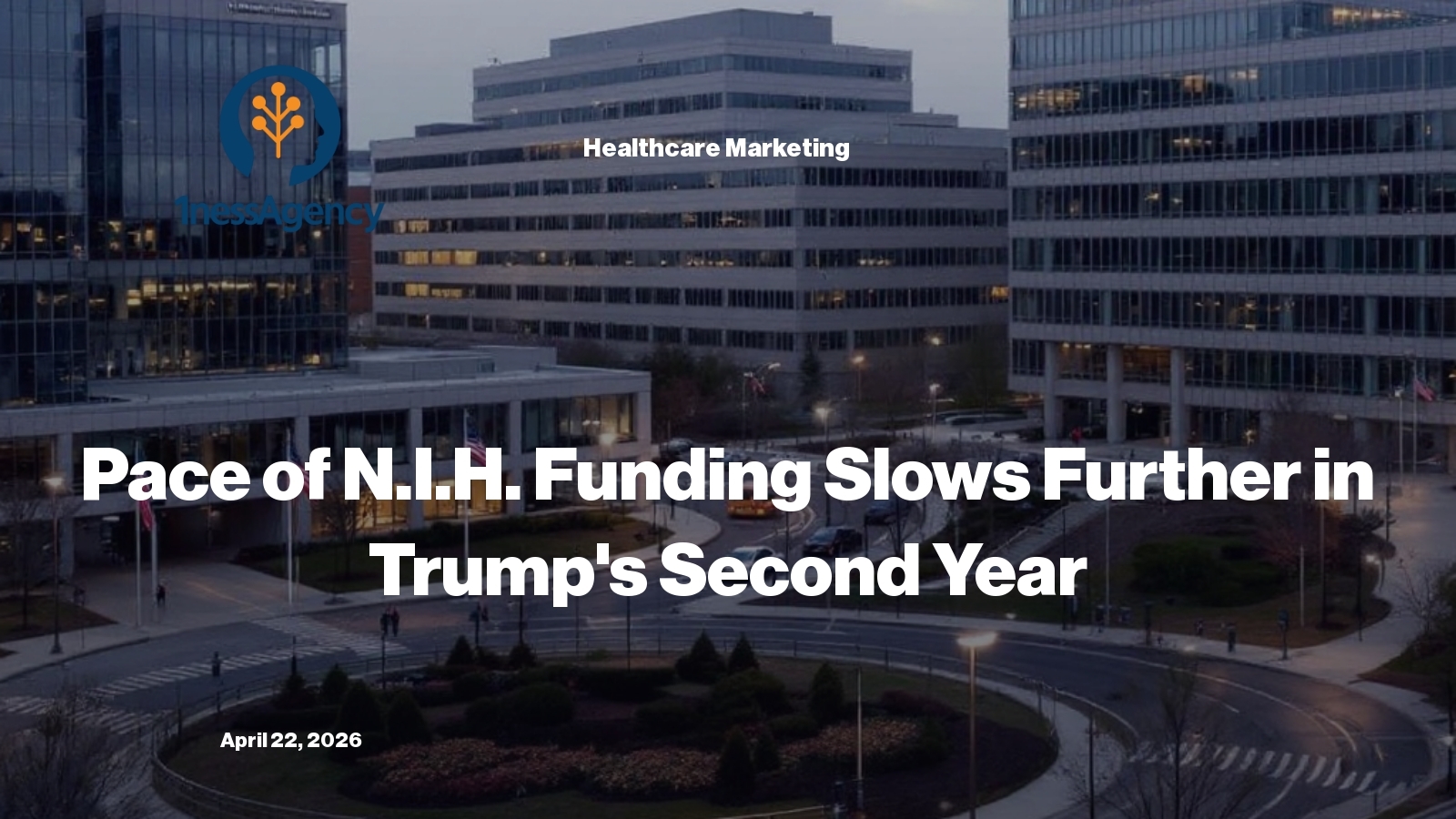
As of April 2026, NIH funding disbursements have slowed further under the second year of the Trump administration, continuing a trajectory of reduced federal research investment that began with budget restructuring in early 2025 [1]. While the exact dollar figures from the April 22 New York Times report are not available in full text, the headline confirms the trend is deepening , not stabilizing. For academic medical centers, where NIH grants historically fund 15–20% of total research operating budgets [2], this contraction is not an abstraction. It cuts recruiting budgets, stalls trial launches, and quietly erodes the brand differentiation that separates a research institution from a community hospital in the minds of referring physicians and prospective patients.
The downstream effect on marketing is direct: fewer active clinical trials means fewer reasons for patients to choose a flagship academic center over a lower-cost regional competitor. The institutions most exposed are those that relied on trial enrollment volume as a de facto patient acquisition channel without building the marketing infrastructure to replace it.
Academic Medical Centers Must Reframe Their Value Proposition , Now
For decades, institutions such as Mayo Clinic, Johns Hopkins Medicine, and major university health systems used NIH-backed research activity as an implicit marketing asset. A robust trial portfolio signals clinical depth, attracts subspecialty physicians, and generates media coverage that no paid campaign can replicate. When that pipeline contracts, the marketing gap is immediate and measurable.
What this means in practice: a center running 40 active NIH-funded trials attracts a different patient referral network than one running 22. Referring physicians track trial availability. Patients with complex diagnoses , cancer, rare neurological conditions, autoimmune disease , frequently select centers based on access to experimental protocols. Shrink the trial portfolio and you shrink the catchment area for high-acuity, high-margin patients.
Our recommendation: Academic medical centers should conduct a trial-enrollment audit against their patient acquisition data within the next 90 days. Map which service lines drew measurable patient volume through trial recruitment, calculate the revenue per enrolled patient across those lines, and identify the gap that reduced NIH activity will create by Q4 2026. This is a marketing attribution exercise as much as a finance exercise , and most systems have not done it.Physician Recruitment Marketing Faces a Structural Disruption
NIH funding does not just pay for science. It pays for the academic infrastructure , research coordinators, lab personnel, protected physician time , that makes subspecialty recruitment possible. When funding slows, institutions lose the ability to offer the research-protected time that top-tier academic physicians demand.
This creates a second-order marketing problem: physician recruitment marketing for academic positions depends heavily on the implied promise of a funded research program. A fellowship-trained oncologist choosing between a well-funded private system and an academic center with a contracting NIH portfolio will increasingly choose the private system , especially as integrated delivery networks such as HCA Healthcare and CommonSpirit Health have expanded their subspecialty compensation packages.
For marketing leaders, this means the physician recruitment messaging that worked in 2022 requires a rebuild. Messaging anchored in "join our NIH-funded research enterprise" needs to shift toward career growth frameworks, clinical volume, and quality-of-life differentiators that hold up regardless of federal funding levels.
Our recommendation: Audit every physician recruitment campaign asset , career pages, recruitment brochures, LinkedIn sponsored content, and search ads , for language that references federal funding, grant infrastructure, or research support packages that can no longer be guaranteed. Replace with concrete, verifiable differentiators: surgical volume rankings, patient outcomes data, technology investments, and geographic practice stability.Community Hospitals and Specialty Practices Have a Window , But It Closes Fast
The institutions hurt most visibly by NIH funding deceleration are academic centers. The institutions with the most to gain , if they act , are the community hospitals and regional health systems that compete with those academic centers for patients and physicians.
When academic brand differentiation weakens, the patient decision calculus changes. A patient in a mid-sized metro who previously drove 90 minutes to a research center for a condition that a regional hospital now treats at equivalent quality will make a different choice if the research center's trial availability has declined and its wait times have not. This is a patient acquisition opportunity , but only for systems that have the marketing infrastructure to communicate clinical capability convincingly.
The window matters because academic centers will adapt. They will shift toward industry-sponsored trials, philanthropy-funded research, and partnership agreements with biotech firms to replace federal revenue. Systems that do not move to capture realigned patient volume in the next 12–18 months will find the competitive gap has closed again.
Our recommendation: Regional and community health systems should launch targeted content and paid search campaigns in Q2–Q3 2026 that directly address the conditions and service lines where their nearest academic competitor has the most NIH exposure. Focus on patient-facing messaging that emphasizes access, proximity, and clinical equivalence , not research prestige.Actionable Takeaways for Healthcare Marketing Leaders
- Run the attribution audit. Identify which patient acquisition channels have implicit dependency on NIH-funded trial enrollment or research reputation. Quantify the revenue at risk.
- Rebuild physician recruitment assets. Replace funding-dependent language with verifiable, durable differentiators before the next recruiting cycle begins.
- Activate competitive paid search. For regional systems, target condition-specific and specialist-specific keywords where academic center visibility is declining.
- Invest in owned media depth. With research news coverage potentially declining for affected institutions, health systems need owned content , outcome stories, physician profiles, patient testimonials , that generates organic search volume independent of press coverage.
- Monitor NIH Reporter. The NIH Research Portfolio Online Reporting Tools (NIH Reporter) database is publicly available and updated regularly [3]. Marketing leaders can track which institutions in their market are losing or gaining funded projects , this is competitive intelligence most marketing teams are not using.
Compliance Callout
If your institution redirects marketing investment toward clinical trial recruitment to replace NIH-funded enrollment with industry-sponsored trial volume, FTC guidelines on advertising clinical trials and FDA regulations on trial recruitment materials apply immediately [4]. Any paid promotion that recruits patients into clinical studies must meet IRB-approved protocol language requirements. State-level consumer protection laws in California, New York, and Texas have additional disclosure requirements for healthcare advertising that references experimental treatment access. Do not let urgency override compliance review.
The 1ness Take
The story underneath the NIH funding headline is not about science funding , it is about brand equity erosion in slow motion. Academic medical centers built marketing strategies on the assumption that federal research investment would remain a reliable differentiator. That assumption is no longer safe.
The institutions that will outperform in 2026 and 2027 are not the ones with the largest research budgets , they are the ones that treat this disruption as a marketing strategy inflection point and move first. That means two things simultaneously: academic centers must rebuild their value propositions around clinical outcomes, patient experience, and technology differentiation that does not depend on Washington's budget cycles; and regional competitors must invest aggressively right now, because the window where academic brand equity is structurally weakened will not stay open long.
The deeper strategic insight is this: healthcare marketing has always over-indexed on institutional prestige and under-invested in demonstrating clinical equivalence. NIH funding volatility is forcing the conversation that market forces alone never did. Build the marketing infrastructure that wins on evidence, access, and experience , and it will outperform prestige-dependent strategies in any funding environment.
The Takeaway
1. Within 30 days: Pull NIH Reporter data on the academic competitors in your primary service area. Identify which service lines have the most funding exposure. This is your competitive opportunity map for the next 18 months.
2. Within 60 days: Audit all physician recruitment and patient-facing content for messaging that depends on federal research funding as a differentiator. Revise before the next campaign cycle.
3. Within 90 days: Launch or expand condition-specific paid search and content campaigns targeting service lines where reduced academic research activity has weakened competitor visibility , before those competitors adapt.
References
- "Pace of N.I.H. Funding Slows Further in Trump's Second Year," The New York Times, April 22, 2026 nytimes.com
- Association of American Medical Colleges (AAMC), AAMC Facts & Figures: Research and Development, historical data series aamc.org
- NIH Research Portfolio Online Reporting Tools (NIH Reporter), National Institutes of Health reporter.nih.gov
- U.S. Food and Drug Administration, Recruiting Study Subjects , Information Sheet: Guidance for Institutional Review Boards and Clinical Investigators fda.gov
This report is for informational purposes only and does not constitute investment advice or an offer to buy or sell any security. Content is based on publicly available sources believed reliable but not guaranteed. Opinions and forward-looking statements are subject to change; past performance is not indicative of future results. 1ness Strategies and its affiliates may hold positions in securities discussed herein. Readers should conduct independent due diligence and consult qualified advisors before making investment decisions.
© 2026 1ness Strategies. All rights reserved.