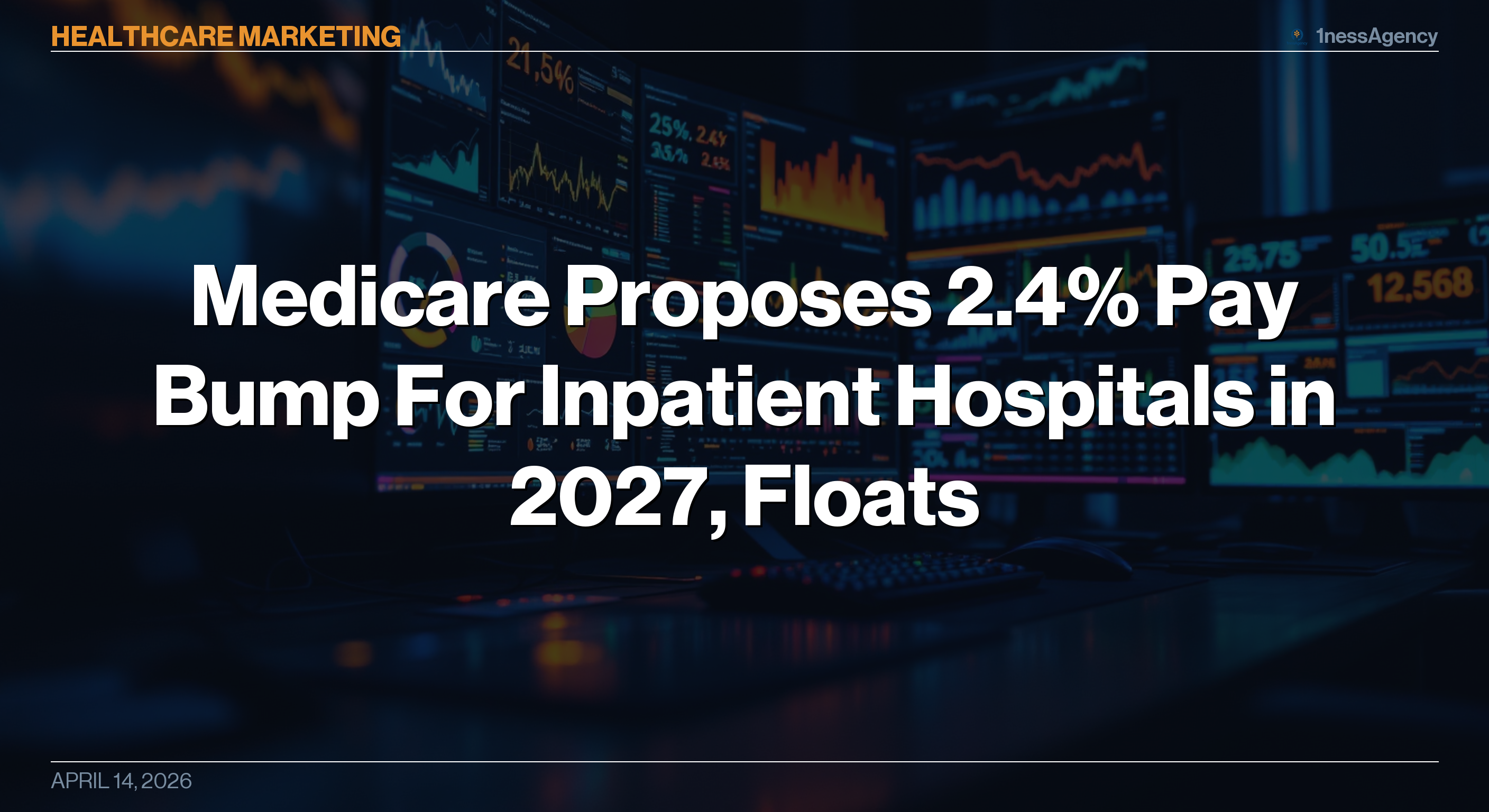
Medicare's proposed 2.4% payment increase for inpatient hospitals in 2027, paired with a potential mandatory payment model, arrives as hospitals face their most challenging patient acquisition environment in a decade [1]. The reimbursement bump, while modest, masks a deeper strategic shift: CMS is moving toward value-based payment structures that will reward hospitals for patient volume efficiency, not just volume itself. For marketing leaders, this means 2026 marks the year to rebuild acquisition strategies around retention, readmission prevention, and demonstrating measurable health outcomes, not just filling beds.
The timing compounds pressure already mounting on hospital systems. As Medicare tightens payment models and floats mandatory participation frameworks, hospitals lose flexibility in how they manage patient flow and reimbursement risk [1]. Meanwhile, regulatory approvals are accelerating in other healthcare sectors: the FDA's approval of Foundayo (orforglipron) in just 50 days under the National Priority Voucher program, the fastest new molecular entity approval since 2002, shows how quickly competitive dynamics can shift when agencies prioritize speed [2]. For hospital marketers, the message is clear: while your reimbursement structures slow down, competitors in pharma, specialty care, and digital health move faster.
The mandatory model proposal carries particular weight. Unlike voluntary alternative payment models that hospitals could decline, mandatory participation removes the exit option. Marketing departments must now prepare for a world where volume alone doesn't guarantee revenue, patient outcomes, readmission rates, and cost efficiency become the metrics that determine reimbursement. This fundamentally changes what "patient acquisition" means.
Hospital executives scanning these headlines should recognize this as a watershed moment regardless of specialty. When Medicare shifts payment incentives, private payers follow within 18 to 24 months. The 2.4% increase won't cover inflation or labor cost growth in most markets, meaning hospitals must generate margin improvement through operational efficiency and smarter patient selection. Marketing's role shifts from "bring in more patients" to "bring in the right patients and keep them engaged through their care journey."
The Reimbursement-Marketing Disconnect That's Costing You Margin
Most hospital marketing departments still operate on a fee-for-service mental model: maximize patient volume, optimize for appointment bookings, measure success by new patient acquisition. Medicare's 2027 proposal demolishes that framework. A 2.4% payment bump barely covers medical inflation, which has consistently run between 3% and 4% annually in recent years. Factor in labor cost increases, nurse wages rose 6% to 8% in competitive markets through 2025, and the math becomes stark: hospitals cannot earn their way to profitability through volume alone [1].
The mandatory model component changes the game entirely. When hospitals cannot opt out of value-based payment structures, every patient becomes a potential margin risk if readmitted or if outcomes fall short of benchmarks. Marketing leaders must now ask: Does our acquisition strategy attract patients we can successfully treat within episode-of-care payment limits? Are we targeting service lines where we demonstrate superior outcomes? Are we avoiding high-readmission populations unless we have proven care coordination protocols?
This requires marketing attribution beyond the first appointment. Hospitals need to track which acquisition channels bring patients who complete care plans, don't readmit within 30 days, and generate positive margins under bundled payments. Most marketing departments can't produce this analysis today because their CRM systems don't integrate with clinical outcomes data. That integration becomes mandatory as Medicare's payment model shifts to mandatory participation.
What Drug Approvals Teach About Speed While Hospitals Face Slower Payments
The FDA's 50-day approval of Foundayo under the National Priority Voucher program offers a telling contrast to hospital reimbursement trends [2]. While pharmaceutical manufacturers can now bring obesity treatments to market in less than two months, 294 days ahead of the standard PDUFA timeline, hospitals face increasingly rigid payment structures with multi-year implementation windows. This speed differential matters for patient acquisition.
Consider the obesity market: Foundayo joins a GLP-1 receptor agonist category that's reshaped weight management marketing in 18 months. Digital health companies, specialty pharmacies, and direct-to-consumer telehealth platforms captured market share while hospital-based weight management programs remained tethered to traditional referral patterns and insurance pre-authorization workflows. The lesson isn't that hospitals should market obesity drugs: it's that regulatory speed advantages accrue to competitors who can move fast on emerging therapeutic categories.
For hospital marketers, the strategic implication is clear: identify service lines where you can demonstrate outcomes faster than competitors, then market that speed as a differentiator. Orthopedic surgery with accelerated rehab protocols. Cardiovascular care with 30-day outcome guarantees. Oncology with coordinated care navigation that reduces time-to-treatment. Medicare's value-based models will reward these outcomes; your marketing should signal them before competitors do.
The drug approval also highlights the importance of national priority designation. The FDA's Commissioner National Priority Voucher program exists because certain therapeutic categories address critical national health needs, obesity, in Foundayo's case, affects over 40% of U.S. adults [2]. Hospitals should identify where their service lines align with national health priorities (maternal health, behavioral health, chronic disease management) and position their marketing accordingly. When your care addresses a recognized national priority, both regulators and payers create faster pathways.
The Platform Shift That Changes Where Healthcare Dollars Flow
Meta's projected dominance over Google in 2026 global ad revenue, $243.46 billion versus Google's $239.54 billion, marks the first time Google has ceded the top position in digital advertising [3]. For healthcare marketers, this shift reflects deeper changes in how patients discover and evaluate care options. Meta's 26.8% share of global ad spend versus Google's 26.4% signals that social platforms now drive healthcare decisions as effectively as search intent [3].
The reversal stems from Meta's automation advantages and superior return-on-ad-spend measurement, precisely what healthcare marketers need as margins compress under Medicare's 2027 payment model [3]. When every patient acquisition must generate measurable ROI within episode-of-care payment bundles, platforms that prove conversion tracking and lifetime value become essential. Google still owns high-intent search ("cardiologist near me"), but Meta owns the awareness and consideration phases where patients form preferences before they search.
Hospital marketing budgets should reflect this platform shift, but most don't. Healthcare organizations still allocate 60% to 70% of digital budgets to search, treating social as supplemental brand building. That allocation made sense when fee-for-service volume was the goal. Under value-based payment models, marketers need platforms that can target specific patient populations (diabetes patients who've had one prior admission), demonstrate engagement throughout the care journey (content consumption, appointment completion), and prove which acquisition sources generate patients with positive health outcomes.
Meta's advantage lies in its ability to build lookalike audiences based on your best existing patients: those with high engagement, low readmission rates, and positive margins. Google's search can't replicate that targeting precision because it captures intent, not behavior patterns. As Medicare's mandatory model forces hospitals to become more selective about patient acquisition, Meta's targeting capabilities become strategically essential.
The Compliance Layer: What Medicare's Mandatory Model Means for Marketing Claims
Medicare's shift toward mandatory payment models in 2027 creates new compliance exposure for hospital marketing departments [1]. When reimbursement depends on demonstrated outcomes rather than volume, marketing claims about care quality, success rates, and patient satisfaction move from brand positioning into regulatory territory. If your hospital markets "best outcomes" for joint replacement but fails to meet Medicare's episode-of-care benchmarks, you face both reimbursement clawbacks and potential FTC scrutiny for deceptive advertising.
Marketing leaders must implement compliance reviews for any outcome-based claims. Before advertising "lowest readmission rates" or "fastest recovery times," verify that your data matches CMS quality reporting requirements and that you can substantiate claims with statistically valid comparisons. The FTC has increased healthcare advertising enforcement in recent years, and mandatory value-based models give regulators a clear benchmark for evaluating whether marketing claims reflect actual performance.
HIPAA implications also intensify. As hospitals build more sophisticated patient segmentation for targeted acquisition (high-value patients who fit your outcome profile), marketing technology must ensure protected health information doesn't flow to advertising platforms. Meta and Google offer healthcare-specific audience targeting, but implementation requires careful PHI safeguards. If your patient list used for lookalike modeling contains diagnosis codes or treatment history, you've created HIPAA exposure.
State regulations add another layer. Several states now restrict healthcare advertising that makes comparative outcome claims unless substantiated by specific statistical methodologies. California, New York, and Massachusetts have issued guidance on healthcare advertising standards. As Medicare mandates value-based participation, state attorneys general will likely increase scrutiny of how hospitals market quality and outcomes.
The 1ness Take
Medicare's 2027 payment proposal requires hospital marketing leaders to rebuild their patient acquisition strategies around three core capabilities most organizations lack today: predictive patient value modeling, outcomes-based attribution, and clinical integration.
First, implement predictive patient value modeling. Your CRM should score prospective patients not just by acquisition cost but by predicted lifetime value under episode-of-care payment models. This requires integrating clinical data (comorbidities, prior utilization, social determinants) with marketing data (channel source, engagement patterns, likelihood to complete care plans). Start with one high-volume service line, orthopedics or cardiology, and build a model that predicts which patients will generate positive margins under bundled payments. Use that model to refine targeting on Meta and Google, focusing acquisition spend on patient profiles that match your highest-performing cohorts. Second, build outcomes-based attribution. Traditional marketing attribution ends at the appointment. Under mandatory value-based models, attribution must extend through treatment completion, 30-day and 90-day outcomes, and readmission rates. Work with your analytics team to create closed-loop reporting that connects acquisition channel to clinical results. Which digital campaigns bring patients with the lowest readmission rates? Which referral sources generate patients who complete post-acute care protocols? This data should drive budget allocation decisions by Q3 2026, before the 2027 payment model takes effect. Third, integrate marketing and clinical operations. Value-based payment success depends on care coordination, ensuring patients follow treatment plans, attend follow-up appointments, and engage with post-discharge support. Marketing's role extends beyond acquisition to activation and retention. Build campaigns that support clinical protocols: pre-surgical education content that reduces complications, post-discharge text messaging that improves medication adherence, care plan reminders that prevent readmissions. These aren't traditional marketing tactics, but they directly impact the outcomes that determine your reimbursement under mandatory models.The hospitals that thrive under Medicare's 2027 structure will be those that recognized in 2026 that patient acquisition and patient outcomes are now the same strategic problem. Marketing departments that continue optimizing for volume while finance struggles with value-based risk are solving yesterday's problem. The organizations that integrate marketing, clinical operations, and outcomes measurement into a unified patient engagement strategy will find the 2.4% payment bump is just the beginning: they'll capture share from competitors still stuck in fee-for-service thinking.
The Takeaway
Start these three initiatives before Q3 2026:1. Audit your marketing attribution infrastructure. Can you track which acquisition channels produce patients with the best clinical outcomes and lowest readmission rates? If not, implement integrated reporting that connects marketing source to claims data and clinical results. Start with one service line, prove the model, then scale.
2. Rebalance digital platform allocation. Test shifting 20% of search budget to Meta for targeted patient acquisition campaigns. Build lookalike audiences from your best existing patients (low readmission, high engagement, positive margins) and measure whether Meta-acquired patients deliver better value than search-acquired patients under bundled payment scenarios.
3. Create an outcomes-based compliance review process. Before Medicare's mandatory model takes effect in 2027, implement legal review for any marketing claims related to quality, outcomes, or patient results. Ensure you can substantiate every comparative claim with CMS-quality data, and verify that your patient targeting doesn't create HIPAA exposure.
The 2.4% payment increase won't save hospitals that rely on volume. The margin opportunity lies in smarter patient selection and better outcomes, which makes marketing's targeting and engagement capabilities more strategically important than ever.
References
- Healthcare Dive. "Medicare proposes 2.4% pay bump for inpatient hospitals in 2027, floats mandatory model." 2026 healthcaredive.com
- U.S. Food and Drug Administration. "FDA Approves First New Molecular Entity Under National Priority Voucher Program." Press Release, April 1, 2026 fda.gov
- Ostwal, Trishla. "Meta is Quietly Becoming a Bigger Ad Business Than Google." Adweek, 2026 adweek.com