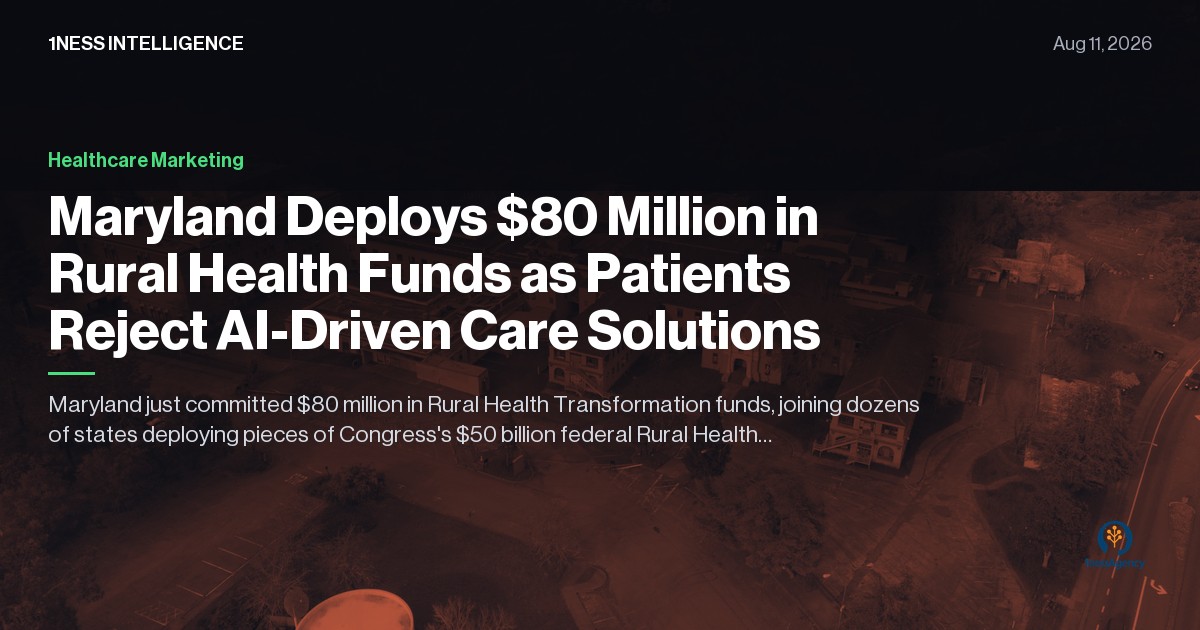
- Maryland deployed $80 million in Rural Health Transformation funds from Congress's $50 billion five-year federal Rural Health Transformation Program created last summer.
- Health Secretary Robert F. Kennedy Jr. and CMS Administrator Mehmet Oz promoted AI nurses and AI-based avatars for rural mental health services, but rural patients widely reject these AI-driven care solutions.
- States must demonstrate measurable patient access improvements and financial sustainability metrics within the five-year program window, with similar programs typically directing 40-60% toward infrastructure, 20-30% toward workforce recruitment, and 10-20% toward technology implementation.
Maryland just committed $80 million in Rural Health Transformation funds, joining dozens of states deploying pieces of Congress's $50 billion federal Rural Health Transformation Program created last summer . The dollars create immediate opportunities for healthcare marketers who understand rural patient acquisition, but the money comes with a catch: federal health officials are pushing AI-driven solutions that rural patients don't trust. Health Secretary Robert F. Kennedy Jr. told senators that AI nurses can deliver "concierge care" to rural patients, while CMS Administrator Mehmet Oz claimed "the best way to help some of these communities is going to be AI-based avatars" for mental health services . Rural Americans aren't buying it.
Maryland's award represents one of the largest single-state allocations in the first year of the program. The funding aims to stabilize rural healthcare infrastructure as hospitals face closure threats and physician shortages worsen. State health leaders are directing portions of their federal allocations toward technology expansion, including AI tools for administrative automation and patient monitoring . The timeline matters: states must demonstrate measurable patient access improvements and financial sustainability metrics within the five-year program window, creating pressure to deploy funds quickly.
"I get artificial intelligence for certain things, but for personal healthcare — no," said Tara Haffner, a Hot Springs, South Dakota resident expressing concerns shared across rural communities. Haffner cited worries about AI mistakes and the desire to keep healthcare between patients and doctors . Her perspective reflects a trust gap that no amount of federal funding can bridge without deliberate community engagement strategies.
For healthcare marketers, this creates a paradox: transformational funding is available, but the solutions federal officials are promoting clash with patient preferences. The disconnect reveals a strategic opening for health systems that can translate technology investments into human-centered marketing narratives. The organizations that win rural market share over the next five years won't be those with the most sophisticated AI—they'll be those that communicate how technology preserves rather than replaces the physician-patient relationship.
Federal Dollars Meet Local Resistance
The Rural Health Transformation Program emerged as a congressional sweetener in President Trump's One Big Beautiful Bill Act, passed last summer . The $50 billion appropriation over five years represents the largest federal rural health investment in decades, dwarfing previous initiatives that focused narrowly on telehealth reimbursement or loan forgiveness programs.
Maryland's $80 million allocation puts the state in the top tier of recipients. While the specific breakdown of Maryland's fund distribution wasn't available in public reporting, similar state programs have directed 40-60% toward infrastructure, 20-30% toward workforce recruitment, and 10-20% toward technology implementation. States must submit outcome reports tracking patient access metrics, cost per encounter, and financial sustainability indicators.
The federal push for AI adoption lacks supporting evidence. Several reports contend there's little proof that AI can improve access to care or patient health outcomes in rural settings . This evidence gap creates risk for marketers who make specific outcome promises based on AI implementation. Claims about improved access or care quality tied to AI tools require careful substantiation to avoid FTC scrutiny around deceptive advertising.
Phillip Mues, who oversees technology at Cherry County Hospital and Clinic in rural Valentine, Nebraska, offered a more measured view: AI is helping clinicians save time and reduce burnout, allowing more focus on patient care. "I think it will help reduce burden on actual staffing. It won't replace people, but I think it will help in rural communities," Mues said. But he added a critical qualifier: AI can't fix every challenge, and rural hospitals at risk of closing likely can't use AI to save enough money to prevent closure .
The Trust Gap That Technology Can't Close
Rural healthcare marketing has always required different tactics than urban patient acquisition, but the AI skepticism documented in Hot Springs reveals a deeper challenge. Rural patients value continuity, personal relationships with providers, and local accountability. Technology that appears to remove the human element triggers resistance regardless of its technical capabilities.
This matters for Maryland's funded organizations and every health system competing for rural patients. Marketing messages that emphasize AI capabilities, virtual care platforms, or automated systems may actively repel the patients they're designed to attract. The data from Hot Springs shows patients want reassurance that technology supports rather than replaces their existing care relationships .
The timing coincides with new treatment approvals that demonstrate how precision medicine is advancing. The FDA approved Orzeyful (oveporexton) in August 2026 as the first drug to treat the full range of narcolepsy type 1 symptoms by directly targeting the loss of orexin signaling that causes the disease . While narcolepsy affects only an estimated 1 in 2,000 Americans, the approval illustrates how medicine is moving toward treating underlying biological causes rather than masking symptoms. This precision-medicine trend creates a counterpoint to AI skepticism: patients may resist automated diagnosis but embrace treatments that address root causes rather than symptoms.
Money Without Message Wastes Opportunity
The $80 million Maryland allocation creates immediate tactical opportunities that most rural health systems will miss because they lack strategic marketing frameworks:
Capital Improvement Storytelling: Rural hospitals receiving infrastructure funds typically announce expansions with facility-focused press releases. The missed opportunity: framing capital improvements as commitment to community permanence. Patients in markets with hospital closure threats make care decisions based on institutional survival prospects. Marketing that connects infrastructure investment to long-term presence addresses the underlying patient anxiety. Workforce Recruitment as Market Differentiator: Federal rural health funds increasingly flow toward physician and nursing recruitment incentives. Health systems that announce new provider hires without connecting them to patient access improvements waste marketing assets. The strategic approach: quantify capacity expansion in patient-relevant terms—appointment availability, wait time reduction, new service lines—rather than simply announcing new names. Technology Implementation With Human Translation: The AI skepticism documented in South Dakota creates a blueprint for technology marketing in rural markets. Successful campaigns will show providers using technology to spend more time with patients, not less. Demonstrate how ambient documentation tools allow physicians to maintain eye contact during appointments. Show how remote monitoring catches problems earlier, preventing emergency situations. Frame every technology investment through the lens of enhanced human connection.The outcomes measurement requirements embedded in the Rural Health Transformation Program create a secondary opportunity: health systems that publicly share patient access improvements and cost data will differentiate themselves in markets where competitors stay silent. Transparency around funded program outcomes builds trust in communities skeptical of government-mandated solutions.
Compliance Risks in Rural Health Marketing
Marketing campaigns built around federal funding require careful regulatory navigation:
Grant Attribution Requirements: Federal funding typically carries publicity and acknowledgment requirements. Marketing materials that reference program-funded improvements must include appropriate attributions to avoid audit issues. State health departments usually provide specific language and logo requirements. Outcome Claims and Substantiation: The FTC's Health Breach Notification Rule and longstanding advertising substantiation requirements apply equally in rural markets. Claims that AI tools improve diagnostic accuracy, reduce wait times, or enhance care quality require documented evidence. The acknowledgment that "there's little evidence AI can improve access to care and patient health in rural areas" creates risk for marketers making specific AI-related outcome promises . HIPAA Considerations for AI Implementation: Marketing that describes AI diagnostic tools or patient monitoring systems must avoid disclosing protected health information. Case studies and patient testimonials require appropriate authorizations. Rural markets' smaller populations create higher re-identification risk when sharing even de-identified patient stories.The 1ness Take
The Maryland allocation and broader Rural Health Transformation Program funding represent the rare convergence of available capital and urgent market need, but healthcare marketers are approaching the opportunity backward. The instinct is to tout technology capabilities and modernization. The strategic approach is the opposite: use federal funding to double down on relationship-driven marketing that positions technology as a tool for preserving what rural patients value most.
Here's the framework that will separate rural health marketing winners from losers over the next five years:
Lead with permanence, not innovation. Rural patients' primary anxiety is institutional survival. Every marketing message should reinforce long-term commitment to the community. Federal funding provides proof: "This $4.2 million investment in our emergency department ensures we're here for the next generation" resonates more powerfully than facility specs. Make providers, not platforms, the hero. AI tools and telehealth platforms are supporting characters, never the protagonist. Marketing content should show named physicians and nurses using technology to deliver better care, with technology visible but secondary. The Hot Springs interviews reveal patients want to know technology serves their doctor, not replaces them . Quantify access in patient time, not system capacity. Saying "we hired three new physicians" means nothing to patients. Saying "average appointment wait time dropped from 23 days to 8 days" gives patients decision-making information. Federal outcome measurement requirements will force this data discipline anyway; marketers who lead with access metrics will own the narrative. Build community advisory visibility into technology rollout. The skepticism toward government-pushed AI solutions creates an opportunity for health systems that demonstrate local control. Form visible community advisory boards that evaluate technology implementations. Market their involvement: "Before implementing any new patient monitoring system, we asked 40 local patients what mattered most." This approach transforms potential resistance into engagement.The organizations that will dominate rural market share by 2030 understand that federal funding creates permission to invest in relationship infrastructure, not just technology infrastructure. That means community health workers who knock on doors, mobile units that show up at county fairs, and physicians who coach Little League. Technology enables this presence; marketing must show how.
The Takeaway
Maryland's $80 million commitment and similar state allocations create a 24-month window for rural health systems to establish market position before competitors deploy their funded improvements. Three immediate actions for healthcare marketing leaders:
Audit your current technology messaging against rural patient skepticism. Review your website, paid search campaigns, and patient communications for language that emphasizes automation, AI capabilities, or virtual replacement of in-person care. Reframe every instance to show technology supporting rather than replacing human connection. The Hot Springs data proves this skepticism is real and widespread . Build a content calendar around funded improvement milestones. If your organization received Rural Health Transformation Program funds or state allocations, map every project milestone to a patient-facing communication opportunity. Groundbreakings, equipment installations, provider hires, and service expansions each justify community outreach. Organizations that stay visible throughout multi-year improvement projects build momentum; those that wait for ribbon cuttings waste relationship-building opportunities. Develop access metrics you can track and market. Outcome measurement requirements mean you'll track patient access improvements anyway. Get ahead by identifying the 3-5 metrics that matter most to patients in your market—appointment wait times, emergency department boarding times, specialist availability, after-hours access—and establish baseline measurements now. Marketing these improvements as they occur creates a narrative of continuous advancement that competitors can't match without similar data discipline.The rural health opportunity is real, funded, and time-limited. The marketing advantage goes to organizations that translate federal dollars into community trust rather than technology hype.
References
- Zionts, A., & Tahir, D. (2026, August 11). Patients Wary of Governments, Companies Pushing AI as a Rural Healthcare Solution. KFF Health News kffhealthnews.org
- U.S. Food and Drug Administration. (2026, August 5). FDA Approves First Drug to Treat the Full Range of Narcolepsy Type 1 Symptoms [Press release] fda.gov
This report is for informational purposes only and does not constitute investment advice or an offer to buy or sell any security. Content is based on publicly available sources believed reliable but not guaranteed. Opinions and forward-looking statements are subject to change; past performance is not indicative of future results. 1ness Strategies and its affiliates may hold positions in securities discussed herein. Readers should conduct independent due diligence and consult qualified advisors before making investment decisions.
© 2026 1ness Strategies. All rights reserved.