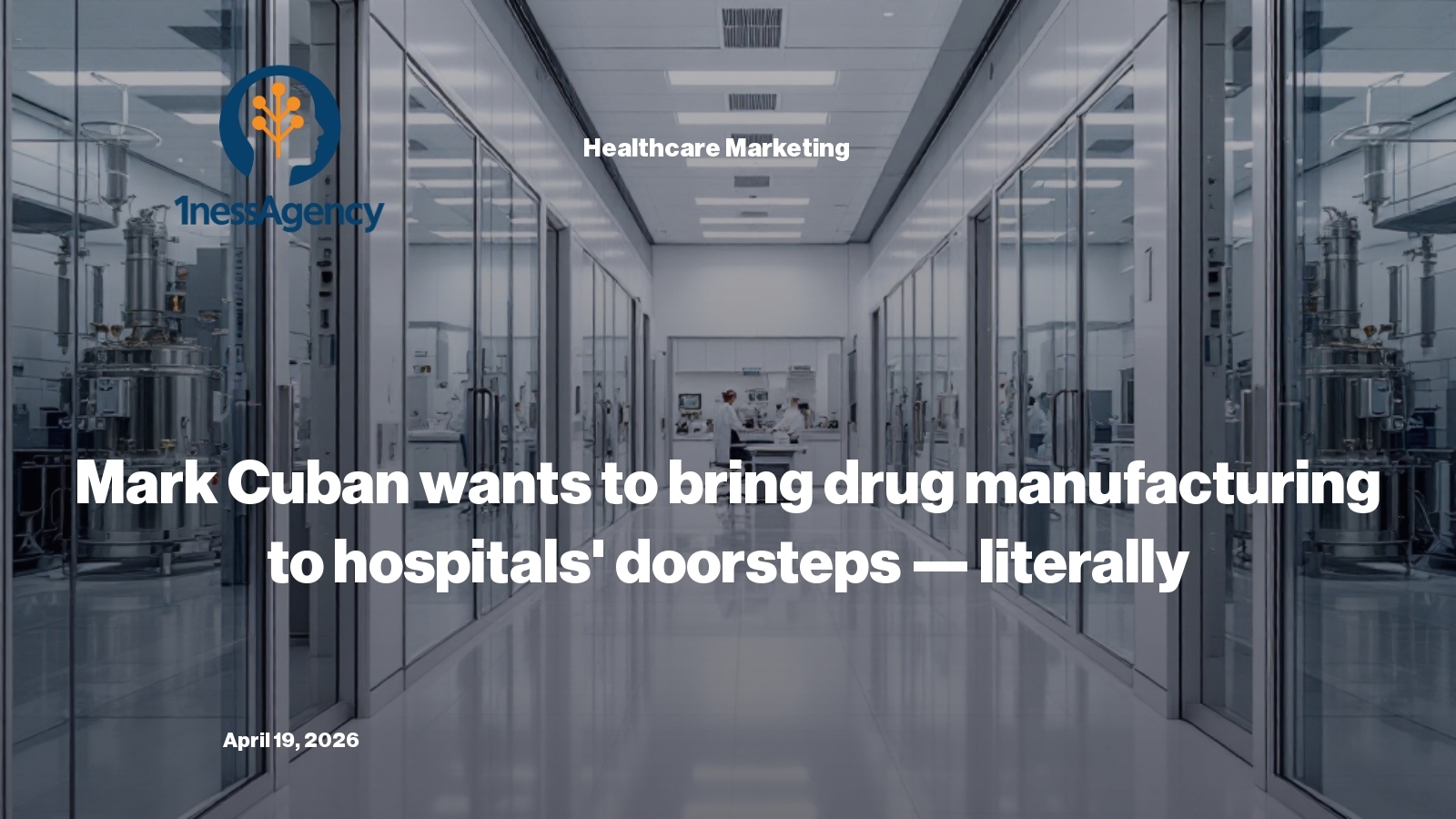
Mark Cuban's push to place drug manufacturing facilities directly adjacent to hospitals represents the most significant threat to traditional pharmaceutical marketing relationships since the 340B pricing debate erupted. When the intermediary between manufacturer and patient collapses to zero distance, every assumption about drug awareness campaigns, physician detailing, and patient acquisition funnels breaks.
Cuban's Cost Plus Drug Company has built a $6 billion valuation on transparent pricing and direct-to-consumer distribution. Moving production to hospital doorsteps removes the final barrier between manufacturing economics and patient access. For hospital marketers, this creates an unprecedented opportunity to own the pharma narrative from molecule to discharge. For pharmaceutical marketers, this is an extinction-level event for legacy channel strategies.
The model Cuban proposes inverts 70 years of pharmaceutical distribution architecture. Traditional drug marketing relies on information asymmetry,patients don't know manufacturing costs, hospitals negotiate in the dark, and pharmacy benefit managers extract margin from opacity. Place the factory next to the facility, and every stakeholder sees the actual cost of goods. Marketing messages built on "access" and "innovation" face immediate price comparison.
This shift arrives as hospitals face a 47% increase in drug spending over the past five years, according to industry data, while simultaneously competing on patient experience and cost transparency. The health system that can truthfully advertise "we manufacture the drugs we prescribe" gains a competitive moat that traditional service line marketing cannot match.
The Distribution Model That Makes Traditional Pharma Marketing Obsolete
Cuban's hospital-adjacent manufacturing concept builds on the success his company achieved in mail-order: radical price transparency paired with supply chain compression. Cost Plus Drug Company already sells medications at manufacturer cost plus 15%, a $3 pharmacy fee, and a $5 shipping charge. Bringing production to hospital campuses eliminates even the shipping cost and delivery delay.
For healthcare marketers, this creates two distinct scenarios. Hospital systems that partner with Cuban gain a marketing asset worth millions in patient acquisition: demonstrable cost savings on the exact medications patients already take. A cardiac patient paying $120 monthly for generic atorvastatin through their insurance can receive the same medication for $4 from a hospital with on-site manufacturing. That $1,392 annual savings becomes the most powerful patient acquisition message in that market.
Pharmaceutical companies face the opposite calculus. Traditional marketing budgets allocate 60-70% to physician detailing, samples, and relationship management with prescribers. When a hospital manufactures generics on-site, the prescriber's default shifts from "which brand?" to "what's made here?" Detailing budgets become donations to competitors.
The regulatory environment enables this shift. The FDA's Hospital Compounding Under Section 503A allows facilities to compound medications without pre-approval if they meet specific criteria. While Cuban's model likely requires more formal drug manufacturing approval, the regulatory pathway exists. State boards of pharmacy in Texas, Florida, and Tennessee have already begun modernizing facility requirements for on-site pharmaceutical production.
What Health Systems Gain Beyond Drug Margins
The marketing implications extend far beyond medication pricing. A hospital system with on-site pharmaceutical production gains four distinct competitive advantages that traditional service line marketing cannot replicate.
Supply chain immunity becomes a patient safety message. During the COVID-19 pandemic, drug shortages forced hospitals to delay procedures and ration critical medications. A facility that manufactures essential medications on-site can guarantee availability. For surgical programs and oncology centers, "we never run out of the drugs that save your life" is a safety proposition that drives both patient preference and physician recruitment. Price transparency turns from regulatory burden to marketing weapon. Hospital price transparency rules have forced facilities to publish negotiated rates, creating comparison shopping pressure. When the hospital manufactures the drug, the published price reflects actual production cost rather than opaque PBM negotiations. Facilities can advertise "these are our actual costs" with credibility. Physician recruitment accelerates when prescribers can focus on clinical decisions rather than formulary politics. Academic medical centers spend thousands of hours annually on pharmacy and therapeutics committee meetings debating which statin or PPI makes the formulary. Manufacturing common generics on-site eliminates those debates. Physicians gain prescribing freedom; the hospital retains the margin. Clinical trial integration becomes seamless. Research hospitals conducting Phase II or III trials often struggle with investigational drug supply and cost allocation. On-site manufacturing capability allows facilities to produce trial medications, reducing costs and accelerating enrollment. This matters for hospitals building research reputation as a service line differentiator.The capital requirement remains uncertain without full details of Cuban's model, but existing hospital compounding facilities operate on $2-5 million infrastructure investments. For a 300-bed hospital spending $40 million annually on pharmaceuticals, manufacturing even 20% of volume on-site generates $6-8 million in annual savings based on Cost Plus Drug pricing models. The marketing ROI comes from converting those savings into patient acquisition messages.
The Pharmaceutical Marketing Response: Adapt or Irrelevance
Pharmaceutical companies watching hospitals become their own manufacturers face strategic choices that will define the next decade of drug marketing. Brand-name products with patent protection retain their moat, but the 90% of prescriptions filled with generics become contested territory.
Specialty medication marketing intensifies. Drugs that require complex manufacturing, cold chain logistics, or specialized administration remain in pharmaceutical company control. Oncology biologics, gene therapies, and rare disease treatments cannot be manufactured hospital-adjacent with current technology. Marketing budgets will shift toward these high-complexity, high-margin products where physician relationships and patient support programs still drive prescribing. Physician detailing pivots from product to partnership. When the hospital makes the drug, pharmaceutical reps cannot sell on price, availability, or formulary position. The remaining value lies in clinical education, outcomes data, and practice management support. Expect detailing teams to shrink while clinical liaison teams expand. Direct-to-consumer becomes higher stakes. If a patient arrives at the hospital requesting a brand-name medication they saw advertised, the hospital faces a choice: prescribe the branded product and lose margin, or educate the patient about the on-site generic equivalent. Pharma companies will increase DTC spending to create demand that hospitals cannot ignore. Hospital partnerships replace hospital sales. Smart pharmaceutical companies will offer hospitals contract manufacturing partnerships rather than competing with them. A company with excess capacity could produce generics for hospital partners under white-label agreements, retaining the manufacturing margin while ceding the distribution margin.The Compliance Landscape: Tighter Than It Appears
Hospital-adjacent drug manufacturing introduces regulatory complexity that marketing teams must navigate before launching cost-savings campaigns. State boards of pharmacy regulate manufacturing facilities with varying stringency. The FDA distinguishes between hospital compounding under Section 503A and full pharmaceutical manufacturing under 21 CFR Part 211. Marketing claims about "our on-site facility" require precision about what the facility actually produces and under which regulatory framework.
Anti-kickback statute implications emerge when hospitals manufacture drugs they also prescribe. While the facility captures the manufacturing margin rather than paying it to an outside supplier, OIG guidance requires that cost savings flow to patients or payers rather than creating physician incentive arrangements. Marketing messages must demonstrate that savings reduce patient out-of-pocket costs or lower payer rates, not that they fund physician bonuses.
State pharmacy benefit manager regulations in 27 states now govern how drugs can be priced and promoted. Arkansas, Louisiana, and Ohio require PBMs to disclose manufacturing costs for medications. Hospital marketing of on-site manufacturing costs must align with these disclosure requirements to avoid FTC scrutiny over deceptive pricing claims.
HIPAA constraints apply when marketing uses patient savings stories. A hospital that wants to advertise "our cardiac patients save an average of $1,200 annually" must aggregate data in ways that prevent patient identification and obtain appropriate authorizations if using individual testimonials.
The 1ness Take
Healthcare marketers should view Cuban's hospital-adjacent manufacturing model as a template for vertical integration marketing, not merely as a pharmaceutical story. The strategic principle,bring production to the point of care and market the cost transparency,applies across healthcare service lines.
Immediate action for hospital systems: Request proposals from pharmaceutical manufacturers and compounding firms for on-site generic production feasibility studies. The marketing advantage belongs to the first system in each market that can credibly advertise on-site manufacturing. Even if full implementation takes 24-36 months, announcing a partnership with Cost Plus Drug or a contract manufacturer creates immediate competitive positioning. Price the feasibility study at $50,000-100,000 and measure it against patient acquisition campaigns that deliver far less tangible value. Reframe marketing messaging around supply chain ownership. Health systems have spent a decade marketing "patient experience" with limited differentiation. Patients cannot distinguish one system's patient portal from another's. They can understand "we make the drugs we prescribe." Begin auditing which medications your facility could produce on-site based on volume, complexity, and margin. Build marketing campaigns around the top 10 medications by patient volume. A hospital system that manufactures metformin, atorvastatin, lisinopril, amlodipine, and metoprolol on-site covers 40% of maintenance medications for the typical Medicare population. For pharmaceutical marketers, abandon the generic battleground. Reallocate brand budgets away from generic product education toward specialty medication launch excellence and patient support program innovation. The hospital that manufactures generic atorvastatin will never switch to your branded competitor. Focus marketing investment on products where manufacturing complexity creates durable competitive advantage. Partner with hospitals on outcomes tracking and population health rather than competing on cost. Integrate financial navigation into clinical marketing. The cost-savings message only resonates if patients understand their out-of-pocket difference. Hospital marketers must build financial navigation into every patient acquisition touchpoint. When advertising cardiac services, include medication cost calculators that show annual savings. Train call center staff to discuss medication costs alongside appointment scheduling. Build CRM workflows that identify patients on high-cost medications available through on-site manufacturing and proactively offer switches. Measure new KPIs. Traditional hospital marketing tracks service line volume, market share, and patient satisfaction. Add medication cost savings per patient, percentage of prescriptions filled through on-site production, and patient retention rates for chronic disease management. These metrics demonstrate whether vertical integration creates marketing advantage or merely shifts costs.The hospital that figures out vertical integration marketing first gains a 24-month competitive advantage while others catch up with their own manufacturing partnerships. That window is worth tens of millions in patient acquisition value.
The Takeaway
Mark Cuban's hospital-adjacent drug manufacturing concept transforms pharmaceutical cost from a financial problem into a marketing asset. Healthcare marketing leaders should take three immediate actions:
Audit your pharmaceutical spend for the 20 highest-volume generic medications your facility prescribes. Calculate the potential annual savings if those drugs were manufactured on-site using Cost Plus Drug pricing as a baseline. Present that savings figure to executive leadership as a patient acquisition investment rather than merely a cost reduction. Develop proactive pharmaceutical marketing campaigns before your competitors. Identify patient populations on maintenance medications with high out-of-pocket costs,cardiac patients, diabetes patients, behavioral health patients. Build targeted campaigns showing cost comparisons between retail pharmacy prices and potential on-site manufacturing prices. Even without on-site manufacturing today, this positions your facility as a cost transparency leader. Revise service line marketing budgets to prioritize supply chain differentiation over generic experience claims. A $500,000 heart center marketing campaign advertising "compassionate care" generates the same response as every competitor's campaign. Redirect that budget toward vertical integration messaging,including pharmaceutical manufacturing, diagnostic lab ownership, imaging center partnerships,that creates genuine competitive moats.Cuban's model succeeds because it follows the money and tells patients what they actually care about: what they pay. Healthcare marketers who adopt that same clarity will dominate the next decade of patient acquisition.
References
- Cost Plus Drug Company public pricing and business model information, 2024-2026
- FDA Hospital and Institution Compounding Under Section 503A guidance, current edition
- State pharmacy benefit manager regulation summaries, National Conference of State Legislatures, 2026