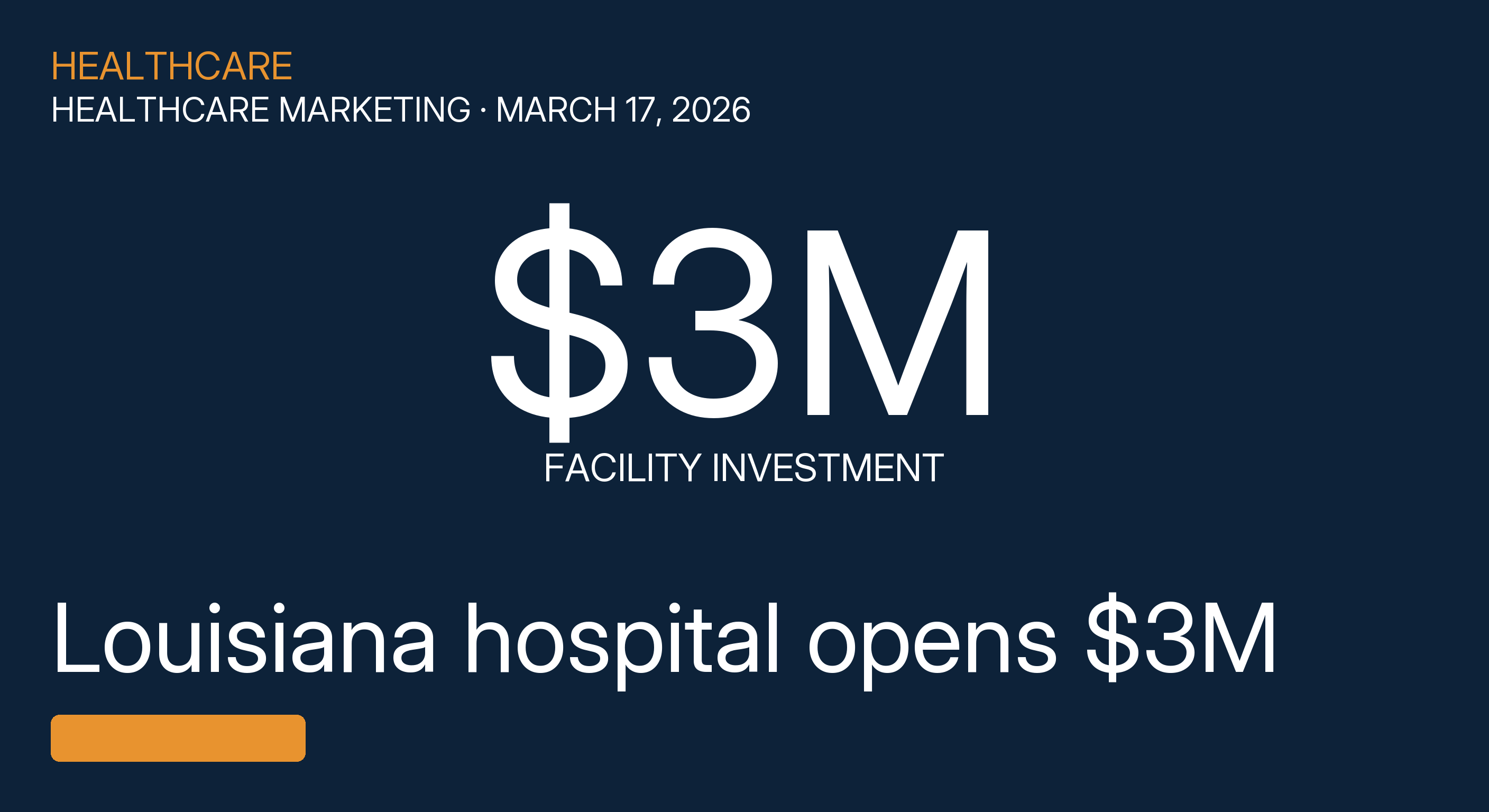
A Louisiana hospital just opened a $3 million interventional radiology suite, and if your marketing team learned about it from a press release after the ribbon-cutting, you've already lost six months of patient acquisition opportunity. Capital investments in specialty service lines aren't just facility upgrades: they're market repositioning plays that demand integrated marketing from day one of planning. The hospitals winning the patient volume game in 2025 aren't treating new service lines as "announce and hope" initiatives. They're building marketing strategy into capital allocation decisions, creating demand before the first procedure is ever scheduled.
The Hidden Marketing Cost of Clinical Expansion
Here's what most healthcare executives miss: a $3 million interventional radiology suite requires an additional $300,000-$500,000 in marketing investment over 18 months to achieve utilization targets. That's not excess spending: it's the cost of market education, physician liaison outreach, patient awareness, and referral network development that actually fills the schedule.
Interventional radiology sits in a particularly challenging marketing position. These minimally invasive procedures, treating everything from uterine fibroids to peripheral artery disease to cancer, offer genuine clinical advantages over traditional surgery. But patient awareness remains remarkably low. Most potential patients don't know interventional radiology exists as a treatment option, and many referring physicians default to surgical referrals out of habit rather than clinical necessity.
The math is straightforward: if your new IR suite sits at 40% utilization in year one because you allocated zero marketing budget, you're not saving money. You're losing $1.5-2 million in contribution margin while still carrying the full fixed cost of the facility, equipment, and staffing. The ROI calculation for specialty service line marketing isn't whether you can afford it: it's whether you can afford not to do it.
The 90-Day Pre-Launch Window No One Uses
The most effective healthcare service line launches begin marketing 90 days before the first patient appointment is available. This pre-launch period isn't about announcing construction timelines. It's about three specific marketing objectives:
Physician education and referral pathway development. Interventional radiologists depend entirely on referrals from primary care, vascular surgery, oncology, and OB/GYN. Your physician liaison team should be conducting lunch-and-learns, presenting at medical staff meetings, and scheduling one-on-one consultations with high-volume referrers. The message isn't "we're opening a new suite": it's "we're expanding treatment options for your patients with conditions X, Y, and Z, with faster recovery times and fewer complications." Patient awareness campaigns targeting specific conditions. General "now offering interventional radiology" campaigns fail because patients don't search for interventional radiology: they search for solutions to their symptoms. Heavy menstrual bleeding. Leg pain when walking. Enlarged prostate symptoms. Your paid search, content marketing, and patient education materials should target condition-specific searches and position IR as a treatment alternative, not a facility announcement. Referral network expansion beyond your traditional base. New specialty capabilities allow you to compete for referral relationships you previously couldn't serve. If you're adding IR capabilities, you can now approach vascular surgeons, interventional cardiologists, and oncologists with a legitimate value proposition about collaborative care and patient access.Building the Service Line Marketing Stack
Effective specialty service line marketing requires a different approach than general hospital brand advertising. You're not building awareness of your organization: you're creating demand for a specific clinical solution most people don't know exists.
The foundational elements:
Condition-specific landing pages with clear clinical information. Each page should explain the condition, traditional treatment options, how interventional radiology differs, what the procedure involves, recovery expectations, and a direct scheduling path. These pages need to rank for condition-specific searches ("treatment for uterine fibroids," "varicose vein treatment options") not procedure names ("interventional radiology"). Physician-specific content and referral tools. Create a dedicated physician portal with clinical protocols, referral criteria, contact information for direct consultation, and case studies demonstrating outcomes. Make referring to your IR suite easier than referring anywhere else. Paid search campaigns with conversion-optimized budget allocation. You should be bidding on condition-specific, high-intent keywords with landing pages designed for appointment conversion, not general awareness. Expect cost-per-acquisition in the $150-$400 range for specialty procedures, depending on market competition and payer mix. Patient testimonial video content. IR procedures lend themselves particularly well to patient stories because the recovery advantage over traditional surgery is dramatic. A patient walking normally two days after peripheral artery disease treatment is more persuasive than any clinical messaging you can create.The Takeaway: Marketing as a Capital Planning Function
If your organization is planning specialty service line expansion, interventional radiology, orthopedic surgery centers, cardiac catheterization labs, cancer centers, your CMO should be in the initial planning meetings, not informed after the business case is approved.
Three specific actions for healthcare marketing leaders:
Request a seat in capital planning discussions. Make the case that marketing strategy affects utilization assumptions, which directly impact ROI calculations. Your input on market demand, competitive positioning, and patient acquisition costs should inform the go/no-go decision, not scramble to support it afterward. Build a service line marketing playbook with defined budget parameters. Create a standardized framework: specialty service lines receive 15-20% of first-year projected revenue as marketing investment, allocated across pre-launch physician outreach, patient awareness campaigns, and ongoing demand generation. When this becomes standard practice rather than negotiated case-by-case, you avoid the "announce and hope" trap. Measure what matters: procedures scheduled, not impressions delivered. Shift your reporting from marketing activity metrics to clinical utilization metrics. Track referral sources, patient acquisition costs by condition, and time-to-full-utilization. When you can demonstrate that marketing investment directly correlates with procedure volume and contribution margin, the budget conversation changes permanently.Capital investments in specialty capabilities represent your organization's strategic vision for market position and service differentiation. Marketing shouldn't be an afterthought: it should be the plan for turning clinical capability into competitive advantage.
References
- American College of Radiology. (2024). Interventional Radiology Service Line Development Guidelines.
- Advisory Board. (2023). Service Line Marketing: Budget Benchmarks and ROI Analysis for Hospital Executives.
- Society of Interventional Radiology. (2024). Patient Awareness and Physician Referral Patterns in Interventional Radiology.
This report is for informational purposes only and does not constitute investment advice or an offer to buy or sell any security. Content is based on publicly available sources believed reliable but not guaranteed. Opinions and forward-looking statements are subject to change; past performance is not indicative of future results. 1ness Strategies and its affiliates may hold positions in securities discussed herein. Readers should conduct independent due diligence and consult qualified advisors before making investment decisions.
© 2026 1ness Strategies. All rights reserved.