- Eli Lilly filed suit against six companies for selling unauthorized versions of retatrutide, its triple-hormone obesity drug candidate that has not yet received FDA approval as of mid-2026.
- Retatrutide demonstrated weight loss exceeding 24% of body weight in some Phase 2 trial cohorts, outperforming tirzepatide (Zepbound/Mounjaro).
- The legal action signals a closing window for gray-market GLP-1 marketing and growing liability exposure for telehealth platforms and weight management clinics operating in that space.
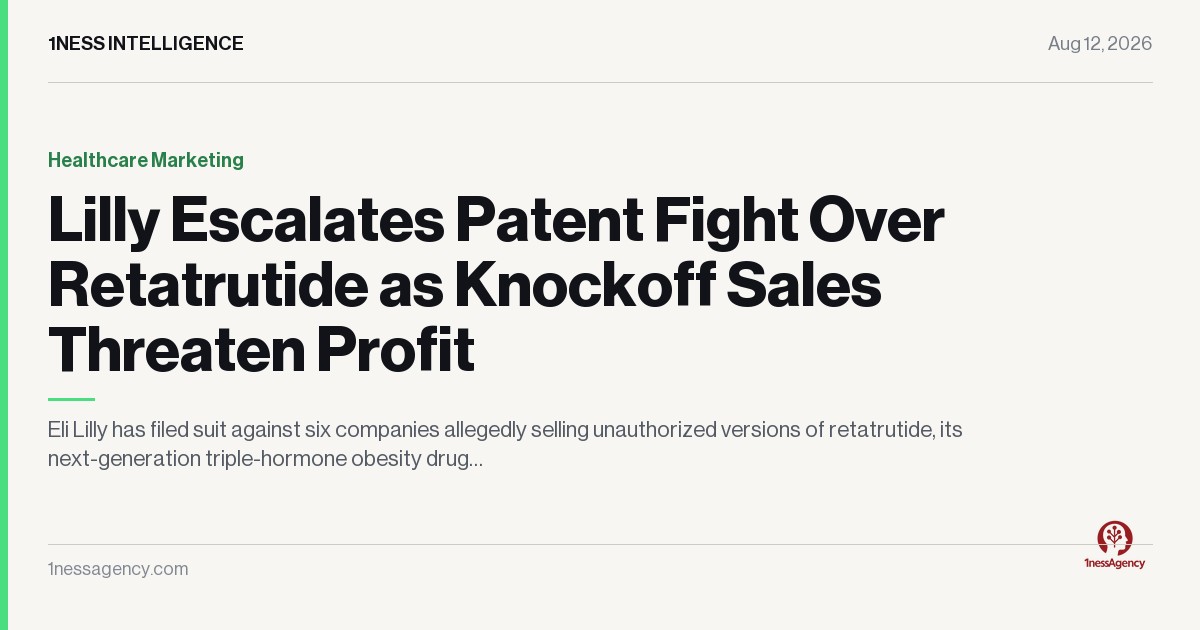
Eli Lilly has filed suit against six companies allegedly selling unauthorized versions of retatrutide, its next-generation triple-hormone obesity drug , and the legal offensive marks a turning point for how GLP-1 treatments are marketed, distributed, and positioned across the healthcare ecosystem. For health system marketers, telehealth platforms, and weight management clinics, the message is unambiguous: the window for gray-market GLP-1 marketing is closing, and the liability exposure for those still operating near that line is growing by the quarter.
Retatrutide, Lilly's investigational GLP-1/GIP/glucagon receptor tri-agonist, has not yet received FDA approval as of mid-2026 . The drug demonstrated weight loss outcomes in Phase 2 trials that exceeded those of tirzepatide (Zepbound/Mounjaro) , in some cohorts, participants lost more than 24% of body weight , making it arguably the most anticipated obesity treatment in the current pipeline. That clinical promise has created a black and gray market for compounded or counterfeit versions, precisely what Lilly's lawsuit targets.
Lilly's legal action follows its 2024–2025 campaign against compounders selling semaglutide and tirzepatide during declared FDA shortage periods. Those earlier suits, combined with FDA enforcement actions, produced measurable market disruption: several compounding pharmacies ceased GLP-1 operations, and telehealth platforms including Hims & Hers saw stock volatility after regulatory pressure . The retatrutide lawsuit escalates the stakes further , because unlike tirzepatide, retatrutide has no approved version to compound "around." Any sale is, by definition, unauthorized.
The broader implication for healthcare marketers extends well beyond obesity clinics. GLP-1 drugs have become a patient acquisition engine across primary care, endocrinology, bariatrics, and cardiology. The legal and regulatory environment surrounding these drugs now directly shapes which marketing claims are defensible, which distribution partnerships are safe to promote, and which patient education content crosses into liability territory.
The Compounding Loophole Is Closing , and Your Marketing Must Reflect That
During the FDA's official shortage designations for semaglutide (2022–2024) and tirzepatide (2023–2025), Section 503A and 503B of the Federal Food, Drug, and Cosmetic Act permitted licensed compounding pharmacies to produce copies of shortage drugs under specific conditions . Lilly and Novo Nordisk argued those conditions were widely violated. The FDA agreed, removing both drugs from shortage lists , semaglutide in early 2024 and tirzepatide in early 2025 , and issuing cease-and-desist guidance to compounders .
Retatrutide never entered a shortage designation because it was never approved. Marketing it, selling it, or implying clinical equivalence to approved drugs is indefensible under current FDA framework. Yet the lawsuit's existence confirms the market exists. Six named defendants allegedly moved product anyway.
What this means for your practice or health system: Any marketing content that references retatrutide as available, positions your clinic as a source for "next-generation GLP-1s," or implies access to pipeline drugs should be audited immediately. Patient-facing language that is vague enough to create that impression , even unintentionally , creates FTC and FDA exposure under the prohibition on marketing unapproved drugs to consumers .GLP-1 Patient Acquisition Is Now a Compliance-First Marketing Problem
The GLP-1 category generated more than $30 billion in combined global revenue for Lilly and Novo Nordisk in 2024 . That scale has created one of the most competitive , and most scrutinized , patient acquisition environments in healthcare marketing. Telehealth platforms spent aggressively on search and social to capture demand: terms like "semaglutide online" and "ozempic prescription" drove some of the highest healthcare cost-per-click rates recorded on Google Ads in 2024–2025 .
As Lilly's legal actions constrict the supply of unauthorized alternatives, patient demand does not disappear , it redirects. Patients who previously obtained compounded GLP-1s through direct-to-consumer telehealth may now seek FDA-approved pathways through primary care or health system-affiliated weight management programs. That is a patient acquisition opportunity for legitimate providers , but only if their marketing is positioned to capture it without making claims that invite scrutiny.
The FTC's updated Health Products Compliance Guidance, reinforced through 2025 enforcement actions, requires that any health-related marketing claim be substantiated by competent and reliable scientific evidence . Claims about GLP-1 outcomes , weight loss percentages, cardiovascular benefit, diabetes remission , must be tied to the specific approved drug and its approved label, not to the drug class broadly or to pipeline compounds.
Naming the Actors: What the Lawsuit Architecture Tells Marketers
Lilly's decision to sue six distinct companies , rather than pursue a single high-profile target , is a deliberate market signal. It maps the distribution chain: manufacturers, distributors, and direct-to-consumer sellers are all named. That architecture mirrors the FTC's approach to deceptive health marketing enforcement, where liability travels up and down the supply and promotion chain.
For healthcare marketing agencies and in-house teams, the practical parallel is this: if your agency, your media buying partner, or your SEO vendor is producing content that promotes access to retatrutide or other unapproved GLP-1 compounds, your organization may share liability exposure under FTC co-promoter standards. This is not hypothetical , the FTC pursued media companies and affiliates, not just advertisers, in several 2024 weight loss marketing actions .
Health systems with employed physician groups running weight management programs should also audit any third-party vendor partnerships , particularly lead generation firms , to confirm those vendors are not running upstream campaigns that violate FDA or FTC standards before passing leads to your intake funnel.
Actionable Takeaways for Healthcare Marketers
- Audit all GLP-1 content immediately. Pull every patient-facing asset , web pages, email sequences, paid ad copy, social content , and flag any reference to retatrutide, pipeline drugs, or vague "new GLP-1" language that could imply access to unapproved compounds.
- Map your vendor chain. Identify every third party generating leads or content on your behalf in the weight management space. Require written confirmation that their campaigns comply with FDA and FTC standards.
- Reposition around approved access. The patient demand Lilly's lawsuit displaces is real. Build marketing content that clearly positions your program as an authorized, clinically supervised pathway to approved GLP-1 therapies , Wegovy, Zepbound, Mounjaro , with the insurance navigation and prior authorization support patients actually need.
- Prepare patient education content for retatrutide's likely approval. Lilly has initiated Phase 3 trials; an NDA submission is anticipated by late 2026 or 2027 . Build compliant, educational content architecture now , disease state awareness, not drug promotion , so you are positioned to activate quickly at approval.
- Train clinical and front-desk staff on inquiry management. Patients will ask about retatrutide by name. Staff need scripted, accurate responses that do not inadvertently make promotional claims about an unapproved drug.
The 1ness Take
Lilly is not just protecting retatrutide , it is systematically reclaiming the commercial high ground across the entire GLP-1 category before its most powerful drug reaches market. Every lawsuit filed against a compounder or unauthorized seller is also a market-shaping action: it eliminates lower-cost alternatives, reinforces brand premium, and trains patients to associate GLP-1 access with authorized, institutional pathways.
Healthcare marketers who understand this dynamic have a narrow and specific opportunity: position your organization as the trusted, friction-reducing bridge between patient demand and authorized access. That means investing now in content that explains insurance coverage for Zepbound and Wegovy, builds patient confidence in supervised clinical programs, and names the real clinical difference between approved agents and what compounders were selling.
The compounding market captured patients because it was fast, direct, and digital-native. Legitimate health systems are slower , but the legal and regulatory environment is rapidly eliminating the speed advantage of unauthorized channels. The organizations that build their GLP-1 marketing infrastructure in Q2 and Q3 of 2026 will own patient acquisition when retatrutide reaches approval. The ones that wait will pay three times more to acquire those same patients after Lilly's launch campaign runs.
Our recommendation: treat this lawsuit as your starting gun, not a warning shot. Build the content, the patient pathways, and the compliant digital infrastructure now. The GLP-1 category is consolidating around institutional, supervised care , and the marketers who get there first will set the acquisition cost benchmarks everyone else chases.
The Takeaway
1. Run a GLP-1 content audit within 30 days. Flag any reference to unapproved compounds or pipeline drugs across all patient-facing channels and remediate before FDA or FTC scrutiny arrives.
2. Build an authorized-access content hub around approved GLP-1 therapies , insurance navigation, clinical eligibility, outcomes data , to capture the demand that unauthorized channels are losing.
3. Start compliant disease-state education content for retatrutide today. When FDA approval comes, the organizations with established content authority will capture organic search and patient trust. Build the infrastructure now, activate it at approval.
References
U.S. Food and Drug Administration. FDA Drug Pipeline and Clinical Trial Registry , Retatrutide (LY3437943). fda.gov, accessed 2026. Jastreboff, A.M., et al. "Retatrutide, a GIP, GLP-1, and Glucagon Receptor Agonist, for People with Type 2 Diabetes." New England Journal of Medicine, June 2023. [Historical Phase 2 data; cited for clinical context.] Reuters. "Hims & Hers shares fall after FDA removes semaglutide from shortage list." Reuters.com, March 2024. [Historical precedent.] U.S. Food and Drug Administration. "Compounding and the FDA: Questions and Answers , 503A and 503B Framework." fda.gov. U.S. Food and Drug Administration. "FDA Announces Tirzepatide No Longer in Shortage." FDA.gov, February 2025. [Historical context.] U.S. Food and Drug Administration. "Promoting Unapproved Medical Products." FDA.gov. Eli Lilly and Company. 2024 Annual Report / Investor Relations , Revenue Disclosures. investor.lilly.com. WordStream / Semrush Healthcare Advertising Benchmarks, 2024–2025. [Historical benchmark data; cited for CPC context.] Federal Trade Commission. "FTC Health Products Compliance Guidance." FTC.gov, 2023, updated 2025. Federal Trade Commission. "FTC Actions Against Deceptive Weight Loss Advertising." FTC.gov, 2024. [Historical enforcement precedent.]This report is for informational purposes only and does not constitute investment advice or an offer to buy or sell any security. Content is based on publicly available sources believed reliable but not guaranteed. Opinions and forward-looking statements are subject to change; past performance is not indicative of future results. 1ness Strategies and its affiliates may hold positions in securities discussed herein. Readers should conduct independent due diligence and consult qualified advisors before making investment decisions.
© 2026 1ness Strategies. All rights reserved.