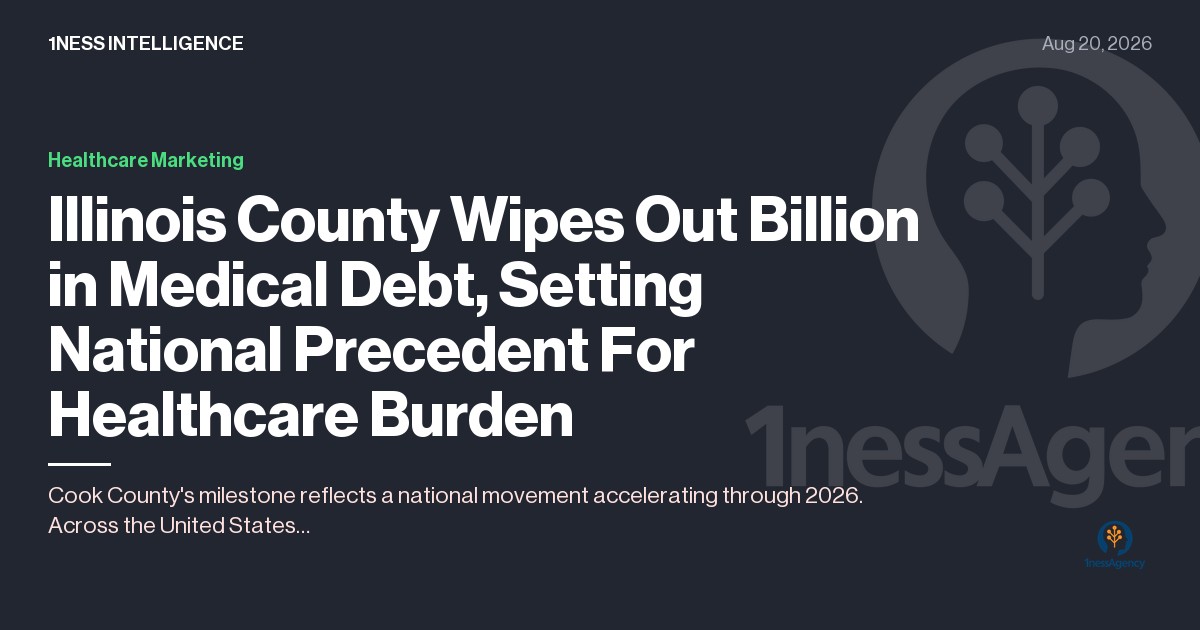
- Cook County, Illinois has eliminated over $1 billion in medical debt through partnerships with organizations like RIP Medical Debt, which purchase debt portfolios at significant discounts.
- Local governments are purchasing medical debt at pennies on the dollar, signaling a national movement that is accelerating through 2026.
- Healthcare systems that acknowledge patient debt aversion and address financial barriers will gain competitive advantages in patient acquisition and retention.
Cook County's milestone reflects a national movement accelerating through 2026. Across the United States, local governments have partnered with organizations such as RIP Medical Debt to purchase and cancel medical debt portfolios at pennies on the dollar , often erasing thousands of dollars in individual patient balances for a fraction of the face value. The Consumer Financial Protection Bureau reported in prior years that medical debt affects tens of millions of Americans, and while the CFPB's 2025 rule to remove medical debt from credit reports has been contested in federal courts, the policy momentum is unmistakable. Patients who have had debt cancelled , or who fear accumulating new debt , behave differently in the market. They delay care, avoid specialist referrals, and choose providers based on perceived billing transparency more than clinical reputation.
"Medical debt is a public health issue, not just a finance issue," reflects the framing increasingly adopted by county health officials and hospital CFOs alike. When a county government spends political capital and public funds to erase a billion dollars in balances, it is telegraphing that the status quo , opaque billing, aggressive collections, credit-damaging debt , is no longer acceptable to the communities health systems depend on for volume. Marketers who treat this as a back-office finance story are missing its frontline implications.
The broader healthcare marketing community should care about Cook County's milestone even if they operate in Texas, Florida, or Georgia. Medical debt relief programs are now active in over 40 states, and the political environment in 2026 has accelerated local government action as federal Medicaid and coverage policy remains contested. When patients in your market have debt cancelled , or learn that a neighboring county offers relief , their expectations of your health system's billing practices reset upward. The providers who get ahead of this expectation shift will capture the patients who are re-entering the healthcare system after years of avoidance.
Medical Debt Relief Reshapes the Patient Acquisition Funnel
The traditional healthcare marketing funnel assumes a patient who is willing to engage, search, and schedule , provided the clinical offering is compelling enough. Medical debt breaks that funnel at the awareness stage. Patients who carry debt from a prior hospital encounter do not respond to brand advertising for that system. They leave the market entirely or migrate to competitors perceived as more financially forgiving.
Cook County's $1 billion milestone means that a measurable cohort of patients , predominantly lower- and middle-income, disproportionately uninsured or underinsured , has had their financial slate wiped clean. These patients are now re-entering the healthcare market. The health systems that market to them with financial transparency messaging, clear price estimates, and visible charity care programs will have a structural advantage over those still leading with clinical rankings and physician credentials.
What this means for your practice: Patient acquisition campaigns in markets with active debt relief programs should segment for "re-entry" patients , individuals who have avoided care due to prior balance concerns. These patients respond to messaging that leads with financial accessibility before clinical quality. Price transparency landing pages, zero-balance guarantee promotions for preventive visits, and prominent charity care eligibility tools should move from the footer of your website to the top of your paid search strategy.Price Transparency Compliance Is Now a Marketing Asset, Not a Legal Checkbox
The Centers for Medicare & Medicaid Services price transparency rules , requiring hospitals to publish machine-readable files and consumer-friendly cost estimators , have been in effect since 2021, with enforcement penalties escalating through 2024 and into 2026. As of early 2026, CMS has issued civil monetary penalty notices to hospitals that remain non-compliant, with annual penalties reaching up to $2 million for large facilities.
In a market where county governments are making medical debt relief a headline issue, price transparency compliance transforms from a regulatory burden into a first-mover marketing advantage. Patients who have experienced the trauma of an unexpected bill , the core population Cook County's program targeted , will actively compare providers on cost predictability before they compare on clinical outcomes.
Health systems that surface their price transparency tools in digital advertising, on Google Business Profiles, and in patient email nurture sequences are converting a compliance requirement into a patient trust signal. Those that bury the cost estimator three clicks deep on the billing page are leaving acquisition dollars on the table. Our recommendation: Audit your price transparency UX against a mobile-first patient journey. If a prospective patient cannot find a cost estimate within 30 seconds on a smartphone, your compliance investment is generating zero marketing return.
The Collections-to-Community Pipeline: What Health Systems Can Learn From County Programs
Cook County did not cancel $1 billion in debt by accident. It partnered with intermediary organizations, structured a purchase program, and , critically , communicated the relief to affected residents through a coordinated outreach effort. That outreach is a masterclass in targeted healthcare marketing to a historically hard-to-reach population.
Health systems can model the same logic internally. Charity care and financial assistance programs at most large hospitals go dramatically underutilized , not because patients are ineligible, but because awareness is low and the application process is perceived as burdensome. A 2024 analysis by the Kaiser Family Foundation found that nonprofit hospitals, which receive tax exemptions in exchange for community benefit, frequently spend less on charity care than the value of those exemptions , a finding that has drawn scrutiny from state attorneys general and federal legislators in 2026.
What this means for your practice: Proactive financial counseling outreach , triggered by insurance verification flags, prior-balance indicators, or ZIP code-level income data , is one of the highest-ROI patient retention tactics available. If your system is sitting on an underutilized charity care program, marketing it aggressively is not charity. It is patient acquisition.Actionable Takeaways for Healthcare Marketers
- Audit your financial accessibility messaging. Does your website homepage communicate financial assistance options within the first scroll? If not, redesign the hierarchy before your next paid media campaign.
- Segment your re-engagement campaigns. In markets with active debt relief programs, build a separate audience segment for lapsed patients with prior balance history. Lead with financial trust signals, not clinical rankings.
- Activate price transparency as a paid search asset. Bid on terms like "affordable care near me," "hospital cost estimator," and "no-surprise billing" , these are high-intent, low-competition keywords that align directly with the re-entry patient mindset.
- Train front-desk staff as financial navigators. The first call a re-entry patient makes is often a test of your billing culture. Scripting financial assistance conversations into scheduling workflows converts hesitant patients into booked appointments.
- Partner with community organizations. Cook County worked through intermediaries to reach affected patients. Health systems can replicate this by co-marketing financial assistance programs through food banks, community health workers, and faith-based organizations.
The 1ness Take
Cook County's $1 billion milestone is a demographic event, not just a policy one. It means a large, previously disengaged patient population is financially eligible to re-enter the healthcare market , and most health systems are not positioned to capture them.
The marketing implication is this: clinical brand advertising built for commercially insured, digitally engaged patients will not convert this cohort. These are patients who associate health systems with financial stress. They need to see financial safety before they will consider clinical quality.
The health systems that will win this patient segment in 2026 and beyond are those that build a distinct financial trust brand , separate from their clinical brand , and deploy it through the channels where financially stressed patients actually search: Google Maps reviews that mention billing, Reddit threads about hospital costs, community Facebook groups, and Spanish-language digital media in high-density immigrant communities.
This is not about being soft on revenue cycle. It is about understanding that the patient who trusts your billing process will return for the knee replacement, the colonoscopy, and the cardiac workup. The patient who fears your billing department goes to the urgent care down the street and never re-engages. Financial accessibility is a growth strategy, not a concession.
The Takeaway
1. This week: Pull your charity care utilization rate from your CFO and compare it to your tax-exempt community benefit obligation. The gap is a marketing opportunity.
2. This month: Run a UX audit of your price transparency and financial assistance pages using a first-time mobile visitor as your test persona. Measure clicks to cost estimator against your overall site traffic.
3. This quarter: Build a re-engagement campaign specifically targeting lapsed patients in ZIP codes covered by Cook County-style debt relief programs , or any market where medical debt has been publicly addressed. Lead the campaign with financial safety messaging, not clinical awards.
References
1. RIP Medical Debt. (2026). Program overview and county partnership model. https://ripmedicaldebt.org
2. Consumer Financial Protection Bureau. (2025). Medical debt and credit reporting rule. https://www.consumerfinance.gov
3. Becker's Hospital Review. (2026). Illinois county surpasses $1B in medical debt relief. https://www.beckershospitalreview.com/finance/illinois-county-surpasses-1b-in-medical-debt-relief/
4. Centers for Medicare & Medicaid Services. (2026). Hospital price transparency enforcement updates. https://www.cms.gov/hospital-price-transparency
5. Kaiser Family Foundation. (2024). Nonprofit hospital community benefit and charity care spending analysis. https://www.kff.org
6. Federal Trade Commission. (2025). Health Breach Notification Rule update. https://www.ftc.gov
This report is for informational purposes only and does not constitute investment advice or an offer to buy or sell any security. Content is based on publicly available sources believed reliable but not guaranteed. Opinions and forward-looking statements are subject to change; past performance is not indicative of future results. 1ness Strategies and its affiliates may hold positions in securities discussed herein. Readers should conduct independent due diligence and consult qualified advisors before making investment decisions.
© 2026 1ness Strategies. All rights reserved.