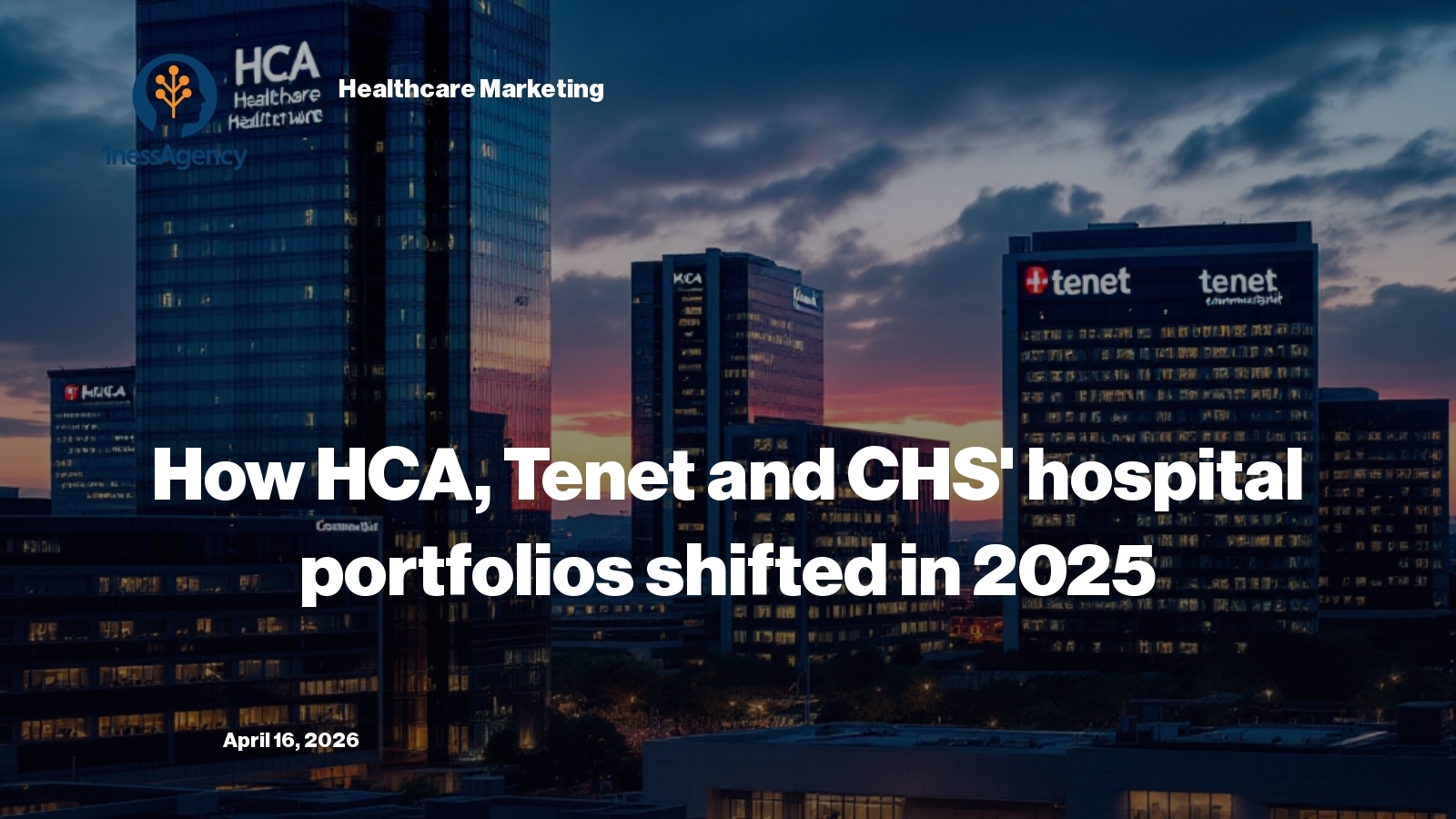
The three largest for-profit hospital systems in America (HCA Healthcare, Tenet Healthcare, and Community Health Systems) redrew the competitive map in 2025 through a wave of acquisitions and divestitures that fundamentally altered patient access corridors across dozens of markets. For healthcare marketers, this isn't just industry news. It's a mandate to audit every assumption about service area definitions, referral patterns, and digital targeting strategies built before these portfolio shifts took effect.
The 2025 restructuring continues into 2026 with integration timelines, rebranding requirements, and competitive repositioning that will define market share for the next decade. HCA Healthcare operates 186 hospitals and approximately 2,400 sites of care across 20 states and the United Kingdom as of early 2026. Tenet Healthcare manages 110 hospitals and over 500 outpatient centers. Community Health Systems operates 62 hospitals across 13 states after aggressive portfolio pruning. These numbers represent the outcome of strategic exits from underperforming rural markets and aggressive expansion in high-growth metropolitan areas.
Mark Partin, Senior Vice President of Operations at HCA Healthcare, noted in a 2025 earnings call that the company's acquisition strategy focused on markets with population growth exceeding 2% annually and household incomes above regional medians, a data-driven approach that places marketing capabilities at the center of due diligence.
The consolidation wave matters beyond these three systems. When dominant players redraw service area boundaries, they trigger competitive responses from regional health systems, physician groups, and specialty providers. Patient acquisition costs rise in contested markets. Search behavior fragments as brand recognition resets. Referral networks require reconstruction. Healthcare marketers face a choice: adapt targeting and messaging to the new competitive reality, or watch patient volumes migrate to better-positioned rivals.
The Service Area Definition Problem
Hospital acquisitions break the foundational assumptions of healthcare marketing geography. A facility that operated as an independent community hospital in 2024 now carries HCA branding, pricing structures, and network affiliations in 2026. The patient who previously considered this their "local hospital" now navigates a corporate identity that may signal either enhanced capabilities or loss of community connection, depending on messaging execution.
Digital advertising campaigns built on historical service area definitions miss the mark when catchment boundaries shift. Google Ads geotargeting radiuses that made sense for a 150-bed independent hospital fail when that facility becomes part of a system offering complex tertiary care 20 miles away. The inverse problem hits harder, systems that divest facilities lose the geographic targeting logic that drove patient acquisition, often discovering the gap only when scheduled procedure volumes decline.
Tenet Healthcare's 2025 portfolio changes illustrate the challenge. The system divested hospitals in markets where it lacked scale advantages while acquiring facilities in metropolitan areas where it could build genuine service line depth. For marketers at competing systems in those metro markets, Tenet transformed overnight from a secondary player to a resourced competitor with national purchasing power for digital media and sophisticated CRM platforms.
Community Health Systems' contraction from 79 hospitals in 2024 to 62 in early 2026 created a different dynamic. The rural markets CHS exited didn't go dark, regional systems, critical access hospitals, or private equity-backed operators acquired most facilities. But the marketing sophistication gap widened. A CMO at a regional system that acquired a former CHS facility inherits a brand perception problem: patients remember the previous owner's reputation, whether positive or negative, and resetting that perception requires both time and budget.
Patient Confusion Creates Competitor Advantage
Brand transition periods present the highest-value targeting opportunity in healthcare marketing. When a hospital changes ownership, a predictable percentage of patients actively research alternatives. Internal data from system integrations suggests 18-22% of non-acute patients reconsider their facility preference during ownership transitions, according to patient experience research conducted across multiple system mergers between 2020-2024.
This reconsideration window lasts approximately 90-180 days post-announcement. Patients search for information about network changes, insurance acceptance, physician retention, and service continuity. Competing health systems that deploy targeted search campaigns, geo-fenced mobile advertising near acquired facilities, and physician liaison outreach during this window capture disproportionate market share.
HCA's standard integration playbook accelerates the timeline, often completing branding transitions within 120 days of acquisition close. This compressed schedule minimizes patient confusion but creates intense pressure on marketing teams to execute flawless communication across every touchpoint, website updates, physician directory integration, insurance verification systems, wayfinding signage, and patient portal migration.
The stakes show in the numbers. A 250-bed hospital generates approximately $250-350 million in net patient revenue annually. A 5% volume shift during transition, well within the range of poorly managed integrations, represents $12-17 million in annual revenue loss. Marketing competence during portfolio transitions isn't cosmetic. It's a material financial outcome.
The Digital Footprint Integration Challenge
Hospital acquisitions create immediate technical debt in digital marketing infrastructure. Every acquired facility brings its own website, social media presence, Google Business Profile, physician directory, online scheduling platform, and patient portal. Integration timelines rarely align with marketing best practices.
The typical scenario: operations teams prioritize EHR integration and revenue cycle consolidation. Marketing receives a mandate to "align branding" but inherits technical constraints that block optimal execution. Acquired hospital websites redirect to corporate templates that strip out local market content, destroying years of SEO authority. Google Business Profiles merge or consolidate, often losing reviews, photos, and local search ranking in the process.
Community Health Systems' portfolio reduction meant dozens of facilities transitioned to new operators with different marketing platforms and strategies. For the acquiring organizations, the opportunity was real, immediate market presence with established patient relationships. But the execution challenge was equally real. Patient reviews on legacy platforms no longer aligned with new branding. Directory listings across healthgrades, vitals, and insurance provider locators required manual updates. Paid search campaigns driving traffic to old URLs needed emergency redirects.
Systems that treat digital integration as a day-one priority gain measurable advantage. Organizations that delay digital consolidation while focusing on operational integration leak patient volume to competitors who dominate local search during the vacuum period.
When Market Concentration Triggers Regulatory Scrutiny
The Federal Trade Commission monitors hospital consolidation with increasing aggression. The agency challenged multiple hospital mergers in 2024-2025, arguing that concentration in specific service areas reduces competition and increases prices. While most FTC challenges focus on same-market consolidation rather than portfolio expansion across multiple states, healthcare marketers should understand the regulatory sensitivity around market dominance claims.
Marketing messages that emphasize "regional healthcare leader" or "largest provider of [service line] in [geography]" can attract regulatory attention during acquisition review periods. Communications that stress expanded access, service line enhancement, or community benefit navigate regulatory scrutiny more successfully than those focused purely on scale or dominance.
State attorneys general in California, New York, and Washington have established hospital transaction review processes that examine market impact beyond federal antitrust standards. Healthcare systems pursuing acquisitions in these states face extended timelines and heightened scrutiny of competitive positioning, including marketing claims and brand strategy.
For marketing leaders, the compliance imperative is clear: coordinate messaging with legal and regulatory affairs during any acquisition integration. A social media post celebrating "market leadership" can become an exhibit in an antitrust review.
The 1ness Take
Portfolio consolidation creates a 24-month window where marketing execution determines whether an acquisition delivers projected value or destroys it. Our recommendation for healthcare marketing leaders navigating system expansion or contraction: build the marketing integration playbook before the deal closes, not after.
Three strategic imperatives drive success:
First, claim the digital territory immediately. The health system that dominates local search, claims accurate directory listings, and controls the patient review narrative in the first 90 days post-acquisition captures the patients researching alternatives. This requires pre-close planning, staging new websites, preparing redirect maps, drafting templated responses for patient questions, and allocating emergency paid search budget to compensate for organic search disruption. Second, segment the patient base and customize messaging. Long-tenured patients of an acquired facility need reassurance about continuity. New patients attracted by system capabilities need education about expanded services. Physician relationships require different communication than direct-to-consumer outreach. A single corporate announcement fails all these audiences. Build audience-specific campaigns that address the actual concerns and questions each segment brings to the transition. Third, treat acquired facilities as greenfield market entry for 18 months. The brand equity of the acquiring system doesn't automatically transfer to the acquired facility's patient base. Budget and resource acquired facility marketing as if launching in a new market, because functionally, you are. This means dedicated market research, community engagement, physician relations programs, and sustained paid media presence at levels that reflect competitive intensity, not assumed loyalty.Systems that execute these three imperatives see patient volume maintenance or growth through integration. Systems that assume the brand transfer happens automatically face volume erosion that persists for years. The difference between these outcomes is marketing strategy and execution, not operational performance.
The Takeaway
Hospital portfolio shifts at HCA, Tenet, and Community Health Systems in 2025 reset competitive dynamics that will define market share through 2030. For healthcare marketing leaders, three immediate actions matter:
- Audit your service area definitions and competitive set quarterly, not annually. The market you mapped 12 months ago may no longer reflect current competitive reality. Update buyer personas, search campaigns, and media targeting to reflect actual competitive pressure, not historical assumptions.
- Monitor acquisition announcements in your markets and adjacent geographies. The 90-180 day post-announcement window represents your highest-ROI targeting opportunity. Build rapid response campaign templates now so you can deploy within days of competitor portfolio changes.
- Stress-test your own digital infrastructure for acquisition readiness. Whether your organization is pursuing growth or defending market share, the technical capability to integrate or defend digital presence determines marketing outcomes during transitions. Identify gaps in website scalability, directory management, and paid search flexibility before they become emergency projects.
Portfolio consolidation isn't slowing in 2026. The systems that treat marketing integration as a strategic priority rather than a post-close communications exercise will capture market share. The systems that underestimate the complexity will lose patients they assumed were loyal.
References
- HCA Healthcare corporate website and investor relations materials, accessed January 2026
- Tenet Healthcare corporate website and investor relations materials, accessed January 2026
- Community Health Systems corporate website and investor relations materials, accessed January 2026
- Federal Trade Commission hospital merger enforcement actions, 2024-2025
- Patient experience and hospital integration research, Healthcare Marketing Journal, 2020-2024