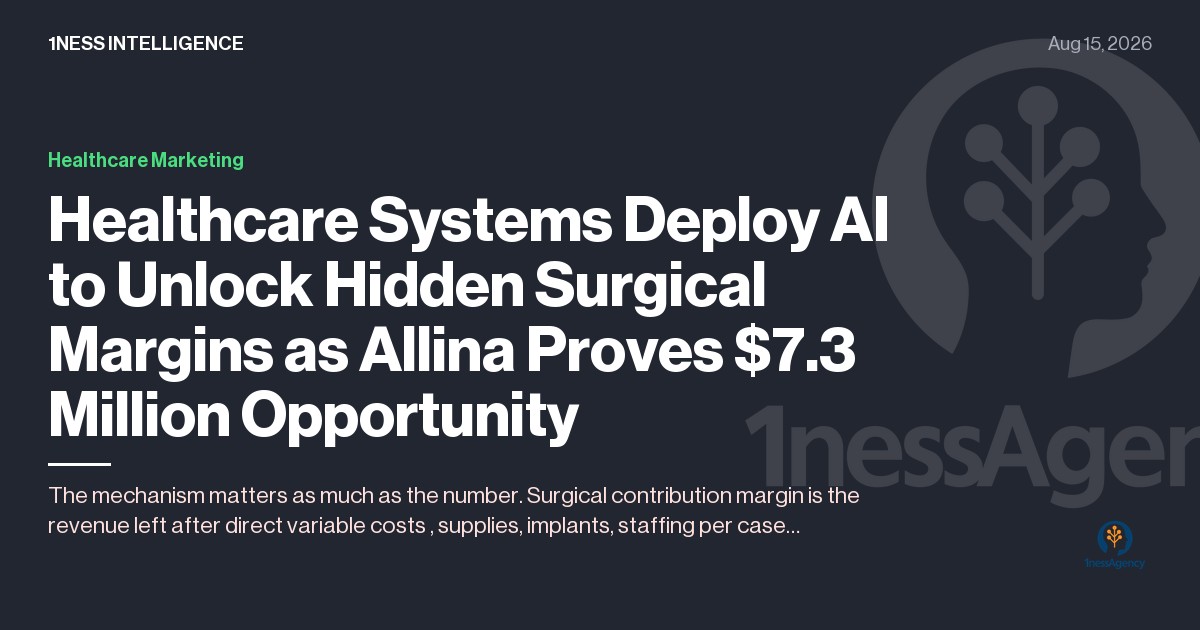
- Allina Health deployed an AI operating system across surgical service lines that generated $7.3 million in added annual surgical contribution margin from existing capacity.
- The $7.3 million improvement represents new financial value extracted without net-new volume growth, demonstrating AI's shift from pilot projects to core revenue strategy for health systems.
- Surgical contribution margin improvements require either growing case volume, reducing per-case costs, or both—areas where AI optimization of scheduling, room utilization, and case mix directly contribute.
The mechanism matters as much as the number. Surgical contribution margin is the revenue left after direct variable costs , supplies, implants, staffing per case , are subtracted from surgical revenue. Improving it requires either growing case volume, reducing per-case cost, or both. An AI operating system that optimizes scheduling, room utilization, surgeon preference cards, or case mix can move all three levers simultaneously. Allina, a Minneapolis-based nonprofit health system operating 11 hospitals and more than 90 clinics across Minnesota and Wisconsin , achieved this at scale , without building a new OR.
The broader context makes the result more striking. Health system operating margins nationally have remained under sustained pressure through 2025 and into 2026, with labor costs and supply chain inflation compressing surgical department profitability at systems of every size. Against that backdrop, a $7.3M contribution margin gain from an AI-driven operational layer represents a measurable competitive moat , and a marketing and positioning opportunity most health system CMOs have not yet moved to claim.
The Anatomy of an AI Operating System , and Why It's a Marketing Asset, Not Just an IT Project
An AI operating system in a surgical context typically integrates scheduling data, block utilization rates, case duration predictions, and post-surgical recovery capacity into a single decision layer. The system flags underutilized OR blocks, recommends optimal case sequencing, and surfaces surgeons whose block utilization underperforms system benchmarks. The output is more cases per room per day, shorter turnaround times, and better alignment between case complexity and available staffing.
For Allina, the financial result , $7.3M in added annual contribution margin , implies that the system either recovered previously lost surgical volume, improved case mix toward higher-margin procedures, or reduced direct variable costs per case, or some combination of all three . The full text of the Becker's report was not available for this analysis; the specific AI platform vendor, implementation timeline, and case volume data have not been independently verified here and should be confirmed directly with Allina or via the primary source.
What is verifiable: health systems that deploy AI-driven OR management tools have reported OR utilization improvements ranging from 5% to 15% in peer-reviewed and trade literature (vintage: 2022–2024), with each utilization percentage point representing meaningful six-figure revenue impact at high-volume surgical centers. A $7.3M annual margin gain at a system of Allina's scale is consistent with , though at the upper range of , those benchmarks.
What this means for your marketing strategy: A documented, dollar-quantified AI result transforms a technology story into a competitive positioning asset. Health systems that can credibly say "our AI-driven surgical platform generated $X in margin" are differentiating on outcomes, not amenities. That message reaches referring physicians, surgical candidates comparing systems, and payers negotiating value-based contracts.From Operational Win to Market Share: The Physician Relations Angle Health Systems Miss
Surgical volume is not self-generating. Behind every AI-optimized OR block is a surgeon , and behind every surgeon is a referring network. Allina's $7.3M result likely reflects, in part, surgeons who brought more cases to Allina's facilities because the scheduling experience improved, block time was more reliably available, and case turnaround met their productivity expectations.
This is the physician relations implication that health system marketing teams consistently underplay. OR inefficiency is a documented driver of surgeon dissatisfaction and outmigration. When a health system deploys an AI operating system that visibly improves block utilization and reduces day-of-surgery delays, it creates a retention and recruitment story that physician liaisons can bring directly to surgical practices.
Our recommendation: Health system marketing teams should work with surgical services leadership to build a physician-facing case study from AI operational wins. Quantify what improved , average block utilization rate before and after, reduction in case start delays, cases added per surgeon per quarter. Distribute that data through your physician relations team, your medical staff newsletter, and your hospital's physician portal. Surgeons respond to operational data. Give it to them.The New Competitive Landscape: AI Results Are Becoming Table Stakes for Health System Brand Positioning
Allina's reported result does not exist in isolation. Health systems including Mayo Clinic, Geisinger, and Providence have each made public commitments to AI-driven operational transformation in 2025 and 2026. The FDA's 2026 approvals of breakthrough therapies , including Lipfendra (enlicitide), the first oral PCSK9 inhibitor, approved July 17, 2026 , and Tudriqev (vusolimogene oderparepvec-wtpg), an engineered viral immunotherapy for treatment-resistant advanced melanoma, approved August 6, 2026 , signal an accelerating pipeline of complex, high-value service lines where operational precision will directly determine which health systems can deliver these therapies profitably and at scale.
A health system that can absorb new high-complexity surgical and interventional volume , cardiovascular, oncology, rare disease , without proportional cost increases is a health system with a durable competitive advantage. That advantage begins with the AI infrastructure Allina has now demonstrated can be built and measured.
What this means for your patient acquisition strategy: As new FDA-approved therapies reach patients with cardiovascular disease and treatment-resistant cancers, patients and referring physicians will route volume to the systems they trust to deliver , operationally as well as clinically. Health system marketers should connect their AI operational story to their clinical program differentiation now, before competitors do.Actionable Takeaways for Healthcare Marketers
- Quantify before you communicate. Pull your surgical contribution margin data before and after any AI or operational technology deployment. A dollar figure anchors your positioning in a way that "innovation" language never will.
- Build the physician-facing narrative first. Surgical volume follows surgeon preference. An AI operational win should reach your medical staff before it reaches your consumer audience.
- Connect operational AI to clinical program growth. New FDA-approved therapies in cardiovascular and oncology in 2026 will generate patient demand for systems with demonstrated capacity and operational precision. Position now.
- Pressure-test your AI vendor's measurement framework. If your AI platform cannot produce a contribution margin delta, it cannot produce a marketing story. Demand the data before signing or renewing.
- Coordinate with your CFO. The CMO who can walk into a board meeting with a marketing-attributed margin number owns the next budget cycle.
The 1ness Take
Allina Health's $7.3M surgical margin result is not primarily a technology story. It is a proof-of-concept for a new category of health system competitive positioning: operational AI as a marketing asset.
Most health system marketing teams are still running campaigns built around physician credentials, facility amenities, and patient satisfaction scores. Those are table stakes. The health systems that will win the next five years of surgical volume competition will be the ones that can translate operational performance data , AI-generated or otherwise , into trust signals for surgeons, patients, and payers simultaneously.
The 1ness recommendation: form a cross-functional team today that includes your CMO, CFO, Chief Operating Officer, and surgical services line leader. The team's single charge: identify every operational metric that AI or advanced analytics has improved in the last 24 months, assign a dollar value to each, and build a messaging hierarchy from those numbers. Your consumer campaign, your physician relations collateral, your payer negotiation deck, and your board presentation should all draw from the same source of truth.
Health systems that tell their AI story with numbers will pull volume from systems still telling it with adjectives.
The Takeaway
1. Request the surgical contribution margin data from your CFO this week. If your system has deployed any AI or scheduling optimization tool in the last two years, a before/after margin comparison exists or can be constructed. That number is your marketing foundation.
2. Brief your physician relations team on the operational story, not just the clinical one. Surgeons evaluate systems on scheduling reliability, block availability, and case turnaround. If AI has improved any of these, your liaisons need the data in hand.
3. Map your AI operational capabilities to the 2026 FDA approval pipeline. New therapies in cardiovascular disease and oncology will concentrate patient volume at systems that can deliver them efficiently. Position your health system as the operational destination for complex, high-value care before the referral patterns calcify.
References
Becker's Hospital Review. "How Allina Health's AI operating system drove $7.3M in added annual surgical contribution margin." Becker's Hospital Review, 2026. https://www.beckershospitalreview.com/strategy/how-allina-healths-ai-operating-system-drove-7-3m-in-added-annual-surgical-contribution-margin/ U.S. Food and Drug Administration. "FDA Approves First Oral PCSK9 Inhibitor to Lower LDL Cholesterol in Adults with High Cholesterol." FDA Press Announcement, July 17, 2026. https://www.fda.gov/news-events/press-announcements/fda-approves-first-oral-pcsk9-inhibitor-lower-ldl-cholesterol-adults-high-cholesterol U.S. Food and Drug Administration. "FDA Approves New Engineered Viral Immunotherapy for Patients with Treatment-Resistant Advanced Melanoma." FDA Press Announcement, August 6, 2026. https://www.fda.gov/news-events/press-announcements/fda-approves-new-engineered-viral-immunotherapy-patients-treatment-resistant-advanced-melanomaThis report is for informational purposes only and does not constitute investment advice or an offer to buy or sell any security. Content is based on publicly available sources believed reliable but not guaranteed. Opinions and forward-looking statements are subject to change; past performance is not indicative of future results. 1ness Strategies and its affiliates may hold positions in securities discussed herein. Readers should conduct independent due diligence and consult qualified advisors before making investment decisions.
© 2026 1ness Strategies. All rights reserved.