- UnitedHealth's Optum division generated over $100 billion in revenue in 2024 by selling data, software, and care management services alongside insurance products.
- UnitedHealth Group, CVS Health, and Elevance Health are collectively redirecting billions of dollars from traditional insurance operations toward AI-powered platforms and predictive analytics engines.
- CVS has embedded AI across its Aetna and MinuteClinic operations, while Elevance has deployed machine learning models to manage prior authorizations and member engagement at scale.
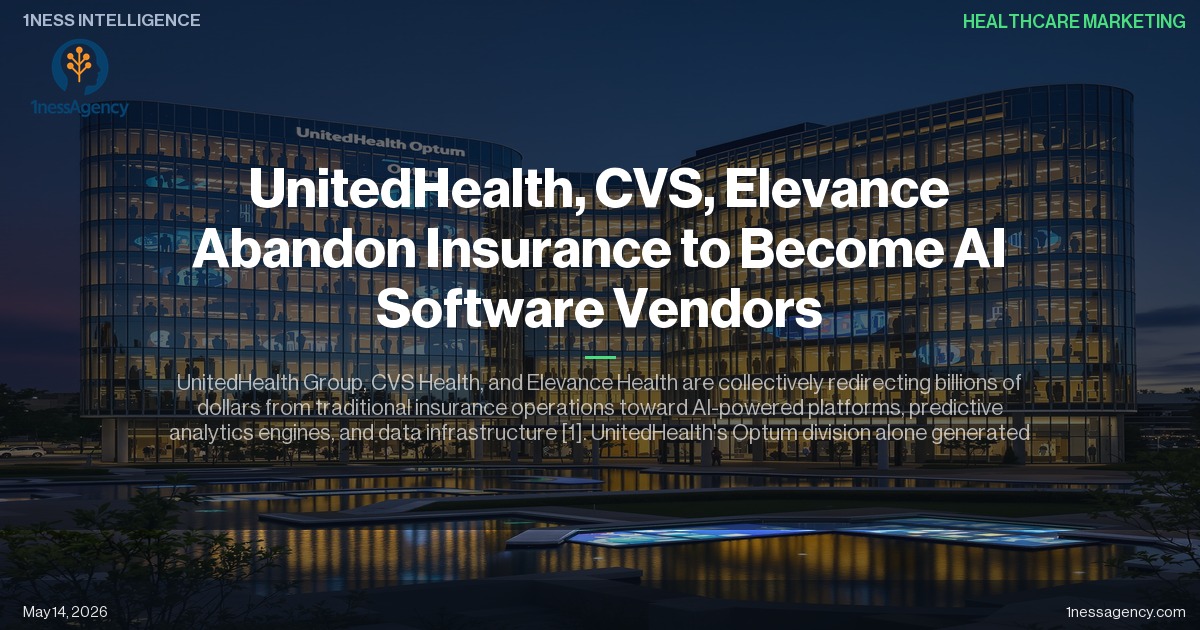
UnitedHealth Group, CVS Health, and Elevance Health are collectively redirecting billions of dollars from traditional insurance operations toward AI-powered platforms, predictive analytics engines, and data infrastructure . UnitedHealth's Optum division alone generated over $100 billion in revenue in 2024 , more than many mid-sized technology companies , by selling data, software, and care management services alongside insurance products . CVS has embedded AI across its Aetna and MinuteClinic operations, while Elevance has deployed machine learning models to manage prior authorizations and member engagement at scale . These are not incremental IT upgrades. They are structural transformations that shift power over patient data, care navigation, and provider relationships from health systems to payers.
"The distinction between payer and technology vendor is collapsing," according to analysts who cover health system strategy at firms including Gartner Health and Kaufman Hall. The organizations that control the data layer , who the patient is, what they've been diagnosed with, where they sought care last , increasingly control the first touchpoint in a patient's care journey.
For healthcare marketers at hospitals, specialty practices, and ambulatory networks, this pivot reshapes patient acquisition from the ground up. When a payer's AI model recommends a provider, routes a member to an in-network clinic, or sends a care gap alert through a branded app, that payer , not your marketing department , owns the relationship. The practices and systems that do not build independent digital engagement infrastructure now will find themselves competing for patient attention on someone else's platform.
The AI Stack These Payers Are Building , and What It Replaces
UnitedHealth's Optum has acquired more than 40 physician groups, a pharmacy benefits manager, a health IT company (Change Healthcare), and an analytics platform (Advisory Board) over the past decade . The strategy is now yielding an AI infrastructure that can predict which members will need a knee replacement, route them to an Optum-affiliated orthopedic group, manage the prior authorization automatically, and fill the post-surgical prescription through Optum Rx , all without the patient ever searching Google or asking their primary care doctor for a referral.
CVS Health's integration of Aetna, MinuteClinic, and Caremark creates a parallel closed loop. The company reported in early 2026 that it is deploying generative AI tools to streamline member communications and reduce care navigation friction, with the explicit goal of keeping members inside CVS-affiliated care settings .
Elevance , formerly Anthem , has invested in AI-driven prior authorization platforms that reduce human review time and, by design, accelerate approvals for providers within its preferred networks. The financial incentive is direct: faster approvals for in-network providers means lower administrative cost and higher member retention.
What this means for your practice: If your patient acquisition strategy relies on referral volume from primary care physicians who are employed by or aligned with one of these payers, that referral pipeline is at risk of algorithmic redirection. The AI does not make exceptions for historical relationships.Patient Data as a Competitive Moat , and a Compliance Minefield
The reason these companies are investing in AI is not operational efficiency alone. Data is the asset. UnitedHealth processed claims for approximately 49 million Americans in 2024 . That volume generates a longitudinal health record , diagnosis history, pharmacy utilization, lab results, provider visits , that no independent health system, outside of the largest integrated delivery networks, can match.
This data advantage compounds. A payer with richer member data trains better AI models. Better models produce more accurate care navigation recommendations. More accurate recommendations keep members inside the network. More network utilization generates more data. The moat widens with every transaction.
For healthcare marketers, the compliance implications are immediate. The FTC's Health Breach Notification Rule, updated in 2024 and actively enforced in 2026, applies to health apps and platforms that share consumer health data with third parties . As payers build consumer-facing AI tools that collect behavioral and self-reported health data alongside claims data, the regulatory scrutiny around how that data is used for targeted marketing , including retargeting ads and personalized outreach , is intensifying. HIPAA's minimum necessary standard applies to covered entities, but the payers' consumer-facing apps often operate in a gray zone that state attorneys general are beginning to examine.
Compliance callout: If your organization is purchasing data segments, lookalike audiences, or AI-powered patient outreach lists from any vendor with payer affiliations, audit the data lineage now. The FTC's 2026 enforcement posture on health data sharing makes this a liability that no marketing budget can absorb.What Independent Health Systems Must Do Before the Platform Lock-In Completes
The window for health systems and independent practices to build direct patient relationships , outside of payer-controlled platforms , is narrowing. Three strategic moves define the organizations that will retain marketing leverage.
First, own the digital front door. Health systems that route patients through payer apps or third-party scheduling platforms surrender first-party data. Every patient who books through a payer-affiliated app is a patient whose next interaction will be managed by that payer's AI, not your care team. Building a native patient engagement platform , with appointment scheduling, care gap reminders, and post-visit follow-up , is not a technology project. It is a patient retention strategy. Second, invest in condition-specific content that payer platforms cannot replicate. A payer's AI can route a diabetic member to an in-network endocrinologist. It cannot build a trusted relationship between that patient and your diabetes education program. Condition-specific content hubs , built around clinical depth, physician voice, and community credibility , create search visibility and trust that algorithmic routing cannot fully displace. Third, build attribution models that track payer-sourced patients separately. If payer-aligned AI is already redirecting patients to your competitors, your marketing team needs to see it in the data. Track the source of new patient acquisition by insurance affiliation. If a payer's preferred network is pulling volume away from a specific service line, that is a strategic signal , not just a billing issue.Actionable Takeaways for Healthcare Marketing Leaders
- Audit your referral mix today. Identify what percentage of new patient volume flows from payer-affiliated primary care groups or care navigation programs. Set a threshold , if more than 30% of a service line's volume is payer-sourced, that service line has a concentration risk.
- Map the patient journey against payer touchpoints. Document every step where a UnitedHealth, CVS, or Elevance app could intercept a patient before they reach your scheduling team. Build a counter-strategy for each intercept point.
- Develop a first-party data strategy. CRM systems, patient portal engagement, and email opt-ins are not optional infrastructure. They are the only data assets your marketing team controls when payer platforms own the ambient layer.
- Pressure-test your content strategy against AI search. As payer AI tools surface provider recommendations inside member apps, Google's AI Overviews and similar features are reshaping how patients find care information. Optimize for entity-based SEO , your physicians, your programs, your outcomes , not just keywords.
- Review vendor contracts for data-sharing provisions. Any technology vendor with a payer parent or payer investor should be scrutinized for data flow agreements that could direct patient leads away from your organization.
The 1ness Take
The headline , AI is turning UnitedHealth, CVS, and Elevance into software companies , undersells the strategic threat. What these organizations are actually becoming is the operating system for American healthcare. And in that architecture, independent hospitals and practices are applications running on someone else's platform.
Our recommendation: stop treating digital marketing as a channel and start treating it as infrastructure. The health systems that will compete effectively in a payer-platform world are the ones that build direct, durable, and data-rich relationships with patients before the AI intervenes. That means investing in owned media , condition-specific content, physician thought leadership, patient community platforms , not rented attention on social feeds or payer directories.
The practical implication for your 2026 marketing budget: shift at least 20% of paid acquisition spending toward owned-channel development. The return on paid search degrades every time a payer's AI answers a patient's care question before they ever reach a search result. The return on a loyal patient who books directly, refers family members, and engages with your portal compounds indefinitely.
The payers are not your partners in this transition. They are your competitors for the patient relationship. Treat the marketing strategy accordingly.
The Takeaway
1. Conduct a referral source audit within 30 days. Quantify how much of your new patient volume is already flowing through payer-affiliated channels. This is the baseline for every strategic decision that follows.
2. Commission a digital front door assessment. Map every digital touchpoint a patient encounters from symptom onset to your scheduling system. Identify where payer platforms currently intercept that journey and build owned alternatives.
3. Brief your legal and compliance team on FTC Health Breach Notification Rule enforcement in 2026. Any AI-powered marketing tool that touches health data , yours or a vendor's , needs a compliance review before the next campaign launches.
References
- Becker's Hospital Review. "How AI is turning UnitedHealth, CVS and Elevance into software companies." Becker's Hospital Review, 2026 beckershospitalreview.com
- UnitedHealth Group. 2024 Annual Report to Shareholders. UnitedHealth Group, 2025 unitedhealthgroup.com
- CVS Health. CVS Health 2026 Strategic Update: AI and Care Integration Initiatives. CVS Health Investor Relations, 2026 investors.cvshealth.com
- Robbins, M. "Optum's Vertical Integration Strategy: A Decade of Acquisitions." Health Affairs Blog, 2024 healthaffairs.org
- CVS Health. Q1 2026 Earnings Call Transcript. CVS Health Investor Relations, 2026 investors.cvshealth.com
- Federal Trade Commission. "FTC Health Breach Notification Rule: Updated Guidance and 2026 Enforcement Priorities." FTC.gov, 2026 ftc.gov