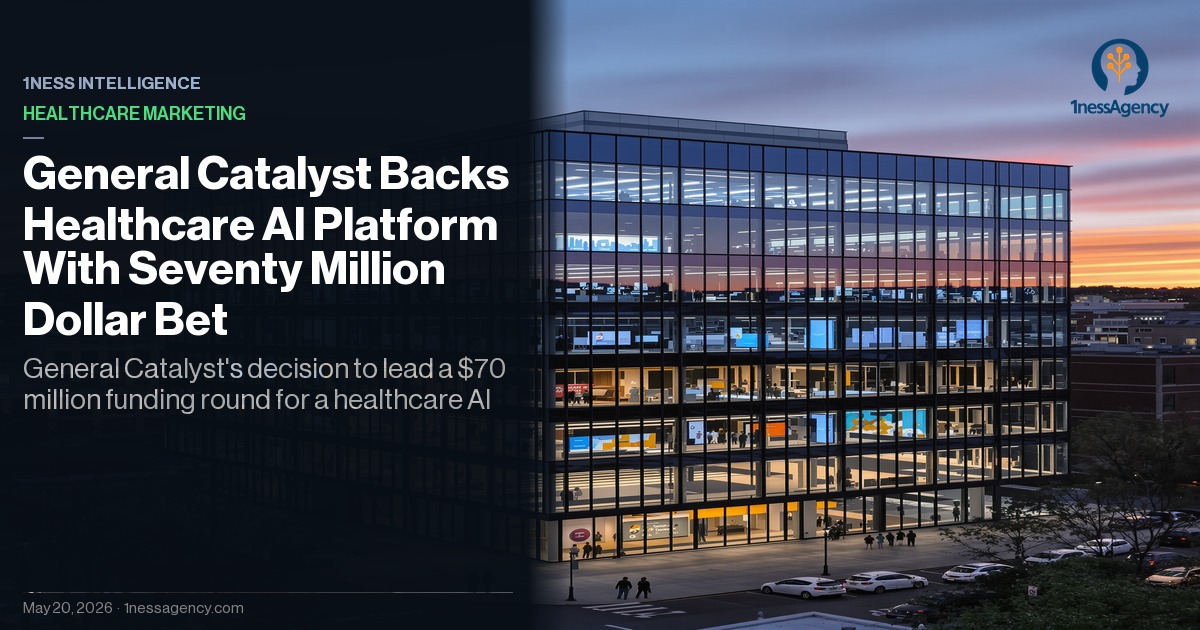
- General Catalyst led a $70 million funding round for a healthcare AI platform in 2026, signaling institutional capital has shifted from experimenting with AI in healthcare to scaling it.
- General Catalyst's nine-figure investment indicates healthcare AI infrastructure has evolved from pilot projects to competitive differentiators for health systems.
- The firm previously backed healthcare companies including Livongo, Commure, and Transcarent that repositioned care delivery around data and consumer experience.
General Catalyst's decision to lead a $70 million funding round for a healthcare AI platform in 2026 marks one of the clearest signals yet that institutional capital has moved from experimenting with AI in healthcare to betting on it at scale, and the marketing implications for health systems and practices are immediate.
When one of Silicon Valley's most aggressive venture firms writes a nine-figure check into healthcare AI infrastructure, the technology is no longer a pilot project buried in an IT roadmap. It becomes a competitive differentiator that separates health systems investing in intelligent, data-driven patient engagement from those still running static email campaigns and generic paid search ads.
General Catalyst has previously backed companies including Livongo, Commure, and Transcarent, organizations that repositioned care delivery around data and consumer experience rather than traditional access models. A $70 million commitment at this stage signals that AI platforms capable of handling clinical workflows, patient communication, and population health management have reached a maturity level where health systems can deploy them at enterprise scale.
For healthcare marketers, this funding event is a forcing function. The organizations that land contracts with the kind of AI platform General Catalyst just funded will gain compounding advantages in patient acquisition, retention, and lifetime value, while competitors who delay will inherit the same structural disadvantage that late adopters faced when digital advertising displaced print directories a decade ago.
The Money Follows the Problem: Why $70M Goes to Healthcare AI Now
General Catalyst does not fund ideas. It funds infrastructure with a clear path to market dominance. Healthcare AI in 2026 sits at the intersection of three converging pressures that make it precisely the kind of infrastructure bet the firm favors.
First, physician shortages have intensified demand for tools that extend clinical capacity without adding headcount. The Association of American Medical Colleges projected a shortage of up to 86,000 physicians by 2036, a structural gap that AI-assisted workflows are now being engineered to fill.
Second, CMS reimbursement models continue shifting toward value-based care, which rewards outcomes and efficiency over volume. Health systems operating under alternative payment models need data platforms that connect patient behavior, engagement history, and clinical outcomes in real time. That is exactly what enterprise healthcare AI platforms are designed to deliver.
Third, patient acquisition costs have climbed steadily. Industry data from recent years placed the average cost to acquire a new patient in the $150–$300 range for primary care, with specialty care running higher, and those figures have not improved as digital advertising costs have risen. AI platforms that improve conversion rates from inquiry to scheduled appointment, or that identify high-risk patients before they disengage, directly compress those costs.
The $70 million round funds the engineering, compliance infrastructure, and go-to-market resources needed to reach health system procurement at scale. The real question for healthcare marketers is: what does this platform do to the competitive landscape when your crosstown competitor deploys it and you do not?
What AI Platforms Actually Change for Healthcare Marketers
The category of "healthcare AI platform" covers significant ground, from clinical decision support to revenue cycle automation. The marketing applications, which often get less attention than the clinical ones, are where health system CMOs and VP-level marketing leaders should focus first.
AI-driven patient engagement platforms can now segment audiences by predicted health need, not just demographic profile. A health system using this capability can deliver targeted outreach for preventive screenings, chronic disease management programs, or post-discharge follow-up with a specificity that legacy CRM tools cannot match. Where a traditional email campaign might achieve a 20–25% open rate and a 2–3% conversion to scheduled appointment, AI-personalized outreach has demonstrated meaningful improvement in both engagement and downstream scheduling in peer-reviewed studies across integrated delivery networks.
Reputation management, the single largest organic driver of patient acquisition for most health systems, also changes with AI. Platforms can now monitor, analyze, and respond to patient sentiment across review sites, social platforms, and post-visit surveys in near-real time, giving marketing teams visibility into experience gaps before they become volume problems.
The second-order effect matters as much as the first: health systems that deploy these capabilities do not just acquire patients more efficiently. They retain them. Patient lifetime value, not acquisition cost, is where the financial case for healthcare AI marketing investment closes, and investors backing platforms like the one General Catalyst just funded understand that the real revenue opportunity sits in retention, not acquisition alone.
The Compliance Layer Healthcare Marketers Cannot Ignore
Every AI platform operating in healthcare sits inside a regulatory environment that has grown more complex in 2026, not less.
HIPAA's Privacy and Security Rules apply to any AI system that touches protected health information, which means most patient engagement platforms. The FTC's updated Health Breach Notification Rule, which took effect following 2024 regulatory action and continues to be enforced aggressively in 2026, requires covered entities to notify consumers when health data is disclosed without authorization, including through third-party AI tools.
The Office for Civil Rights at HHS has signaled ongoing scrutiny of AI vendors operating as business associates, with particular attention to how patient data is used to train models. Health systems that sign enterprise contracts with AI platforms must conduct thorough business associate agreement reviews and confirm that patient data used for personalization is not being used to train foundation models without explicit consent frameworks in place.
Compliance callout: Before deploying any AI-powered marketing or patient engagement tool, confirm three things: the vendor holds a current BAA, their data retention and model training policies have been reviewed by your privacy counsel, and your consent management infrastructure captures the specific uses to which patient data will be applied. Failure here does not just create regulatory exposure, it creates patient trust exposure, which is the harder asset to rebuild.Actionable Takeaways for Healthcare Marketing Leaders
- Audit your current patient engagement stack against AI-native competitors. If your CRM cannot segment by predicted clinical need or behavioral signal, you are competing with a map against GPS.
- Request AI vendor roadmaps from your existing technology partners. If they cannot articulate an AI integration strategy for 2026, treat that as a procurement risk signal.
- Benchmark your patient acquisition cost by service line today. You need a baseline to measure the ROI impact when AI tools are deployed, and to make the internal business case to leadership.
- Assign compliance review resources before deployment, not after. BAA review, data use policy analysis, and consent framework updates take time that post-deployment discovery does not allow.
- Monitor the General Catalyst portfolio as a competitive intelligence source. Firms of this profile back interconnected companies, the AI platform they just funded may integrate with other portfolio companies already in your procurement pipeline.
The 1ness Take
General Catalyst's $70 million commitment is not a story about venture capital. It is a signal that healthcare AI has crossed the threshold from innovation to infrastructure, and infrastructure investments reshape competitive markets on timelines measured in 18 to 36 months, not five years.
Our recommendation: the health systems and large practices that will win patient acquisition battles in 2027 and 2028 are making platform decisions right now. The window to evaluate, pilot, and integrate AI-native patient engagement tools before your competitors lock in multi-year contracts is open today and will not stay open indefinitely.
The marketing leaders who treat this funding round as a distant technology story are making the same mistake that hospital marketers made in 2012 when they dismissed mobile search as a niche channel. Within three years, it was the primary driver of local patient acquisition.
Build your AI evaluation process now. Define the outcomes you will measure, cost per acquisition by service line, appointment conversion rate from digital inquiry, patient retention at 12 months. Bring those metrics to every vendor conversation. And when a platform backed by institutional capital at this level comes into your market, your question should not be "do we need this?" It should be "which patients are we losing while we wait?"
The Takeaway
1. Start the procurement conversation this quarter. Identify two or three enterprise healthcare AI platforms, including the one General Catalyst just funded, and schedule a capabilities review focused on patient engagement and acquisition use cases, not clinical workflow alone.
2. Set a compliance baseline before you evaluate features. Your privacy counsel and your marketing team need to be in the same room for these conversations. HIPAA and FTC exposure from AI tools is not hypothetical in 2026.
3. Define your AI marketing KPIs now. Patient acquisition cost, appointment conversion rate, and 12-month patient retention are the three numbers that will tell you whether your AI investment is working, or whether your competitor's is outperforming yours.
References
- General Catalyst. Portfolio and investment history. generalcatalyst.com. Accessed 2026.
- Association of American Medical Colleges. "The Complexities of Physician Supply and Demand: Projections From 2021 to 2036." AAMC, 2023. aamc.org.
- Centers for Medicare & Medicaid Services. "Value-Based Care." cms.gov. Accessed 2026.
- Kyruus Health. "Patient Access Journey Report." Industry benchmark data, 2023–2024. kyruus.com.
- Journal of the American Medical Informatics Association. Research on AI-driven patient outreach and scheduling conversion. Published findings, multiple studies 2022–2025. academic.oup.com/jamia.
- Federal Trade Commission. "FTC Health Breach Notification Rule, Revised Rule." ftc.gov. Rule updates enforced through 2026.