- DeepIntent named Ian Colley, who spent seven years at The Trade Desk, as chief marketing officer in April 2026 amid Trump administration consideration of restrictions on the $10 billion annual pharmaceutical advertising market.
- If pharmaceutical advertising is restricted, the $10 billion in annual spending will shift to provider education, medical conference sponsorships, and targeted digital campaigns to healthcare professionals rather than disappear entirely.
- Pharmaceutical marketers are accelerating their shift from linear television to programmatic advertising as viewership among adults 65 and older, the heaviest prescription drug users, continues to decline due to streaming adoption.
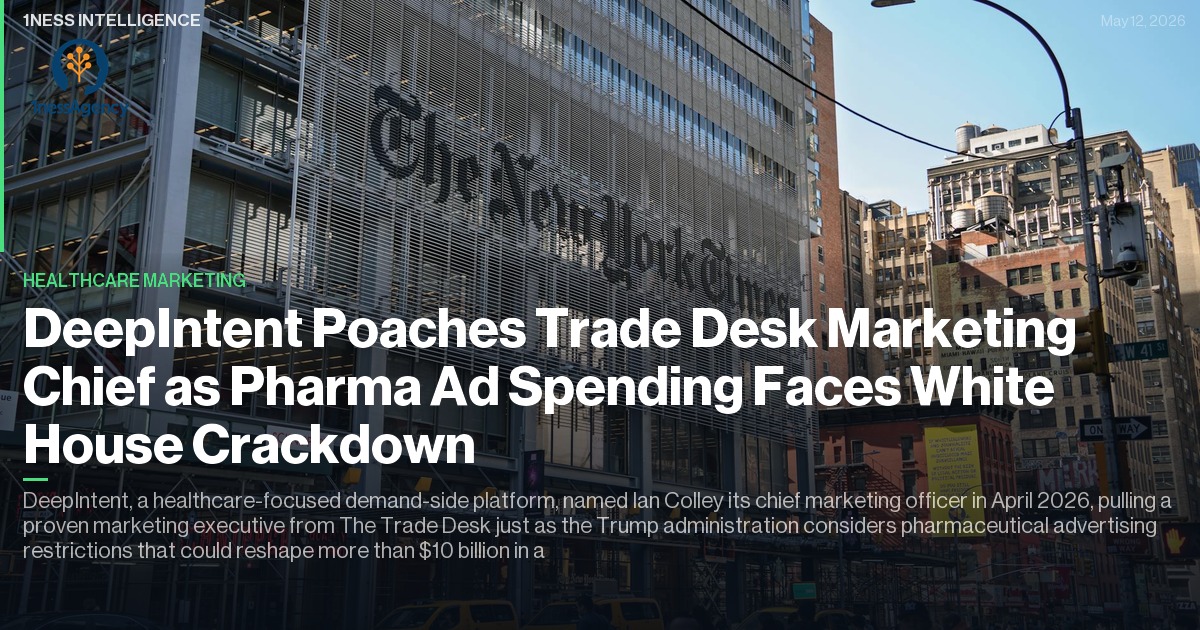
DeepIntent, a healthcare-focused demand-side platform, named Ian Colley its chief marketing officer in April 2026, pulling a proven marketing executive from The Trade Desk just as the Trump administration considers pharmaceutical advertising restrictions that could reshape more than $10 billion in annual ad spending . The move signals that healthcare adtech platforms see the current regulatory uncertainty not as a threat, but as a consolidation opportunity, one that demands marketing leadership who can navigate both programmatic transformation and Washington policy shifts.
Colley brings seven years from The Trade Desk and more than 30 years of marketing experience to a company betting that pharmaceutical marketers will accelerate their shift from linear television to programmatic channels even as regulatory headwinds build . He replaces Adam Kapel, who departed in 2024, and will report to DeepIntent founder and CEO Chris Paquette .
The timing reflects a inflection point for pharmaceutical marketing. Healthcare brands face simultaneous pressure from three directions: aging linear television audiences, rising programmatic capabilities for patient targeting, and a White House examining whether to curtail direct-to-consumer pharmaceutical advertising, a practice the United States shares with only New Zealand among developed nations.
For healthcare marketing executives, this leadership change at a specialized DSP reveals which way the smart money is moving. When a CMO leaves one of the world's largest demand-side platforms for a healthcare-specific competitor, the message is clear: vertical specialization in healthcare adtech now commands more strategic value than horizontal scale.
Why DeepIntent Hired a CMO During Regulatory Uncertainty
Most companies freeze executive hiring when their industry faces existential regulatory threats. DeepIntent did the opposite. The company filled its vacant CMO role, open since Kapel's 2024 departure, with a high-profile hire just as pharmaceutical advertising faces its most uncertain policy environment in decades .
The calculus is straightforward. If the Trump administration restricts pharmaceutical advertising, the $10 billion in annual spending doesn't vanish: it shifts . Brands that can no longer reach consumers directly will increase spending on provider education, medical conference sponsorships, and targeted digital campaigns to healthcare professionals. All of those channels run through programmatic infrastructure. DeepIntent's healthcare focus positions it to capture budget reallocations that generalist DSPs will miss.
Colley's background at The Trade Desk matters because that platform built its reputation on transparent, data-driven media buying in an industry notorious for opacity. Pharmaceutical brands face mounting pressure to prove marketing ROI as drug pricing scrutiny intensifies. A CMO who can credibly message around measurement, attribution, and accountable media spending becomes an asset, not overhead.
The Linear-to-Programmatic Shift Accelerates Under Pressure
Pharmaceutical brands spent decades perfecting linear television advertising. The 60-second spot explaining drug benefits and side effects became a fixture of evening news programming and cable networks targeting older demographics. That model is collapsing under dual pressure: audience fragmentation and regulatory risk.
Linear television viewership among adults 65 and older, the heaviest prescription drug users, continues its steady decline as streaming adoption reaches even older cohorts. Pharmaceutical marketers who built empires on broadcast reach now face a dilemma: follow audiences to fragmented digital platforms or accept declining reach efficiency.
Programmatic advertising offers precision that linear television never could. A healthcare DSP can target patients based on condition-specific signals, avoiding the waste of broadcast reach. For a specialty pharmaceutical brand treating a condition affecting 2% of the population, the ability to buy impressions against relevant health content rather than entire primetime blocks changes the economic model completely.
This shift from broadcast to programmatic represents the largest structural change in pharmaceutical marketing since direct-to-consumer advertising became legal in 1997. DeepIntent's hiring of Colley, and his willingness to leave The Trade Desk, suggests the specialized healthcare adtech players believe they can own this transition.
What Potential Advertising Restrictions Mean for Programmatic Spend
The Trump administration's consideration of pharmaceutical advertising restrictions creates a scenario where digital targeting may face tighter scrutiny than ever, or emerge as the compliant alternative to broadcast messaging, depending on how regulations develop .
If restrictions focus on direct-to-consumer emotional appeals common in television spots, digital formats emphasizing educational content and condition awareness may face less regulatory burden. Pharmaceutical marketers could shift budgets toward informational campaigns that programmatic channels deliver more efficiently than linear television.
Conversely, if restrictions target patient data use for advertising, programmatic pharmaceutical marketing faces an existential challenge. Healthcare DSPs built their value proposition on precise targeting using health-related signals. Regulations that prohibit using health conditions, prescription history, or provider visit patterns for ad targeting would force the industry to rebuild its models around contextual signals and broader demographic segments.
This uncertainty explains why DeepIntent needs a CMO now. The company must shape the regulatory conversation, not just react to it. Colley's challenge is positioning DeepIntent's targeting capabilities as privacy-respecting and patient-beneficial before regulators define the terms.
The Agency Implications: Specialization Beats Scale
For healthcare marketing agencies and their clients, Colley's move from The Trade Desk to DeepIntent signals a broader trend: vertical specialization now outcompetes horizontal scale in healthcare advertising technology.
The Trade Desk operates across every advertising vertical with massive reach and sophisticated technology. DeepIntent focuses exclusively on healthcare with deeper integration into pharmacy benefit managers, electronic health records, and healthcare-specific data assets. Colley's decision suggests the specialized platform offers more strategic value despite smaller scale.
Healthcare marketing agencies should recognize this principle extends beyond DSP selection. Clients increasingly value partners who understand HIPAA compliance, healthcare privacy regulations, and FDA promotional guidelines over generalist agencies offering broader capabilities. The healthcare marketing landscape is fragmenting into specialists who can navigate regulatory complexity and generalists who cannot compete on healthcare-specific expertise.
This fragmentation accelerates as regulatory pressure intensifies. When pharmaceutical brands face advertising restrictions, they need partners who understand the regulatory landscape deeply enough to find compliant alternatives, not agencies scrambling to add healthcare expertise.
The 1ness Take
DeepIntent's hire reveals the winning playbook for healthcare marketing in 2026 and beyond: bet on programmatic transformation and regulatory navigation simultaneously. The two trends are not separate: they're the same strategic challenge.
Healthcare marketing executives should reframe the current regulatory uncertainty as a forcing function that accelerates digital transformation. Brands that move now while competitors wait for regulatory clarity will capture disproportionate share as budgets shift from linear to programmatic channels. The pharmaceutical companies that treat potential advertising restrictions as a crisis will lose ground to competitors who treat them as a catalyst for marketing modernization.
The tactical recommendation: audit your current media mix and identify the percentage of pharmaceutical marketing spend still locked in linear television and other legacy channels. Build a 12-month scenario plan for how that budget redeploys if direct-to-consumer advertising faces restrictions. The brands that plan now gain first-mover advantage on programmatic platforms, provider channels, and patient education campaigns that compliant alternatives will require.
For marketing technology vendors and agencies, Colley's move demonstrates that executive talent follows strategic opportunity, not just company scale. The Trade Desk is a larger company with broader reach than DeepIntent. Colley joined DeepIntent anyway because the specialized healthcare focus offers more leverage during a market transition. Healthcare marketing agencies should apply this lesson: depth of healthcare expertise now commands more value than breadth of general marketing capabilities.
The regulatory uncertainty surrounding pharmaceutical advertising will resolve, either through formal restrictions, industry self-regulation, or White House policy shifts. What won't change is the structural decline of linear television and the rise of programmatic channels. DeepIntent hired Colley to position the company for both scenarios. Healthcare marketers should adopt the same dual-track strategy: prepare for regulatory change while accelerating digital transformation regardless of policy outcomes.
The Takeaway
Healthcare marketing leaders should take three immediate actions in response to this leadership move and the trends it represents:
Scenario plan your media strategy. Build specific budget reallocation models for three regulatory scenarios: continued DTC advertising freedom, partial restrictions on emotional appeals, and full prohibitions on consumer pharmaceutical advertising. Identify which programmatic capabilities you need in each scenario and begin vendor discussions now rather than after regulations finalize. Evaluate specialized versus generalist partners. Review your current agency roster and technology vendors. Assess whether your partners demonstrate deep healthcare regulatory expertise or general marketing capabilities adapted to healthcare. The gap between specialists and generalists will widen as regulatory complexity increases. Make partnership decisions that prioritize healthcare-specific knowledge over scale. Invest in compliant targeting infrastructure now. Regardless of regulatory outcomes, pharmaceutical marketers face intensifying scrutiny on patient data use. Audit your current targeting practices for HIPAA compliance, state privacy law adherence, and FDA promotional guidelines. Build programmatic capabilities using privacy-preserving targeting methods (contextual signals, aggregate data, and provider-focused channels) that will survive regulatory tightening. The brands that build compliant infrastructure now will maintain competitive advantage if restrictions arrive, and lose nothing if they don't.References
- Ostwal, T. (2026). Former Trade Desk CMO Ian Colley to Lead Marketing at DeepIntent. Adweek adweek.com