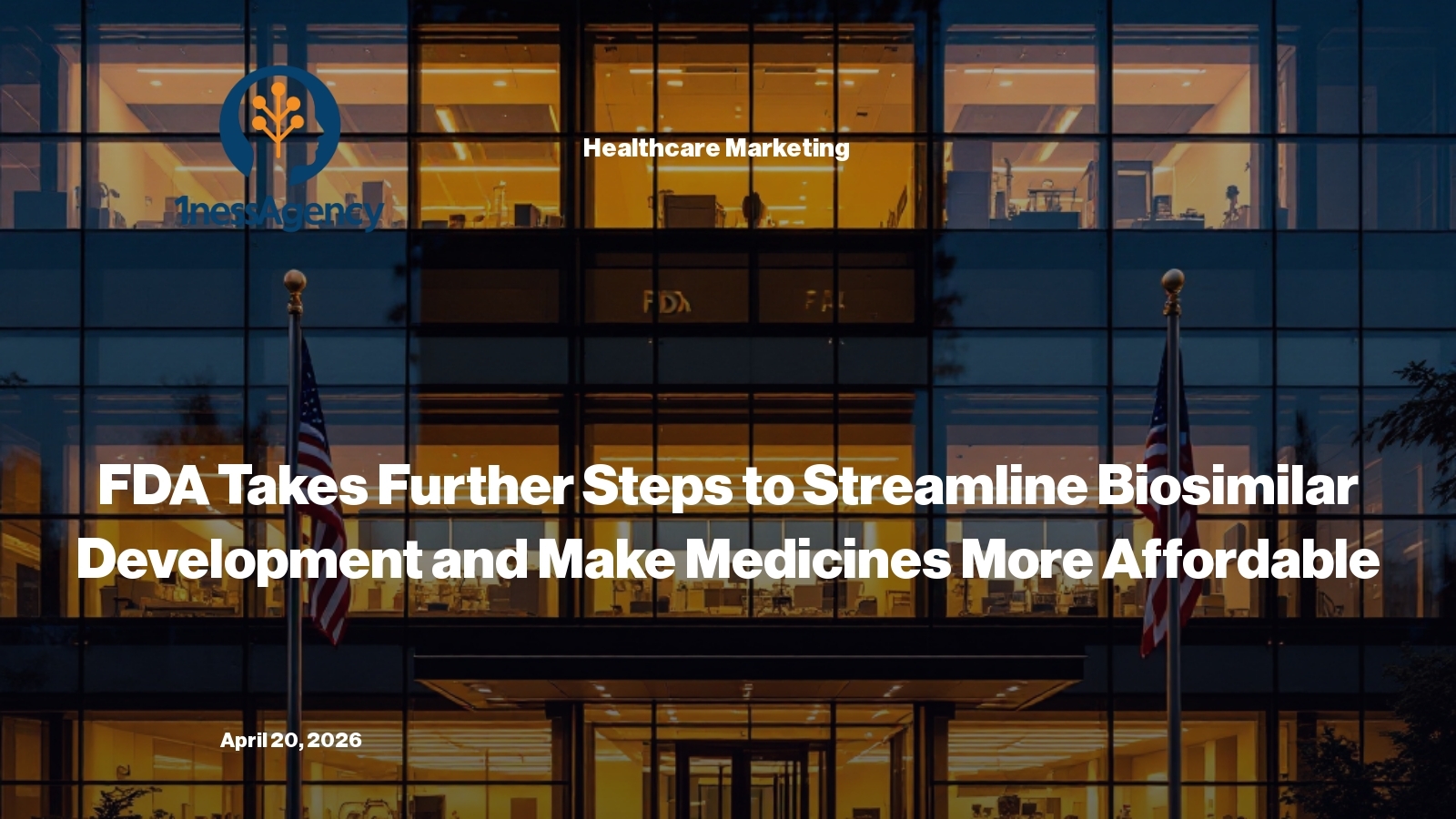
The FDA's accelerated push to streamline biosimilar development and expand state drug importation programs in 2026 has opened a marketing opportunity most health systems haven't recognized: affordability messaging now belongs at the center of patient acquisition strategy, not buried in financial assistance pages. As Commissioner Marty Makary fast-tracks both biosimilar pathways and Canada drug imports under White House pressure to lower costs, healthcare organizations face a choice, lead the affordability conversation or watch competitors claim the high ground.
The urgency is measurable. The FDA held a high-stakes meeting with multiple states in March 2026 to accelerate section 804 importation proposals, launching a quality assurance tool in January designed to help states submit approvable plans for importing prescription drugs from Canada [1]. The agency is offering pre-reviews of draft proposals and streamlined cost analysis requirements to remove barriers for states and tribes. This represents the most aggressive federal drug pricing intervention since Medicare negotiation launched, and it's happening now, not in pilot phase, but in active implementation.
"We are committed to lowering prescription drug prices for Americans, building on recent MFN wins," FDA Commissioner Marty Makary stated in March 2026, explicitly connecting the importation program to President Trump's executive order on drug pricing [1]. The language matters: the FDA is positioning itself as a patient affordability advocate, not just a safety regulator.
Why healthcare marketers beyond pharmacy leadership should care: patient financial anxiety now rivals clinical outcomes as a driver of provider selection and loyalty. A Connecticut Mirror-KFF Health News investigation published in April 2026 found that doctors, dentists, and ambulance companies now file more than 80% of medical debt collection lawsuits in Connecticut, a complete reversal from 2019, when hospitals dominated such cases at 75% [2]. The lawsuits, typically over bills under $3,000, result in wage garnishment, home liens, and patients being blacklisted from care [2]. One nurse was sued for $1,972 by her own OB-GYN practice and told she couldn't be seen because she was "blacklisted" [2]. This is the patient experience context in which your affordability messaging will be received.
The Regulatory Landscape: Two Pathways to Lower-Cost Medications
The FDA's 2026 biosimilar streamlining initiative aims to accelerate approval of lower-cost alternatives to expensive biologic drugs. While the FDA press announcement doesn't detail specific regulatory changes, the timing aligns with the agency's importation program expansion, suggesting a coordinated affordability strategy across multiple drug categories.
The section 804 importation program allows states and Indian tribes to import prescription drugs from Canada at significantly reduced costs [1]. The program launched with Florida's approval in previous years, but the March 2026 meeting signals scaled implementation. The FDA now offers pre-submission consultations, draft proposal reviews, and standardized cost analysis templates to reduce approval timelines [1].
The National Academy for State Health Policy participated in the March gathering, indicating coordination across health policy infrastructure [1]. For health systems in states pursuing importation authorization, this creates a six-to-eighteen-month window where early affordability positioning can differentiate market leaders from followers.
The financial magnitude justifies the regulatory attention. While specific cost savings from the biosimilar initiative weren't disclosed in available sources, drug importation programs are designed to generate "significant" reductions in consumer costs [1]. For context, biosimilars typically enter the market at 15-35% discounts to reference biologics, with prices declining as competition increases.
What This Means for Healthcare Marketing Strategy
Most health systems treat drug costs as a pharmacy department issue. The smart ones will recognize this as a brand positioning opportunity before Q3 2026.
Patients can't distinguish between hospital-inflicted financial harm and physician practice collections. The Connecticut investigation shows doctors and other non-hospital providers now dominate medical debt litigation, but patients don't parse these distinctions [2]. When a nurse gets sued by her OB-GYN for less than $2,000 and is subsequently denied care, she doesn't blame "physician practice billing", she blames healthcare [2].
This creates asymmetric risk. Health systems that have curtailed aggressive collections still suffer reputation damage from the broader healthcare affordability crisis. Conversely, systems that proactively message around biosimilar adoption and drug cost reduction can capture disproportionate trust.
The regulatory momentum provides air cover. Commissioner Makary's public statements positioning the FDA as a drug affordability champion give healthcare marketers permission to lead with cost messaging without appearing defensive [1]. When the FDA Commissioner says "we are committed to lowering prescription drug prices," health systems can echo that commitment in patient-facing communications without sounding like they're admitting past overcharging.
State-level importation programs create geographic targeting opportunities. If your state is among those meeting with the FDA about section 804 proposals, you have a 12-18 month window before program launch to prepare patient education campaigns. Health systems in participating states can position themselves as importation partners, explaining how patients will access lower-cost medications through their pharmacies and clinics.
The Collections Context Healthcare Marketers Can't Ignore
The Connecticut data reveals how financial harm destroys patient relationships and market position. Providers filed thousands of lawsuits over medical debt in 2024, with more than 80% now coming from physicians, dentists, and other non-hospital entities [2]. These aren't collection letters, these are court actions resulting in wage garnishment and property liens over bills averaging under $3,000 [2].
The financial assistance gap is structural. Most physician practices aren't tax-exempt nonprofits and therefore aren't bound by federal financial assistance requirements that govern hospitals [2]. This creates a two-tier system where hospital bills may be eligible for charity care while physician bills from the same encounter proceed to litigation.
Patients experience this as betrayal, not as a regulatory distinction. The nurse who was "blacklisted" by her OB-GYN practice didn't understand why her medical provider "let my care be interrupted like this" [2]. She's a healthcare worker herself, yet the system remained opaque and punitive.
For healthcare marketers, this context means affordability messaging must be specific, not aspirational. "We care about costs" means nothing. "We offer biosimilar alternatives that cost 30% less than brand biologics" creates patient trust. "We screen every patient for financial assistance eligibility before scheduling procedures" differentiates your system from competitors who sue patients after the fact.
Follow the Money: Why Affordability Marketing Drives Market Share
Patient acquisition costs in competitive healthcare markets now exceed $500 per new patient in many specialties. Financial distress is driving provider selection more than clinical reputation in cost-sensitive segments.
The biosimilar and importation initiatives target expensive maintenance medications for chronic conditions, exactly the patient populations that drive lifetime value for health systems. A patient with rheumatoid arthritis taking a $60,000-per-year biologic represents 20+ years of potential relationship value. If your pharmacy can provide the biosimilar at $40,000 through proactive switching, you've created $400,000 in patient savings over a treatment lifetime, and secured that patient's loyalty across all service lines.
The marketing math is straightforward. A coordinated campaign highlighting biosimilar availability and drug cost transparency costs $50,000-150,000 for a regional market. If it drives 200 new patients into your system at $3,000 average annual margin, you've generated $600,000 in first-year contribution. The payback period is under six months.
The compliance angle creates barrier-to-entry for competitors. Health systems with sophisticated pharmacy operations, prior authorization support, and financial navigation services can actually deliver on affordability promises. Community hospitals without these capabilities can't credibly message on drug costs without operational follow-through. This makes affordability positioning a sustainable competitive advantage, not just a campaign theme.
Compliance and Regulatory Considerations
Financial assistance messaging must align with your organization's actual policies. If your hospital has robust charity care but your affiliated physicians sue patients over small balances, your marketing creates legal exposure. The Connecticut investigation shows this exact disconnect happening across multiple systems [2].
State and federal regulations govern financial assistance for tax-exempt hospitals under IRS Section 501(r). These requirements mandate written financial assistance policies, limitations on collection actions, and billing and collections compliance. Marketing claims about affordability must reflect actual financial assistance availability, screening processes, and collection limitations.
Drug importation marketing requires accuracy about availability and timing. If your state hasn't received FDA approval for section 804 importation, you can't promise access to imported medications. You can message around advocacy for importation or commitment to participate once approved, but claims must be defensible.
Biosimilar messaging must meet FDA standards for truthful, non-misleading prescription drug communications. While biosimilars are highly similar to reference biologics, marketers can't make interchangeability claims unless the FDA has specifically designated the biosimilar as interchangeable. Patient education materials should explain biosimilar equivalence in clinical terms, not marketing superlatives.
The 1ness Take
Healthcare marketers should treat the FDA's 2026 biosimilar and importation acceleration as a forcing function for rebuilding financial trust, not just as a pharmacy operations story.
Build a drug affordability content hub on your website by Q3 2026. Create patient-facing resources explaining biosimilars, importation programs, and medication financial assistance. Most health systems bury this information in pharmacy department pages. Put it in your main navigation under "Affording Your Care" or "Medication Costs." Make it as prominent as "Find a Doctor."
Launch proactive biosimilar conversion outreach for high-cost biologics. Don't wait for insurance mandates or patient questions. Identify patients on expensive reference biologics where biosimilars exist, and have pharmacists or nurses initiate conversations about switching. Frame it as clinical partnership, not cost-cutting. "New options are available that work the same way but cost significantly less. Would you like to discuss whether switching makes sense for you?"
Audit every patient-facing financial communication for clarity and accessibility. The Connecticut investigation revealed patients being sued over debts they didn't know existed [2]. If your billing statements require a graduate degree to understand, you're creating the conditions for patient betrayal. Test your statements with actual patients, not compliance officers.
Partner with state health departments on importation program readiness if your state is pursuing section 804 authorization. Offer to pilot pharmacy participation, provide patient education, or support cost analysis. Early partnership positions your system as a solution partner, not just another healthcare cost driver.
Most importantly, recognize that affordability messaging is worthless without operational delivery. The nurse who was blacklisted by her OB-GYN practice shows what happens when billing operations contradict patient experience promises [2]. Marketing can't fix broken collections practices, but it can expose them. If your patient access campaign drives volume to service lines that sue patients over $2,000 bills, you've accelerated reputation damage, not built brand value.
The FDA has created a policy window for healthcare affordability leadership. It will close when every health system makes the same claims. The organizations that move in Q2 and Q3 2026 will own the positioning. The ones that wait for "proof of concept" will be marketing followers in a commodity conversation.
The Takeaway
Start with a drug affordability audit. By end of Q2 2026, document which biosimilars your pharmacy stocks, what your financial assistance threshold is for prescription medications, and whether your affiliated physicians are filing collection lawsuits. You can't market what you can't deliver.
Build the content infrastructure for patient education on biosimilars and importation before these programs scale. The health systems with robust patient resources in place when state importation programs launch will capture search traffic and patient trust. The ones scrambling to catch up will look reactive.
Connect your affordability positioning to patient access metrics, not just marketing impressions. Track new patient acquisition in high-cost medication categories, patient assistance program enrollment, and biosimilar conversion rates. If your affordability campaign doesn't change these numbers within 90 days, your messaging isn't reaching patients who make decisions based on cost, which is increasingly everyone.
References
- FDA. "FDA Holds Meeting with States on Importation of Lower Cost Drugs." FDA Press Announcement, March 6, 2026 fda.gov
- Levey, N.N., Golvala, K., and Carlesso, J. "In Connecticut, Doctors Now Sue Patients Most Over Medical Bills, Surpassing Hospitals." KFF Health News and CT Mirror, April 20, 2026 kffhealthnews.org