- The FDA selected seven companies including Eli Lilly, Regeneron, and Cellares Corp. for its PreCheck Pilot Program on June 29, 2026, representing the most consequential shift in U.S. pharmaceutical manufacturing policy in a generation.
- The FDA received more than 80 requests to join the PreCheck program between February 1 and March 1, 2026, with only seven selected, yielding an 8.75% acceptance rate.
- The selected companies manufacture biologics, gene therapies, and sterile injectables that are central to competitive markets in oncology, rare disease, and chronic care treatment.
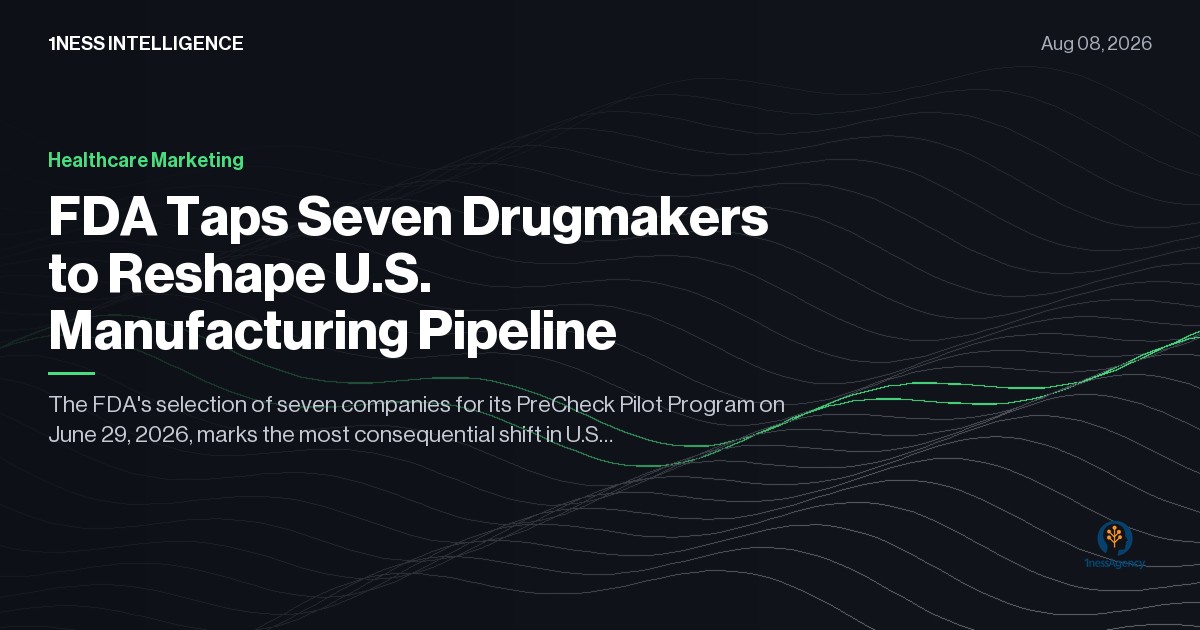
The FDA's selection of seven companies for its PreCheck Pilot Program on June 29, 2026, marks the most consequential shift in U.S. pharmaceutical manufacturing policy in a generation , and it carries direct implications for how health systems, specialty pharmacies, and drug manufacturers communicate supply reliability, treatment access, and therapeutic innovation to patients and payers. The companies selected , including Eli Lilly, Regeneron, and Cellares Corp. , are not peripheral players. They manufacture the biologics, gene therapies, and sterile injectables that sit at the center of the most competitive patient acquisition battlegrounds in oncology, rare disease, and chronic care.
Between February 1 and March 1, 2026, the FDA received more than 80 requests to join the PreCheck program. Seven were selected. That 8.75% acceptance rate signals that the FDA is treating this pilot as a high-stakes regulatory experiment, not a broad invitation. Simultaneously, the FDA issued a proposed rule on July 10, 2026, that would allow distributed manufacturing networks operating on a hub-and-spoke model to register as a single establishment , reducing administrative burden and increasing FDA oversight of foreign drug supply sources. Together, these moves represent a coordinated federal push to rebuild domestic pharmaceutical capacity while making the regulatory pathway more predictable for manufacturers willing to invest in U.S. facilities.
Acting FDA Commissioner Kyle Diamantas framed the PreCheck program as a transparency initiative: "By making our regulatory processes and expectations more transparent, we ensure that American pharmaceutical manufacturers remain global leaders while securely providing high-quality treatments to patients right here at home." That transparency argument has a direct analog in healthcare marketing , patients and payers are making access decisions based on supply confidence, not just clinical efficacy.
For healthcare marketers, this regulatory realignment is not background noise. When drug manufacturers earn faster, more predictable FDA approval pathways through earlier engagement, product launch timelines compress. Compressed timelines mean compressed windows for market education, HCP outreach, and patient activation. The organizations that build their content infrastructure, payer communication strategies, and patient support messaging before FDA approval , not after , will capture the early-mover advantage in category after category.
Gene Therapy and Biologics: The Marketing Frontier Just Got More Competitive
Four of the seven PreCheck participants , Cellares Corp., Kriya Therapeutics, Kyowa Kirin, and Regeneron , are manufacturing biologics, gene therapies, or advanced cell-based therapies. This concentration is not coincidental. These are the product categories where supply chain fragility has historically been most acute and where patient populations are most dependent on uninterrupted access.
The FDA's simultaneous approval of Tregzi on June 30, 2026 , the first regulatory T-cell-based immunotherapy for chronic graft-versus-host disease , demonstrates how quickly the advanced therapy pipeline is moving from clinical trial to commercial market. Tregzi's approval required educating oncologists, transplant centers, and patients about a mechanism of action that did not exist in commercial form twelve months ago. That education gap is a marketing problem before it is a clinical one.
When Cellares Corp.'s Bridgewater, NJ facility and Kriya Therapeutics' Durham, NC facility come online under PreCheck's accelerated oversight model, their commercial launches will arrive faster than the market's current education infrastructure can absorb. Health systems with oncology and hematology service lines need to build physician education programs, patient navigation protocols, and payer pre-authorization frameworks now , not at the filing date.
What this means for your patient acquisition strategy: Specialty therapy launches are no longer 18-month runway events. PreCheck's Phase 2 model , which allows expedited facility evaluation and earlier inspections , compresses that window. Marketing teams supporting biologic or gene therapy brands should treat FDA facility acceptance into PreCheck as the starting gun for launch preparation, not drug approval.Supply Chain Confidence Is Now a Patient Retention Message
Drug shortages have historically been treated as an operations problem. The federal government's coordinated 2026 response , PreCheck, the distributed manufacturing registration rule, and Executive Order 14293 , reframes supply chain resilience as a public health communications priority.
Amneal Pharmaceutical's Long Island, NY facility will manufacture sterile liquid products for pain management, respiratory, and ophthalmic diseases , therapeutic areas where patients have experienced shortage-driven treatment disruptions. FUJIFILM Biotechnologies' Holly Springs, NC facility will support commercial-scale cell culture biomanufacturing. Both represent domestic capacity additions in categories where foreign manufacturing dependence has historically created patient access gaps.
Health systems and specialty pharmacies that can credibly communicate "we have access to the treatments you need, when you need them" are building a retention argument, not just a clinical one. The FDA's proposed manufacturing registration rule , which would require advance notification of any unit relocation within a hub-and-spoke network , creates greater real-time visibility into supply availability. That visibility will eventually be marketable.
Benchmark to watch: Supply continuity messaging is currently underused in health system marketing. 1ness's perspective is that organizations that begin communicating formulary stability and supply chain partnerships as patient-facing value propositions in 2026 will differentiate in markets where patients have experienced shortage-driven care disruptions.Domestic Manufacturing Is a Trust Signal , Use It
Eli Lilly's Lebanon, IN facility and Regeneron's Saratoga Springs, NY facility are manufacturing active pharmaceutical ingredients and novel protein therapeutics for diseases that span primary care, specialty care, and rare disease. These are household names in the physician community, and their PreCheck participation gives them a regulatory trust signal that smaller manufacturers cannot yet match.
HHS Secretary Robert F. Kennedy Jr. framed the PreCheck program explicitly as a national security and patient access initiative. That framing , domestic production, reliable access, high-quality American jobs , maps directly to the values-based messaging that drives patient preference in an era of institutional skepticism toward healthcare.
For health systems and medical groups that partner with or refer to these manufacturers' therapies, the domestic manufacturing story is a co-marketing opportunity. Physicians who can tell patients "this treatment is manufactured in the United States under enhanced FDA oversight" are answering an anxiety that no clinical data sheet addresses.
Actionable Takeaways for Healthcare Marketers
- Audit your therapy portfolio for PreCheck participants. If your formulary or referral network includes products from Eli Lilly, Regeneron, Amneal, or Cellares, their PreCheck participation is a supply reliability story you can tell patients and payers today.
- Compress your launch preparation timeline. Treat FDA facility acceptance into PreCheck as a launch trigger, not a background event. Build HCP education, patient activation, and payer communication assets before NDA/BLA filing.
- Develop supply chain confidence messaging. Patients who have experienced drug shortages respond to access assurance. Build this into your patient communication strategy, particularly for chronic disease and specialty therapy service lines.
- Map the gene therapy education gap. If your health system has oncology or hematology service lines, build physician education infrastructure now for AAV-based and T-cell therapies before the Cellares and Kriya pipelines reach market.
- Monitor the hub-and-spoke registration rule. The FDA's proposed rule creates new transparency into distributed manufacturing networks. Track the comment period and finalization timeline , it will affect formulary planning and payer contracting narratives.
The 1ness Take
The FDA's PreCheck pilot is a regulatory story with a marketing deadline. Seven companies now have a faster, more transparent pathway to U.S. market entry for some of the most complex therapies in the pipeline. That acceleration is not symmetric , manufacturers inside PreCheck will move faster than the market's existing education infrastructure expects.
Our recommendation: healthcare marketers should treat PreCheck acceptance the way they treat Phase 3 trial completion , as a commercial preparation milestone, not a watch-and-wait moment. The organizations that build their patient education content, payer communication frameworks, and physician outreach programs in the 12 months before NDA submission will capture market share from those who wait for the approval letter.
The deeper strategic shift is this: domestic manufacturing is becoming a trust asset, not just a supply chain variable. In a healthcare environment where patients are increasingly skeptical of institutional actors, the ability to say "this therapy is made here, under enhanced FDA oversight, by a company that invested in American manufacturing" is a values-based differentiator that no clinical endpoint communicates on its own. The brands and health systems that learn to tell that story clearly , and compliantly , will convert it into patient preference and payer credibility well before their competitors recognize what happened.
The Takeaway
1. Identify your PreCheck exposure today. Map which therapies in your formulary, referral network, or brand portfolio are manufactured by PreCheck participants. Brief your marketing and payer relations teams on what the program means and what it does not guarantee.
2. Build a supply confidence content library. Develop patient-facing and HCP-facing content that translates FDA manufacturing oversight into plain-language access assurance , before a shortage gives a competitor the opening to do it first.
3. Set a calendar alert for the distributed manufacturing registration rule's comment period. The FDA's July 10, 2026 proposed rule will reshape how foreign and domestic manufacturing networks register and report. Its finalization will affect formulary planning, specialty pharmacy contracting, and any marketing claims tied to supply chain origin or reliability.
References
U.S. Food and Drug Administration. "FDA Selects Seven Participants for PreCheck Pilot Program to Advance U.S. Drug Manufacturing." FDA Press Announcement. June 29, 2026. https://www.fda.gov/news-events/press-announcements/fda-selects-seven-participants-precheck-pilot-program-advance-us-drug-manufacturing U.S. Food and Drug Administration. "FDA Approves New Treatment That Uses Donor Immune Cells to Prevent Serious Complications in Blood Cancer Patients." FDA Press Announcement. June 30, 2026. https://www.fda.gov/news-events/press-announcements/fda-approves-new-treatment-uses-donor-immune-cells-prevent-serious-complications-blood-cancer U.S. Food and Drug Administration. "FDA Proposes Rule to Modernize Drug Manufacturing Registration." FDA Press Announcement. July 10, 2026. https://www.fda.gov/news-events/press-announcements/fda-proposes-rule-modernize-drug-manufacturing-registrationThis report is for informational purposes only and does not constitute investment advice or an offer to buy or sell any security. Content is based on publicly available sources believed reliable but not guaranteed. Opinions and forward-looking statements are subject to change; past performance is not indicative of future results. 1ness Strategies and its affiliates may hold positions in securities discussed herein. Readers should conduct independent due diligence and consult qualified advisors before making investment decisions.
© 2026 1ness Strategies. All rights reserved.