
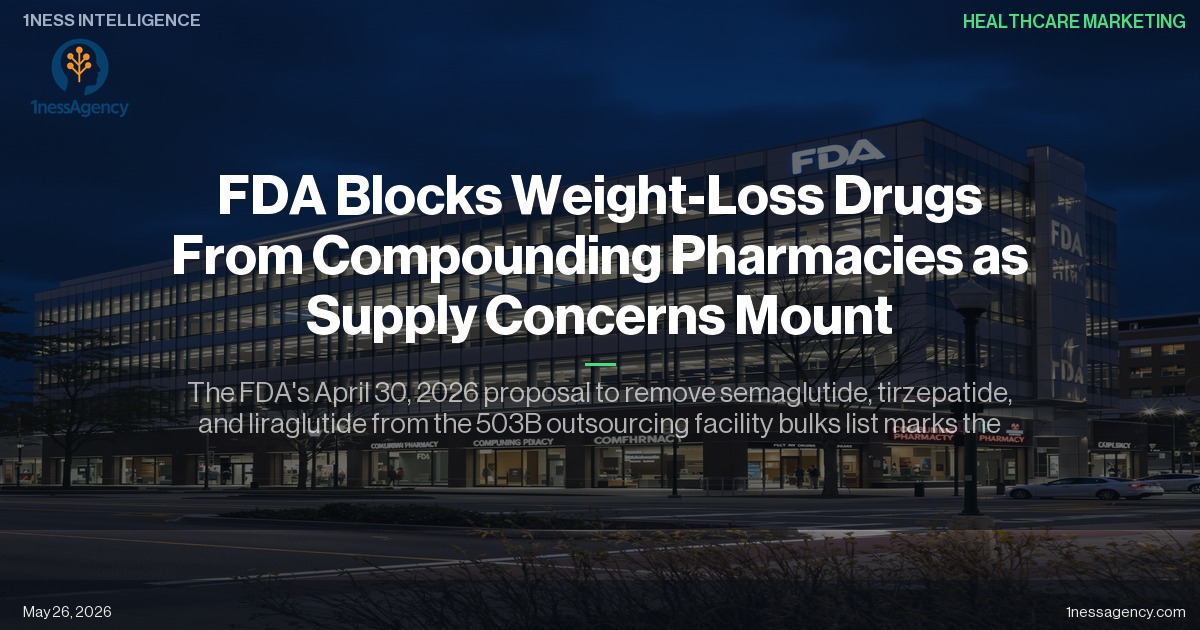
- The FDA proposed on April 30, 2026 to remove semaglutide, tirzepatide, and liraglutide from the 503B outsourcing facility bulks list, closing a major regulatory pathway for compounded weight-loss drugs.
- The FDA's public comment window for this proposal closes June 29, 2026, with a final determination expected within months rather than years.
- Clinics, telehealth platforms, and med spas that built patient pipelines on compounded GLP-1 access face the closure of this distribution channel under FDA Commissioner Marty Makary's regulatory shift.
The FDA's April 30, 2026 proposal to remove semaglutide, tirzepatide, and liraglutide from the 503B outsourcing facility bulks list marks the most consequential regulatory shift in weight management marketing since these drugs entered the mainstream. For the clinics, telehealth platforms, and med spas that built patient pipelines on compounded GLP-1 access, the message from FDA Commissioner Marty Makary, M.D., M.P.H. is unambiguous: that pipeline is closing.
The FDA's proposal, published April 30, 2026, triggers a public comment window that closes June 29, 2026. After that date, the agency will weigh submissions before issuing a final determination , meaning the regulatory floor could shift within months, not years. Under Section 503B of the Federal Food, Drug, and Cosmetic Act, outsourcing facilities can only compound drugs from bulk substances if those substances appear on the 503B bulks list or the drug is actively on the FDA's shortage list at the time of compounding, distribution, and dispensing. The FDA found no clinical need sufficient to keep all three molecules on that list.
"When FDA-approved drugs are available, outsourcing facilities cannot lawfully compound using bulk drug substances unless there is a clear clinical need," Commissioner Makary stated in the April 30 announcement. That single sentence is a compliance deadline disguised as a policy principle.
For healthcare marketers, the downstream effect extends far beyond compounding pharmacies. Any practice, platform, or health system that marketed access to compounded semaglutide or tirzepatide as a patient acquisition hook , lower cost, faster access, no prior auth , faces an immediate strategic gap. The patients you acquired on that value proposition are still in your funnel. The offer that brought them in may not survive final rulemaking.
What the 503B Proposal Actually Closes , and What It Doesn't
The 503B bulks list governs what outsourcing facilities , large-scale compounders registered with the FDA , can produce from raw bulk substances. This proposal does not directly address 503A pharmacies, which serve individual patient prescriptions from licensed prescribers. That distinction matters for marketers advising clinical partners on messaging.
What the proposal does close is the large-volume, outsourcing-facility channel that supplied compounded GLP-1s at scale to telehealth platforms and weight loss clinics across the country. The economics were significant: compounded semaglutide was priced substantially below branded Ozempic and Wegovy, which carry list prices exceeding $900 per month without insurance coverage, according to publicly available manufacturer pricing data. That price gap was the central patient acquisition argument for an entire category of direct-to-consumer weight loss brands.
Practices that relied on compounded supply to serve cash-pay patients , a segment that grew rapidly as GLP-1 demand outpaced insurance coverage , must now decide: absorb higher branded drug costs, restructure toward manufacturer patient assistance programs, or reposition the clinical offer entirely.
The GLP-1 Marketing Landscape Shifts Toward Branded and Insurance-Eligible Patients
The proposal's timing coincides with a broader coverage instability in the individual insurance market. Congress's decision not to extend enhanced ACA marketplace tax credits has pushed consumers toward non-ACA-compliant plans that frequently exclude GLP-1 coverage entirely, according to KFF Health News reporting from May 2026. The result: the patient most likely to seek compounded GLP-1s , the cost-sensitive, cash-pay patient without employer-sponsored insurance , faces simultaneous pressure from both the supply side (compounding restrictions) and the demand side (coverage gaps).
For healthcare marketers, this is a patient segmentation problem that requires immediate attention. The cash-pay GLP-1 patient cohort that fueled growth for telehealth platforms like Hims & Hers and Ro over the past two years may contract sharply if final rulemaking eliminates compounded supply. Marketing messaging built around "affordable GLP-1 access" will require restructuring around manufacturer affordability programs, prior authorization navigation support, or employer benefit partnerships , none of which carry the same frictionless conversion rate as a cash-pay offer.
Practices that pivot toward the commercially insured and Medicare Advantage patient population will find a more durable acquisition channel, but one that demands different creative, different SEO strategy, and different patient education content. Wegovy's FDA approval for cardiovascular risk reduction in patients with obesity and established cardiovascular disease , granted in 2024 , gives clinicians and marketers a medically defensible, insurance-eligible indication that remains unaffected by 503B rulemaking.
Compliance Risk Is Now a Marketing Risk
Healthcare marketers who continue to promote compounded GLP-1 availability after final rulemaking , or who fail to update landing pages, email nurture sequences, and paid search copy , face exposure that extends beyond the clinical team. The FTC has increased scrutiny of health product claims that cannot be substantiated, and state attorneys general have pursued telehealth platforms for deceptive marketing practices related to weight loss treatments.
The comment period closes June 29, 2026. Any marketing asset that references compounded semaglutide, tirzepatide, or liraglutide as an available service should be flagged for legal review before that date. Waiting for final rulemaking to update your content is not a compliance strategy , it is a liability accumulation strategy.
Actionable Framework: The 60-Day GLP-1 Marketing Audit
Healthcare marketing teams should execute the following before the June 29 comment deadline:
- Audit all patient-facing content , website, landing pages, paid search, email, SMS , for any reference to compounded GLP-1 availability. Flag for legal review and prepare alternate versions contingent on final rulemaking.
- Segment your existing GLP-1 patient list by payer type. Identify cash-pay patients who were acquired on a compounded-access value proposition and develop a proactive retention communication that addresses the regulatory change honestly.
- Build a manufacturer affordability pathway guide for clinical staff. Novo Nordisk and Eli Lilly both operate patient savings programs for Wegovy, Ozempic, Mounjaro, and Zepbound. Position your practice as the navigation resource , this becomes a new patient acquisition differentiator.
- Develop an insurance navigation content pillar targeting patients with employer coverage. SEO content around "Does my insurance cover Wegovy?" and "How to get GLP-1 approved by insurance" captures high-intent search volume that will grow as compounded options disappear.
- Submit a public comment to the FDA docket before June 29, 2026, if your organization has clinical data or patient population data that supports a clinical need argument. This is a legitimate regulatory participation opportunity , and a content marketing opportunity documenting your advocacy.
Compliance Callout: Any healthcare organization marketing compounded GLP-1 medications must ensure current and future claims align with FDA 503B regulations and FTC truth-in-advertising standards. The proposed exclusion does not yet carry the force of final regulation, but marketing claims that cannot be sustained after final rulemaking create FTC and state AG exposure. Consult legal counsel before the June 29 comment deadline.
The 1ness Take
The practices that survive this regulatory shift are not the ones that wait for the FDA's final rule. They are the ones that treat April 30, 2026 as a strategic inflection point and start repositioning now.
The compounded GLP-1 boom created a generation of weight loss patients who entered the healthcare system through price-sensitive, direct-to-consumer channels. Many of those patients have now experienced real clinical results , weight loss, metabolic improvement, cardiovascular benefit. That clinical relationship is valuable regardless of how the drug was initially delivered. The marketing opportunity is to re-enroll those patients in a durable, clinician-led care model that is insulated from compounding regulation.
Our recommendation: Shift your GLP-1 marketing narrative from product access to clinical stewardship. The message "we can get you the drug cheaper" has a regulatory expiration date. The message "we manage your metabolic health and navigate your coverage options" does not. Build content, patient journeys, and referral programs around the second message , starting now. Practices that make this pivot before final rulemaking will own the patient relationship. Practices that don't will watch their GLP-1 patient volume exit to whoever does.The Takeaway
1. Audit your GLP-1 marketing assets before June 29, 2026. Every landing page, ad, and email that references compounded semaglutide, tirzepatide, or liraglutide needs legal review and a contingency version ready for post-rulemaking deployment.
2. Segment and communicate with your existing GLP-1 patient base now. Patients who came in on a compounded-access offer deserve proactive, honest communication about what changes and why , before they find out from a competitor or a news article.
3. Reposition your content strategy around insurance navigation and clinical management. The patients who will remain accessible and acquirable after final rulemaking are commercially insured and Medicare Advantage-eligible. Build for that audience today.
References
U.S. Food and Drug Administration. "FDA Proposes to Exclude Semaglutide, Tirzepatide, and Liraglutide on 503B Bulks List." FDA Press Announcement, April 30, 2026. https://www.fda.gov/news-events/press-announcements/fda-proposes-exclude-semaglutide-tirzepatide-and-liraglutide-503b-bulks-list U.S. Food and Drug Administration. FDA drug approval database and manufacturer prescribing information for Wegovy (semaglutide), Ozempic (semaglutide), Mounjaro (tirzepatide), and Zepbound (tirzepatide). Cardiovascular indication for Wegovy approved March 2024. https://www.fda.gov Kwon, Sarah. "Cheaper, Alternative Health Plans Are Having a Moment, but Critics Urge Caution." KFF Health News, May 26, 2026. https://kffhealthnews.org/health-industry/alternative-health-plans-growth-sharing-ministries-short-term-aca-premiums/This report is for informational purposes only and does not constitute investment advice or an offer to buy or sell any security. Content is based on publicly available sources believed reliable but not guaranteed. Opinions and forward-looking statements are subject to change; past performance is not indicative of future results. 1ness Strategies and its affiliates may hold positions in securities discussed herein. Readers should conduct independent due diligence and consult qualified advisors before making investment decisions.
© 2026 1ness Strategies. All rights reserved.