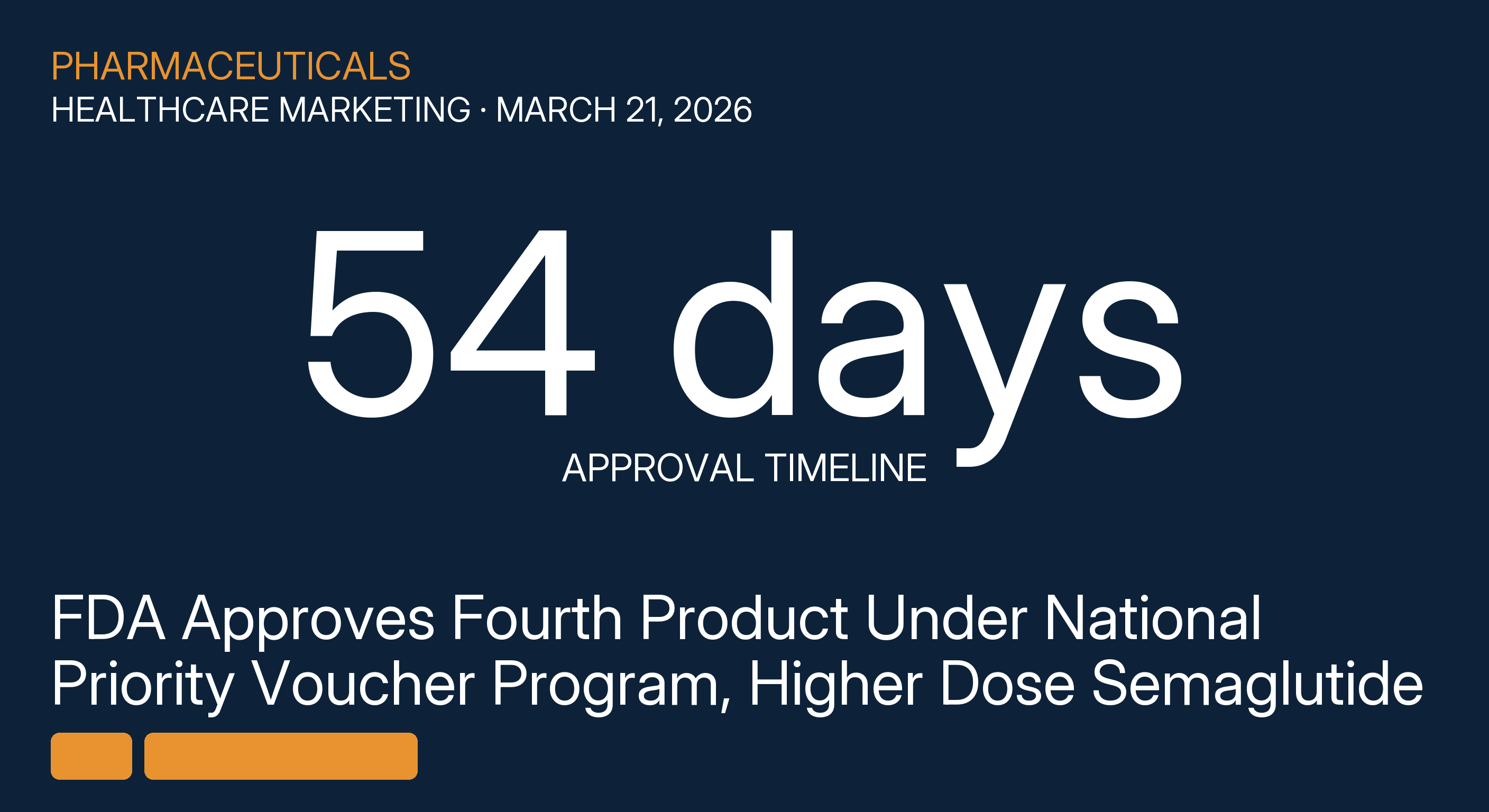
The FDA just approved a higher-dose weight loss medication in 54 days, less than two months from filing to market. For pharmaceutical marketers and healthcare executives, this isn't just a regulatory milestone. It's a fundamental shift in go-to-market planning, competitive positioning, and the entire calculus of how quickly breakthrough therapies can reach patients. When approval timelines compress by 70-80% under the new Commissioner's National Priority Voucher program, your product launch roadmaps need to change accordingly.
The approval of Wegovy HD (7.2 mg semaglutide) on March 19, 2026, represents the fourth product approved under this pilot program, which fast-tracks applications addressing "critical national health priorities." For marketing leaders, the strategic implications extend far beyond obesity treatment: expedited pathways mean compressed launch windows, accelerated competitive responses, and dramatically shortened market exclusivity periods before the next innovation arrives.
The New Regulatory Reality: 54-Day Approvals Change Everything
Traditional FDA approval timelines for new drug applications average 10-12 months. The Wegovy HD approval took 54 days, a timeline reduction that fundamentally alters pharmaceutical marketing strategy.
Under the Commissioner's National Priority Voucher pilot program, selected companies receive enhanced communications, rolling review processes, and shortened approval timelines for products that address national health priorities, promote domestic manufacturing, or increase affordability. This matters because your competitive advantage window just shrunk by six to nine months.
Consider the marketing implications: If your organization operates on traditional 18-24 month launch preparation cycles, you're now building campaigns for products that may face competitive responses in a fraction of that time. The marketing teams that win will be those with agile infrastructure, modular campaign assets, pre-negotiated media buys with flexibility clauses, and sales training programs that can deploy in weeks rather than quarters.
For Wegovy HD specifically, clinical data demonstrated additional average weight reduction compared to previously approved doses, though the FDA announcement didn't provide specific percentage improvements. The safety profile remained consistent with known semaglutide side effects, primarily gastrointestinal issues including nausea, vomiting, diarrhea, constipation, and abdominal pain. One notable addition: altered skin sensation (sensitivity, pain, or burning) occurred more frequently at higher doses, generally resolving on its own or with dose reduction. The FDA is conducting further investigations on this adverse event.
Strategic Positioning in the GLP-1 Market: Moving Beyond "Me Too" Messaging
The obesity treatment market represents one of healthcare's most crowded competitive landscapes, with multiple GLP-1 receptor agonists vying for market share. Wegovy HD's approval as a higher-dose option creates a three-tier market positioning challenge for all players in this space.
For Novo Nordisk: The marketing opportunity lies in positioning dosage flexibility as personalized medicine. Rather than messaging around "stronger" or "maximum dose," the strategic frame should emphasize individualized treatment escalation, giving providers and patients control over their therapeutic journey. This approach also preempts concerns about starting patients on unnecessarily high doses. For competitors: This approval forces immediate response strategies. Do you pursue your own higher-dose options (adding 12-18 months to development timelines, or potentially just 2-3 months under priority voucher programs)? Do you differentiate on safety profile, highlighting lower incidence of skin sensation issues? Or do you pivot to outcome-based messaging around quality of life rather than maximum weight reduction?The expedited approval pathway means these decisions can't wait for the next strategic planning cycle. Marketing leaders need real-time competitive intelligence systems and pre-approved response frameworks that can activate within weeks of competitive launches.
Practical Marketing Implications: What This Means for Patient Acquisition
The Wegovy HD approval offers a masterclass in how regulatory developments create immediate tactical opportunities:
1. Provider Education Becomes the Critical PathWith a new dosage option, prescriber confusion represents the biggest barrier to adoption. Your medical affairs and sales enablement teams need coordinated strategies immediately:
- Develop dosing algorithm tools that help providers determine appropriate patient candidates for higher doses versus standard dosing
- Create comparative safety profiles that position the known side effects (including the new skin sensation adverse events) in clinical context
- Build peer-to-peer education through KOL networks before competitors can establish their own positioning
Direct-to-consumer advertising for obesity treatments already faces scrutiny around unrealistic expectations. A "higher dose" message creates dual marketing challenges: attracting appropriate candidates while not implying that standard doses are inadequate.
Effective DTC strategies should focus on:
- Journey-based messaging: "If you've seen results but need additional support..."
- Provider-gated positioning: Emphasizing that healthcare providers determine appropriate dosing based on individual response
- Outcome diversity: Highlighting that weight loss goals vary by individual rather than suggesting maximum doses achieve maximum results for everyone
The approval announcement mentions affordability as a priority consideration, but provides no pricing details. For formulary placement, anticipate payer questions around:
- Medical necessity criteria for higher versus standard dosing
- Step therapy requirements (must patients try standard doses first?)
- Cost-effectiveness data comparing incremental weight loss to incremental cost
Compliance and Risk Management in an Accelerated Approval Environment
Wegovy HD carries a boxed warning regarding potential risk of thyroid C-cell tumors based on rodent studies. It's contraindicated in patients with personal or family history of medullary thyroid carcinoma or Multiple Endocrine Neoplasia syndrome type 2.
Marketing compliance teams must ensure:- All promotional materials include appropriate boxed warning information with visual prominence matching regulatory requirements
- Sales representatives receive updated training on contraindications before detail calls begin
- Digital advertising platforms properly display risk information (particularly challenging in social media formats)
- Patient selection criteria are clearly communicated to avoid inappropriate use
The FDA's ongoing investigation into the skin sensation adverse events creates additional monitoring obligations. Marketing claims around safety and tolerability need built-in flexibility to incorporate evolving safety data without requiring complete campaign overhauls.
From a regulatory affairs perspective, the Commissioner's National Priority Voucher program will hold a public hearing in June 2026 to solicit feedback. Healthcare marketers should pay close attention, the program's evolution will determine whether 54-day approvals become standard for obesity, diabetes, and other high-priority therapeutic areas, or whether this represents an outlier timeline.
The Broader Context: AI Integration and Operational Efficiency
While not directly related to the Wegovy HD approval, the broader healthcare and retail landscape is rapidly embracing AI-powered operations, a trend that pharmaceutical marketers must match to compete effectively. Major retailers like Macy's are exploring over 35 AI use cases across supply chain, merchandising, marketing, and customer service. If department stores can leverage AI for personalization and operational efficiency, pharmaceutical marketing organizations should be implementing similar technologies for:
- Predictive analytics for prescriber targeting: Identifying providers most likely to adopt new dosing options based on historical prescribing patterns
- Personalized patient journey mapping: Using AI to optimize messaging sequences across awareness, consideration, and conversion stages
- Real-time competitive monitoring: Automated systems that track competitor messaging, pricing changes, and market access developments
The integration of AI into marketing operations isn't future-state planning: it's a current competitive requirement for organizations that need to operate at the speed of 54-day approval cycles.
The Takeaway
The FDA's expedited approval of Wegovy HD fundamentally changes the tempo of pharmaceutical marketing. Here's what healthcare marketing executives should do immediately:
1. Audit your launch readiness infrastructure. Can your organization execute a full product launch in 8-12 weeks rather than 18-24 months? Identify bottlenecks in creative development, regulatory review, media planning, and sales training. Build modular asset libraries that can be rapidly customized for new indications or dosage forms. 2. Develop scenario-based competitive response plans. Don't wait for competitive launches to begin strategy discussions. Create pre-approved response frameworks for common scenarios: new dosing options, new safety data, new indication expansions, and new competitive entrants. Establish decision trees that allow marketing teams to activate responses within days rather than weeks. 3. Invest in real-time market intelligence systems. Traditional quarterly market research cycles are too slow for a 54-day approval environment. Implement continuous monitoring of prescriber behavior, patient sentiment, payer policy changes, and competitive activities. Pair quantitative data with qualitative physician advisory boards that can convene virtually within 48 hours of significant market developments.The National Priority Voucher program may be a pilot, but it signals the FDA's direction: faster approvals for products addressing national priorities. Obesity treatment, diabetes, and weight-related conditions clearly qualify. Marketing organizations that adapt to this accelerated timeline will capture market share; those that maintain traditional planning cycles will find themselves perpetually behind.
---
References
- U.S. Food and Drug Administration. "FDA Approves Fourth Product Under National Priority Voucher Program, Higher Dose Semaglutide." Press release, March 19, 2026 fda.gov
- Jensen, Emily. "Macy's, Inc. is looking to leverage AI ahead of a cautious outlook for 2026." Glossy/Digiday, March 20, 2026 digiday.com