
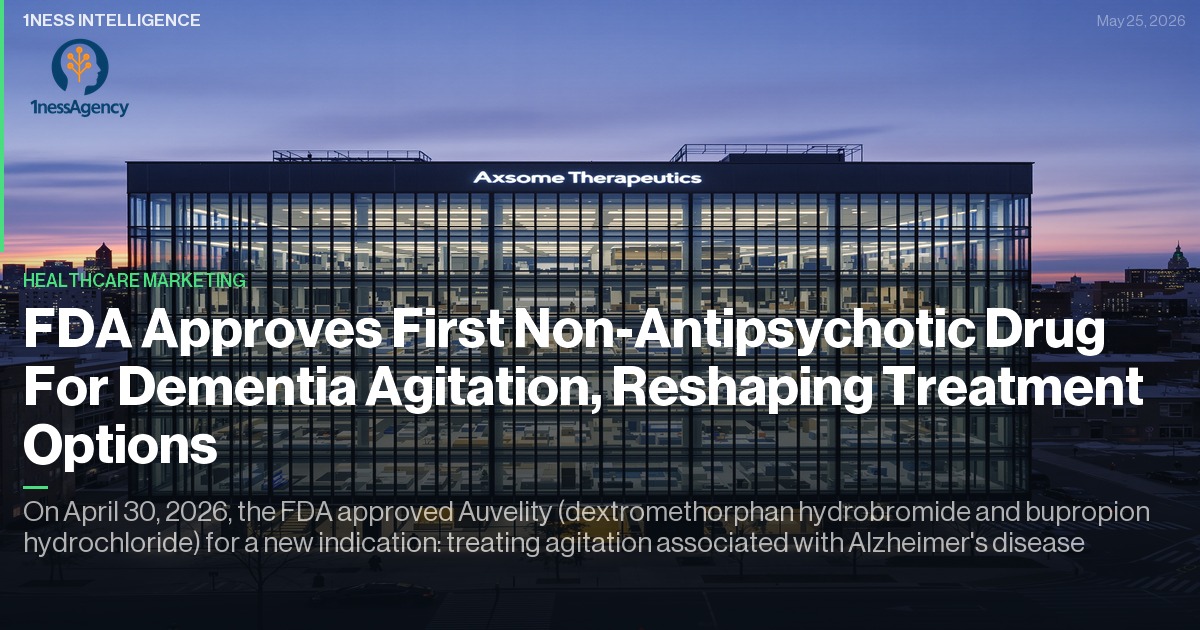
- On April 30, 2026, the FDA approved Auvelity (dextromethorphan hydrobromide and bupropion hydrochloride) as the first non-antipsychotic drug for treating agitation associated with Alzheimer's disease dementia in adults.
- Axsome Therapeutics received the approval after the FDA granted Auvelity both Breakthrough Therapy and Priority Review designations.
- A five-week randomized controlled trial (NCT 03226522) demonstrated that Auvelity was statistically superior to placebo on the Cohen-Mansfield Agitation Inventory scale.
On April 30, 2026, the FDA approved Auvelity (dextromethorphan hydrobromide and bupropion hydrochloride) for a new indication: treating agitation associated with Alzheimer's disease dementia in adults . The approval is a first of its kind , no non-antipsychotic drug has ever carried this indication before. For healthcare marketers, this is not simply a clinical footnote. It is the opening of a new patient acquisition and caregiver engagement channel in one of the most emotionally charged and underserved segments in all of American medicine.
Axsome Therapeutics received the approval after the FDA granted Auvelity both Breakthrough Therapy and Priority Review designations . Two randomized controlled trials anchored the submission. The first, a five-week study (NCT 03226522), showed Auvelity statistically superior to placebo on the Cohen-Mansfield Agitation Inventory, the standard scale for measuring agitated behaviors based on caregiver reports. The second (NCT 04947553) was a withdrawal study demonstrating that patients who stayed on Auvelity had a significantly longer time to relapse compared to those who switched to placebo . Auvelity carries a Boxed Warning related to increased risk of suicidal thoughts and behaviors in adolescents and young adults , a standard antidepressant-class warning that prescribers must communicate clearly , along with risks of seizures, elevated blood pressure, and activation of mania .
"This approval represents a significant advancement in our ability to help patients and families dealing with one of the most challenging aspects of Alzheimer's disease," said FDA Commissioner Marty Makary, M.D., M.P.H. . Tracy Beth Hoeg, M.D., Ph.D., Acting Director of the FDA's Center for Drug Evaluation and Research, added that Auvelity addresses one of Alzheimer's most difficult complications, particularly as the disease progresses .
The Alzheimer's population is large, growing, and surrounded by caregivers who are active, motivated, and exhausted. Agitation is one of the most common reasons families seek additional medical help , and one of the most common reasons they switch providers. A drug approval that specifically names this symptom hands healthcare systems, memory care programs, and neurology practices a concrete, timely message to carry into market. The practices and health systems that move first to educate, inform, and activate around this approval will earn trust precisely when families are most vulnerable and most receptive.
A Decades-Long Treatment Gap Gets a Solution , and a Marketing Window Opens
Before April 30, 2026, clinicians treating agitation in Alzheimer's patients relied primarily on antipsychotic medications , a category that carries its own significant risk profile in elderly populations, including a black box warning about increased mortality in older patients with dementia-related psychosis. That off-label use has long created clinical discomfort and caregiver anxiety.
Auvelity was originally approved by the FDA in 2022 for major depressive disorder . Its 2026 approval for Alzheimer's-related agitation represents a label expansion built on years of additional clinical evidence. For health systems operating memory care clinics, geriatric psychiatry programs, or neurology departments, this approval validates a treatment pathway that many clinicians were already discussing informally with families.
What this means for your practice: The treatment gap was well-known. The caregiver burden was documented. What was missing was a marketing-ready, FDA-approved message. That message now exists. Health systems that move quickly to brief their clinical teams, update their service line content, and communicate this option to existing patients and their families hold a measurable first-mover advantage. Families managing a loved one's agitation are actively searching , Google Trends data on Alzheimer's-related queries consistently spikes following major clinical announcements. If your content isn't there when they search, a competitor's is.The Regulatory Acceleration Trend Is Your Distribution Engine
The Auvelity approval does not exist in isolation. The FDA's posture in 2026 is one of accelerated access, and healthcare marketers should treat this as a structural tailwind.
In April 2026, CMS and the FDA jointly announced the RAPID coverage pathway, designed to reduce the gap between FDA market authorization and Medicare national coverage determinations for Breakthrough Devices . The same month, the FDA announced real-time clinical trial initiatives with AstraZeneca and Amgen, explicitly stating that the agency aims to compress drug development timelines using live data feeds . On May 8, 2026, the FDA's Commissioner's National Priority Voucher program issued its seventh approval, fast-tracking a treatment for a rare bile duct cancer .
The pattern is consistent: regulatory timelines are compressing, and new treatment options are reaching patients faster than at any point in recent memory. For healthcare marketers, this means the window between FDA approval and patient awareness is shrinking , but so is the preparation time. Marketing teams that wait for a drug to appear on formulary before building content, updating service line pages, or briefing patient navigation teams will consistently arrive late to a conversation already happening in Facebook caregiver groups, Reddit forums, and neurology waiting rooms.
What this means for your practice: Build a regulatory monitoring workflow into your marketing calendar. FDA Breakthrough Therapy and Priority Review designations are public record and telegraph approvals months in advance. Auvelity received both designations before April 30 . A prepared marketing team could have had content frameworks, caregiver-facing landing pages, and physician communication templates ready on the day of approval , not six weeks after it.Caregiver Marketing Is the Real Opportunity Here
Alzheimer's agitation does not affect only the patient. Research consistently identifies caregiver burnout as one of the primary drivers of nursing home placement decisions , and caregiver distress as a major factor in which health system or practice a family chooses to trust. Auvelity's approval is, in clinical terms, about managing a symptom. In marketing terms, it is about reaching the adult child who manages appointments, drives to the pharmacy, and makes the call to a memory care program.
The Cohen-Mansfield Agitation Inventory, used as the primary endpoint in both trials, is completed by caregivers, not patients . That design detail is not incidental. It reflects the reality that in Alzheimer's care, the caregiver is often the most active decision-maker in the healthcare journey. Marketing strategies built solely around patient-facing messaging miss the primary audience.
What this means for your practice: Segment your Alzheimer's care marketing by audience. Physician-facing content should emphasize the clinical differentiation: first non-antipsychotic approval for this indication, two randomized trials, Breakthrough Therapy designation. Caregiver-facing content should speak to the lived experience of agitation , the disrupted nights, the fear of escalation, the guilt of not knowing what to do , and position your health system or practice as the place that has answers.Actionable Takeaways for Healthcare Marketers
- Audit your Alzheimer's service line content today. If your website, patient portal, or caregiver resources do not yet reference FDA-approved treatment options for agitation, that gap is visible to every family searching right now.
- Create a caregiver-specific content track. Email nurture sequences, landing pages, and social content should speak directly to the adult children and spouses managing Alzheimer's care , not just to patients.
- Brief your clinical teams before your competitors do. Physician education is a marketing function. Equip neurologists, geriatricians, and primary care providers with updated talking points so they can have informed conversations at the point of care.
- Set up FDA approval monitoring. Track Breakthrough Therapy and Priority Review designations in therapeutic areas relevant to your service lines. Use FDA.gov press announcement feeds as an early-warning system for marketing preparation.
- Develop a rapid-response content protocol. A 48-hour turnaround from FDA approval to published patient-facing content is achievable with templates built in advance.
Compliance Callout
Marketing Auvelity or any FDA-approved drug in patient-facing materials requires strict adherence to FDA promotional guidelines. Health systems and practices cannot promote specific drugs to patients in the same manner as pharmaceutical manufacturers , but they can and should educate patients and caregivers about newly available treatment categories. All content referencing Auvelity should accurately reflect the approved indication (agitation associated with Alzheimer's disease dementia in adults), include appropriate reference to the Boxed Warning, and direct patients to consult their physician. Under HIPAA, any digital marketing that uses patient data for retargeting must comply with the 2024 HHS guidance on online tracking technologies, which remains in effect. FTC guidelines on testimonials and endorsements apply to any patient or caregiver stories used in content marketing.
The 1ness Take
The Auvelity approval is a marketing opportunity disguised as a clinical announcement , and most health system marketing teams will treat it only as the latter. That is a mistake.
The families managing Alzheimer's-related agitation are not passive. They are searching, asking questions in online communities, calling their loved one's doctor, and evaluating which health system or practice actually understands what they are living through. The first health system to show up in that search with clear, accurate, empathetic content about this new treatment option earns something more durable than a click: it earns trust at a moment of genuine need.
Our recommendation: build a "Dementia Care Innovation" content hub on your website and populate it with evergreen content on Alzheimer's staging, caregiver resources, and now , treatment advances. Refresh it within 72 hours of major FDA announcements. Use paid search to capture caregiver queries around Alzheimer's agitation, behavioral symptoms, and non-antipsychotic treatment. Deploy a caregiver email sequence through your patient portal that acknowledges the emotional weight of caregiving before it mentions any clinical solution. The clinical facts earn credibility. The emotional acknowledgment earns loyalty.
The broader 2026 regulatory environment , RAPID coverage pathway, real-time clinical trials, accelerated voucher programs , signals that the pace of treatment innovation is increasing . Health system marketing teams built for a slower approval cycle will be perpetually reactive. The ones that build regulatory monitoring, content readiness, and audience segmentation into their infrastructure will own the conversation before competitors realize it has started.
The Takeaway
1. Within the next 30 days: Audit your Alzheimer's and memory care service line pages. Add accurate, compliant information about FDA-approved agitation treatment options and direct caregivers to consult with your clinical team.
2. Within 60 days: Build a caregiver-specific content and email track for your dementia care program. Segment by audience , caregivers need different messaging than patients or referring physicians.
3. Ongoing: Implement an FDA monitoring workflow that flags Breakthrough Therapy and Priority Review designations in your service line areas at least 90 days before likely approval, giving your team time to build content before the announcement , not after.
References
1. U.S. Food and Drug Administration. "FDA Approves First Non-Antipsychotic Drug to Treat Agitation Associated with Dementia." FDA Press Announcement. April 30, 2026. https://www.fda.gov/news-events/press-announcements/fda-approves-first-non-antipsychotic-drug-treat-agitation-associated-dementia
2. U.S. Food and Drug Administration. "FDA Grants Seventh Approval under the National Priority Voucher Pilot Program." FDA Press Announcement. May 8, 2026. https://www.fda.gov/news-events/press-announcements/fda-grants-seventh-approval-under-national-priority-voucher-pilot-program
3. U.S. Food and Drug Administration / Centers for Medicare & Medicaid Services. "CMS and FDA Announce RAPID Coverage Pathway to Accelerate Patient Access to Life-Changing Medical Devices." FDA Press Announcement. April 23, 2026. https://www.fda.gov/news-events/press-announcements/cms-and-fda-announce-rapid-coverage-pathway-accelerate-patient-access-life-changing-medical-devices
4. U.S. Food and Drug Administration. "FDA Announces Major Steps to Implement Real-Time Clinical Trials." FDA Press Announcement. April 28, 2026. https://www.fda.gov/news-events/press-announcements/fda-announces-major-steps-implement-real-time-clinical-trials
This report is for informational purposes only and does not constitute investment advice or an offer to buy or sell any security. Content is based on publicly available sources believed reliable but not guaranteed. Opinions and forward-looking statements are subject to change; past performance is not indicative of future results. 1ness Strategies and its affiliates may hold positions in securities discussed herein. Readers should conduct independent due diligence and consult qualified advisors before making investment decisions.
© 2026 1ness Strategies. All rights reserved.