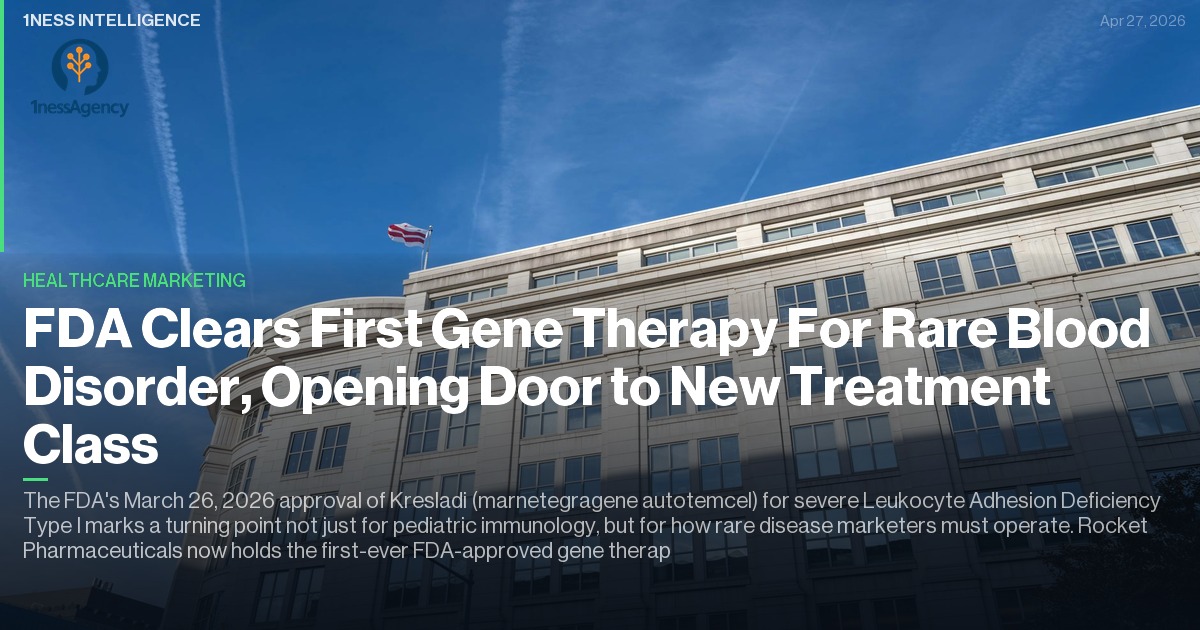
The FDA's March 26, 2026 approval of Kresladi (marnetegragene autotemcel) for severe Leukocyte Adhesion Deficiency Type I marks a turning point not just for pediatric immunology, but for how rare disease marketers must operate. Rocket Pharmaceuticals now holds the first-ever FDA-approved gene therapy for LAD-I , a condition so rare that the agency relied on surrogate biomarker endpoints and a single open-label study to grant accelerated approval. The speed and regulatory flexibility baked into this approval signals that gene therapies for ultra-rare diseases will reach market faster than traditional timelines, compressing the window marketers have to build disease awareness, educate clinicians, and identify patients before a competing standard of care becomes entrenched.
The approval was granted under the accelerated approval pathway, supported by Orphan Drug, Rare Pediatric Disease, Regenerative Medicine Advanced Therapy, and Fast Track designations. Rocket Pharmaceuticals also received a Rare Pediatric Disease Priority Review Voucher , a financial instrument that can be sold to other manufacturers seeking to accelerate their own FDA reviews, and which has recently commanded prices exceeding $100 million on the open market (based on historical voucher transactions). The FDA's Center for Biologics Evaluation and Research simultaneously issued draft guidance in April 2026 standardizing genome editing safety assessments using next-generation sequencing, signaling that more gene therapies are in the pipeline and that the agency intends to move faster across the board. For marketers at gene therapy companies, biotech startups, and rare disease centers of excellence, the regulatory infrastructure is now built for speed , and marketing strategies need to match that pace.
"Kresladi offers a potentially transformative treatment option that targets the root cause of this serious condition," said Megha Kaushal, M.D., M.S., Acting Deputy Director of the CBER Office of Therapeutic Products. "For children with severe LAD-I and their families, this treatment allows them to participate in day-to-day activities and hopefully experience a better quality of life." That framing , rooted in quality of life and family impact , is not just clinical language. It is a marketing brief.
Rare disease approvals like Kresladi rarely fail because of clinical science. They fail commercially because the patient population is dispersed, diagnosis is delayed, and prescribers outside specialized centers have never encountered the disease. Kresladi is indicated specifically for pediatric patients with severe LAD-I who lack an HLA-matched sibling donor for transplant. That is a patient population measured in dozens per year in the United States, not thousands. The marketing challenge is not demand generation , it is patient identification, specialist activation, and institutional access, all on a timeline compressed by accelerated approval.
The FDA Is Moving Faster , Your Launch Timeline Just Shortened
The same regulatory machinery that approved Kresladi is now approving products across categories at historically unprecedented speed. The FDA's Commissioner's National Priority Voucher program approved Wegovy HD (semaglutide 7.2 mg) in 54 days and Foundayo (orforglipron) in 50 days , described as the fastest NME approval since 2002. The FDA's April 2026 genome editing guidance explicitly supports a framework for accelerating individualized therapies for ultra-rare diseases.
What this means for rare disease marketers is concrete: the pre-launch window is shrinking. Traditional rare disease launch timelines assumed 12-18 months of pre-approval disease awareness building. When the FDA can approve a product in under two months under priority programs, and when surrogate endpoints replace long-term outcome data for accelerated approval, the disease awareness campaign and the product launch are nearly simultaneous. Marketers who wait for approval to begin patient advocacy partnerships, physician education, or payer engagement will be 6 to 12 months behind on day one.
Patient Identification Is the Core Marketing Problem for Gene Therapy
Severe LAD-I is caused by mutations in the ITGB2 gene and results in white blood cells unable to effectively combat bacterial and fungal infections. Patients face life-threatening infections in the first decade of life. The population who qualifies for Kresladi , severe LAD-I without an available HLA-matched sibling donor , is a subset of an already rare disease.
For Rocket Pharmaceuticals, the patient acquisition funnel looks nothing like a primary care drug launch. There is no mass-market DTC campaign. The funnel is: genetic diagnosis → referral to a specialized immunology or hematology center → assessment for transplant eligibility → identification as a Kresladi candidate. Every step is a potential dropout. Marketers must map this journey and own every handoff. That means partnerships with newborn screening programs, genetic counselors, and rare disease patient advocacy organizations , built before approval, not after.
What this means for your practice: If your organization operates a rare disease center, a children's hospital, or a hematology/oncology program, the Kresladi approval is a signal to audit your patient identification infrastructure. How many LAD-I patients are in your system? Are they coded correctly? Do your referring community pediatricians know to send suspected immunodeficiency cases to your center?Real-Time Data Infrastructure Is Now a Marketing Competitive Advantage
Rocket Pharmaceuticals faces a post-marketing requirement as a condition of accelerated approval: confirmatory trials must verify clinical benefit, and continued approval may depend on those results. That post-market obligation has direct marketing implications. Any real-world evidence strategy , patient registries, outcomes tracking, quality-of-life measurement , doubles as both regulatory compliance and marketing content.
Separately, Hershey's 2026 partnership with Mutinex and Tracer to run AI-powered marketing mix modeling on a monthly basis , compressing what was previously a semi-annual or annual process , illustrates a broader shift in how sophisticated marketers are closing the gap between spend and outcome measurement. Hershey projects a 4% to 5% increase in revenue attributable to media from the shift. While consumer packaged goods and pharmaceutical rare disease marketing are different animals, the underlying problem is identical: fragmented data, slow feedback loops, and marketing spend that cannot defend itself as an investment.
For gene therapy and rare disease marketers, real-time data infrastructure means tracking patient identification rates by referral source, time-to-diagnosis, and center-of-excellence engagement , not quarterly, but monthly.
Actionable Takeaways for Rare Disease and Gene Therapy Marketers
- Build the disease awareness campaign before approval. The FDA's accelerated approval pathway means you may have less than six months between IND filing and market entry. Patient advocacy partnerships, physician education, and payer engagement must begin at Phase 2, not at BLA filing.
- Map the patient identification funnel by institution. For ultra-rare diseases, name the 20-30 U.S. centers that will diagnose and treat the majority of eligible patients. Build relationships with those centers' coordinators, genetic counselors, and department heads directly.
- Convert post-marketing requirements into content. Confirmatory trial enrollment is a marketing opportunity. Patient registries generate real-world evidence that supports both regulatory compliance and peer-reviewed publication , which drives specialist credibility.
- Audit your data infrastructure now. If your marketing team is measuring campaign performance quarterly or annually, you are already behind. Monthly measurement cycles, supported by cleaner data pipelines, are becoming table stakes.
- Leverage the Priority Review Voucher narrative. The Rare Pediatric Disease PRV awarded to Rocket Pharmaceuticals has real dollar value. That story , a rare disease treatment generating assets that fund future rare disease research , is a compelling patient advocacy and institutional partnership narrative.
Compliance Callout
Gene therapy marketing operates under overlapping regulatory frameworks. FDA promotional regulations require that any marketing claims for Kresladi reflect its accelerated approval status , meaning clinical benefit has not yet been confirmed in post-marketing studies. Promotional materials must not overstate efficacy beyond what the surrogate endpoint data supports. HIPAA applies to any patient identification or registry programs that involve data sharing with manufacturer-sponsored initiatives. Healthcare marketers working on rare disease patient identification programs should also review OIG guidance on manufacturer-sponsored patient support programs to ensure referral arrangements do not implicate anti-kickback concerns.
The 1ness Take
The Kresladi approval is a mirror. It shows exactly where rare disease marketing is broken , and where the opportunity sits.
Most gene therapy and rare disease launches underperform commercially not because the science fails, but because the marketing infrastructure is built for a different era. Disease awareness campaigns launch too late. Patient identification is passive. Physician education reaches the wrong tier of specialists. And post-marketing data sits in a regulatory file instead of fueling a real-world evidence content strategy.
Our recommendation: treat the FDA's accelerated approval pathway as a forcing function for marketing infrastructure. If your regulatory team is planning for an accelerated approval, your marketing team should already be 12 months into pre-launch execution. That means patient advocacy organizations should be funded and active. It means the 25 U.S. centers of excellence for your disease area should already know your medical affairs team by name. It means your post-marketing registry protocol should double as a patient engagement platform.
The FDA has signaled, through Kresladi, through the genome editing guidance, and through the CNPV program's 50-day approvals, that speed is the new standard. Marketing organizations that still operate on 18-month launch timelines will be reactive at exactly the moment they need to be proactive. The window to own the disease narrative, educate the right specialists, and build the payer access story is before approval , and that window is now shorter than it has ever been.
The Takeaway
1. Start pre-launch marketing at IND filing, not BLA submission. The FDA's accelerated approval tools mean clinical timelines are compressing. Marketing timelines must compress with them.
2. Identify your 25 centers of excellence and build direct relationships with their patient identification teams. For ultra-rare diseases like LAD-I, the entire addressable market may flow through fewer than 30 institutions in the United States.
3. Design your post-marketing commitment as a content and credibility engine. Confirmatory trial enrollment, patient registry data, and real-world outcomes are your most durable marketing assets , and they are built into the approval condition.
References
- U.S. Food and Drug Administration. "FDA Approves First Gene Therapy for Severe Leukocyte Adhesion Deficiency Type I." FDA Press Announcement. March 26, 2026 fda.gov
- U.S. Food and Drug Administration. "FDA Approves Fourth Product Under National Priority Voucher Program, Higher Dose Semaglutide." FDA Press Announcement. March 19, 2026 fda.gov
- U.S. Food and Drug Administration. "FDA Issues Draft Guidance on Genome Editing Safety Standards to Advance Gene Therapy Development." FDA Press Announcement. April 14, 2026 fda.gov
- U.S. Food and Drug Administration. "FDA Approves First New Molecular Entity Under National Priority Voucher Program." FDA Press Announcement. April 1, 2026 fda.gov
- Ostwal, Trishla. "Hershey Bets on AI Agents to Fix Its $2 Billion Marketing Blind Spot." Adweek. 2026 adweek.com
This report is for informational purposes only and does not constitute investment advice or an offer to buy or sell any security. Content is based on publicly available sources believed reliable but not guaranteed. Opinions and forward-looking statements are subject to change; past performance is not indicative of future results. 1ness Strategies and its affiliates may hold positions in securities discussed herein. Readers should conduct independent due diligence and consult qualified advisors before making investment decisions.
© 2026 1ness Strategies. All rights reserved.