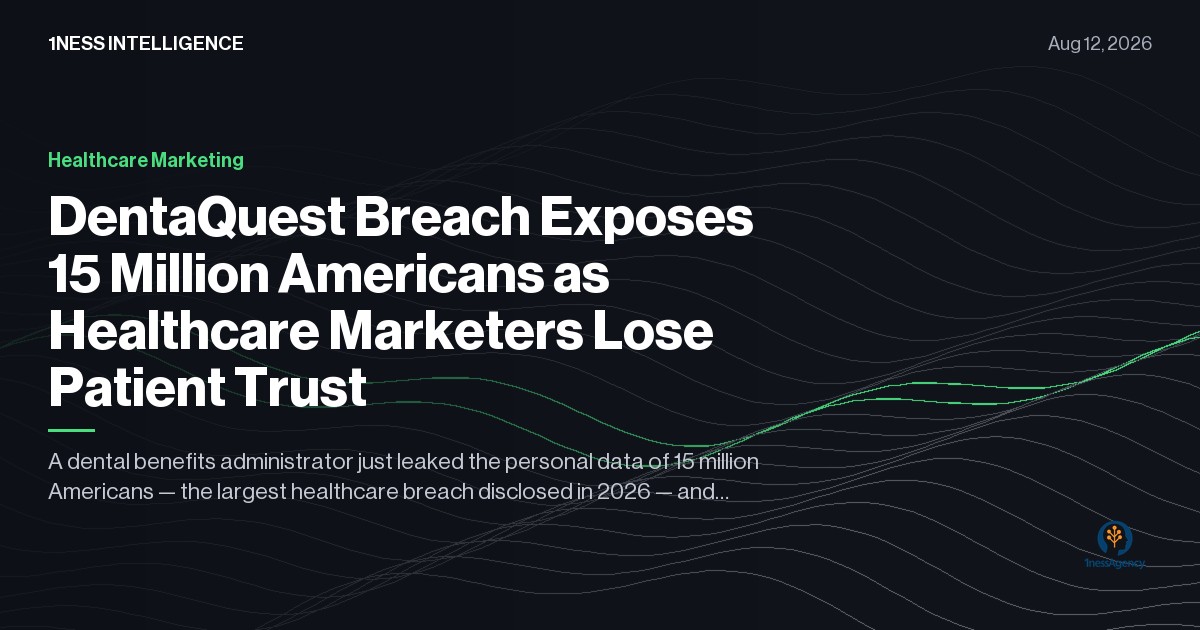
- DentaQuest's breach exposed personal data of 15 million Americans, representing 4.5% of the U.S. population and marking the largest healthcare breach disclosed in 2026.
- Rural patients express deep skepticism toward AI-driven healthcare solutions, with polling showing resistance even as the $50 billion federal Rural Health Transformation Program directs state funding toward AI expansion in rural health organizations.
- DentaQuest operates as a HIPAA business associate rather than a covered entity, demonstrating how third-party vendors outside hospital systems represent the fastest-growing attack surface in healthcare cybersecurity and marketing technology stacks.
A dental benefits administrator just leaked the personal data of 15 million Americans — the largest healthcare breach disclosed in 2026 — and the timing couldn't be worse for healthcare marketers banking on digital patient engagement . DentaQuest's breach arrives as recent polling shows rural patients already expressing deep skepticism toward AI-driven healthcare solutions, with one Hot Springs, South Dakota resident stating flatly: "I get artificial intelligence for certain things, but for personal healthcare — no" . The collision of these two realities creates a trust crisis that no amount of HIPAA compliance theater will solve.
The breach affects 15 million individuals, a figure that represents roughly 4.5% of the U.S. population and eclipses every other healthcare data incident reported this year . For context, that's more than the entire populations of Michigan or Ohio having their protected health information exposed through a single vendor. The incident involves a dental benefits administrator — not a hospital system or major insurer — which demonstrates how deeply third-party business associates penetrate patient data ecosystems.
"I think it will help reduce burden on actual staffing," said Phillip Mues, who oversees technology at Cherry County Hospital and Clinic in rural Valentine, Nebraska, when discussing AI adoption . Yet that optimism about technology's efficiency gains runs headlong into patient anxiety about data security and algorithmic decision-making in clinical settings.
Healthcare marketers face a compounding problem: you're being asked to drive digital patient acquisition and engagement through channels that patients increasingly distrust. When Health Secretary Robert F. Kennedy Jr. promotes AI nurses providing "concierge care" to rural patients, and CMS Administrator Mehmet Oz advocates for "AI-based avatars" connecting rural communities to mental health services, they're building policy around technology adoption at precisely the moment a major breach reminds 15 million Americans why they should be cautious . The $50 billion federal Rural Health Transformation Program is directing state funding toward AI expansion in rural health organizations, but no one's tracking whether that investment erodes or rebuilds patient trust .
The Third-Party Risk Multiplier Healthcare Marketing Can't Ignore
DentaQuest operates as a business associate under HIPAA — the category of vendor that touches patient data without being a covered entity itself. Business associates represent the fastest-growing attack surface in healthcare cybersecurity, and they're woven throughout the marketing technology stack healthcare organizations deploy.
Consider the typical patient acquisition funnel: CRM platforms store contact data, scheduling tools access insurance information, chatbots collect symptoms, retargeting pixels track behavior across websites, analytics platforms aggregate demographics. Each vendor in that chain is a potential breach point. The DentaQuest incident demonstrates that size doesn't equal security — this is a major national benefits administrator, not a fly-by-night martech startup.
Healthcare marketers typically focus business associate agreements on HIPAA compliance checkboxes: signed BAA, annual security attestation, cyber insurance certificate. The DentaQuest breach exposes this approach as insufficient. Fifteen million records didn't leak because paperwork was missing. They leaked because technical controls, threat detection, or incident response failed somewhere in the operational reality that compliance documents never capture.
The marketing implication is direct: every vendor relationship represents reputational risk that patient acquisition campaigns can trigger but cybersecurity teams must manage. When a health system runs digital ads promoting convenient online scheduling, it's implicitly promising that the convenience won't compromise security. Breaches like DentaQuest's make that promise harder to keep and harder for patients to believe.
The Trust Tax on Digital Patient Engagement
Patient wariness toward healthcare technology isn't theoretical. When KFF Health News interviewed rural Americans about AI healthcare solutions, Tara Haffner captured the prevailing sentiment: "I'm worried about AI making mistakes and wants healthcare to stay between her and her doctor" . That quote matters because it reveals the specific nature of patient concern — not that technology exists, but that it interposes itself between patient and clinician.
Healthcare marketers have spent the past five years optimizing for digital convenience: online scheduling, telemedicine, patient portals, automated follow-up, AI chatbots for triage. The value proposition has been frictionless access. The DentaQuest breach and the patient skepticism documented in rural communities suggest that frictionless isn't enough. Patients want secure, private, and human.
This creates a trust tax on digital engagement tactics. Every email campaign, every SMS reminder, every retargeting ad now carries an implicit question from the patient: who else sees this data? A 15-million-record breach makes that question feel urgent rather than paranoid.
The financial stakes are measurable. Healthcare organizations spent an average of $408 per exposed record on breach response costs in recent years. Multiply that by 15 million and DentaQuest faces a potential $6.1 billion liability. Even if actual costs run lower, the reputational damage affects patient acquisition across the industry, not just for the breached entity.
What Federal AI Investment Means When Security Fails Publicly
The federal government is placing a $50 billion bet on rural health transformation through technology, with states directing portions of that funding toward AI adoption in rural health organizations . Health Secretary Kennedy and CMS Administrator Oz are publicly championing AI as the solution to rural access challenges. That policy direction creates both opportunity and risk for healthcare marketers.
The opportunity: federal funding flows toward technology adoption create budget for digital patient engagement infrastructure. Rural health systems receiving transformation grants will invest in telehealth platforms, AI-assisted triage, remote monitoring, and the marketing technology needed to drive utilization of those services.
The risk: the same policy push is happening while patients express explicit skepticism and while major breaches validate their concerns. When government officials promote AI nurses and AI avatars, they're marketing a vision of healthcare that polling suggests rural patients don't want. Healthcare marketers caught in the middle must sell digital services to populations that distrust them, often because leadership has made political commitments to technology adoption regardless of patient readiness.
Mues noted that AI "won't replace people, but I think it will help in rural communities," while also acknowledging that "AI can't fix every challenge" and that rural hospitals at risk of closing "probably can't use AI to save enough money to prevent those consequences" . That nuanced view — technology as helpful but not transformative — gets lost in federal policy rhetoric promoting AI as the solution rather than a tool.
For healthcare marketers, this creates a messaging challenge. How do you promote digital health services when the federal government overpromises what AI can deliver, breaches remind patients why they should be cautious, and the actual clinical staff using the technology see it as incrementally helpful rather than revolutionary?
Rebuilding Patient Data Trust: The Marketing Reframe Required
Healthcare marketing has operated on an assumption that more data enables better targeting and better targeting drives better outcomes. The DentaQuest breach and patient skepticism toward AI suggest that assumption now creates friction rather than value.
The reframe required: position data minimization as a feature, not a constraint. Patients don't want healthcare organizations to collect everything and promise to protect it. They want organizations to collect only what's clinically necessary and to be transparent about what happens to it.
This isn't just philosophical. It's operational. Healthcare marketers should audit their martech stack and ask: which vendors actually need protected health information versus contact data alone? Where is PHI flowing that clinical care doesn't require? Can patient engagement campaigns run effectively with less data rather than more?
The FDA's recent approval of Orzeyful for narcolepsy type 1 treatment offers a useful contrast . The agency emphasized that this was "the first medicine approved for narcolepsy type 1 as a complete disorder" and "the first to work by directly targeting the loss of orexin signaling that causes the disease" . The marketing message is about precision and mechanism — solving the root problem rather than masking symptoms. Healthcare data strategy needs the same focus: collect what solves the patient's problem, not what feeds the algorithm.
The Experian decision to retire the Audigent brand after acquiring it demonstrates how quickly technology categories that seemed essential can become commodified infrastructure . Curation capabilities that were a standalone product in 2024 are now "embedded throughout the ecosystem" according to industry observers . Healthcare marketers should expect the same evolution for many of the martech capabilities currently treated as strategic differentiators. The competitive advantage won't be having AI or having data. It will be having patient trust in how you use both.
The 1ness Take
The DentaQuest breach should trigger an immediate vendor risk audit across your marketing technology stack, but the strategic opportunity is larger: use this moment to differentiate on data restraint rather than data capability.
Every health system marketing team should map where patient data flows — not just where it's stored, but where it moves through third-party platforms for targeting, analytics, and engagement. Then ask: what patient outcome improves because this vendor has this data? If the answer is "better ad targeting" but not "better clinical care," you're creating breach exposure that doesn't serve patients.
The federal AI investment in rural health creates a forcing function. States are allocating Rural Health Transformation Program dollars to technology adoption, which means procurement cycles will accelerate and vendors will position heavily. Healthcare marketers should use that investment window to insist on security architecture as a procurement criterion equal to functionality. The question isn't "can this AI tool handle patient triage?" It's "when this AI tool gets breached, how contained is the damage?"
Patient skepticism toward AI healthcare isn't an obstacle to overcome through better messaging. It's a signal that deployment has outpaced trust-building. The marketing response shouldn't be campaigns that promise AI is safe. It should be demonstrable evidence: transparent data practices, clear opt-in mechanisms, human oversight that patients can verify, and breach response plans that emphasize patient notification speed over reputation management.
The most actionable shift: stop marketing digital health services as convenient alternatives to in-person care. Start marketing them as secure complements that keep care "between you and your doctor" — the exact phrase patients use when they describe what they value . That reframe requires technical architecture that supports it: encrypted messaging platforms, on-premise data storage options, and martech stacks that can deliver personalization without centralized patient data warehouses.
Here's the test: if your organization suffered a breach tomorrow, would your patient engagement messaging look naive or prescient? If it would look naive — if you've been promising frictionless convenience without acknowledging security tradeoffs — then the DentaQuest breach is your signal to rewrite the value proposition before your organization becomes the next headline.
The Takeaway
Healthcare marketers must act now on three fronts:
Immediate audit: Map every third-party vendor in your marketing technology stack that touches patient data. Verify not just HIPAA compliance paperwork, but actual security practices: penetration testing frequency, incident response time commitments, cyber insurance coverage limits. DentaQuest was a major national administrator, which means vendor size and reputation don't predict security competence. Strategic repositioning: Reframe digital health marketing from convenience-first to security-first messaging. Patients are telling us explicitly what they value — care that stays between them and their doctor. Build campaigns around data minimization, transparent consent, and human clinical oversight. Make security architecture a patient-facing differentiator rather than a back-office compliance function. Policy engagement: The $50 billion Rural Health Transformation Program is directing AI investment faster than patient trust is building. Healthcare marketing leaders should engage with health system executives and state health officials to ensure technology adoption dollars include budget for patient education, transparent data governance, and community input on which digital services actually serve rural populations. Federal policy is creating supply of AI healthcare tools. Marketing must ensure demand exists by building trust first.References
- Healthcare Dive. (2026). "Dental benefits administrator discloses breach." Retrieved from healthcaredive.com
- Zionts, A., & Tahir, D. (2026, August 11). "Patients Wary of Governments, Companies Pushing AI as a Rural Healthcare Solution." KFF Health News. Retrieved from kffhealthnews.org
- U.S. Food and Drug Administration. (2026, August 5). "FDA Approves First Drug to Treat the Full Range of Narcolepsy Type 1 Symptoms." Retrieved from fda.gov
- Joseph, S. (2026, August 11). "Experian retires the Audigent brand, folding it into Experian Marketing Services." Digiday. Retrieved from digiday.com
This report is for informational purposes only and does not constitute investment advice or an offer to buy or sell any security. Content is based on publicly available sources believed reliable but not guaranteed. Opinions and forward-looking statements are subject to change; past performance is not indicative of future results. 1ness Strategies and its affiliates may hold positions in securities discussed herein. Readers should conduct independent due diligence and consult qualified advisors before making investment decisions.
© 2026 1ness Strategies. All rights reserved.