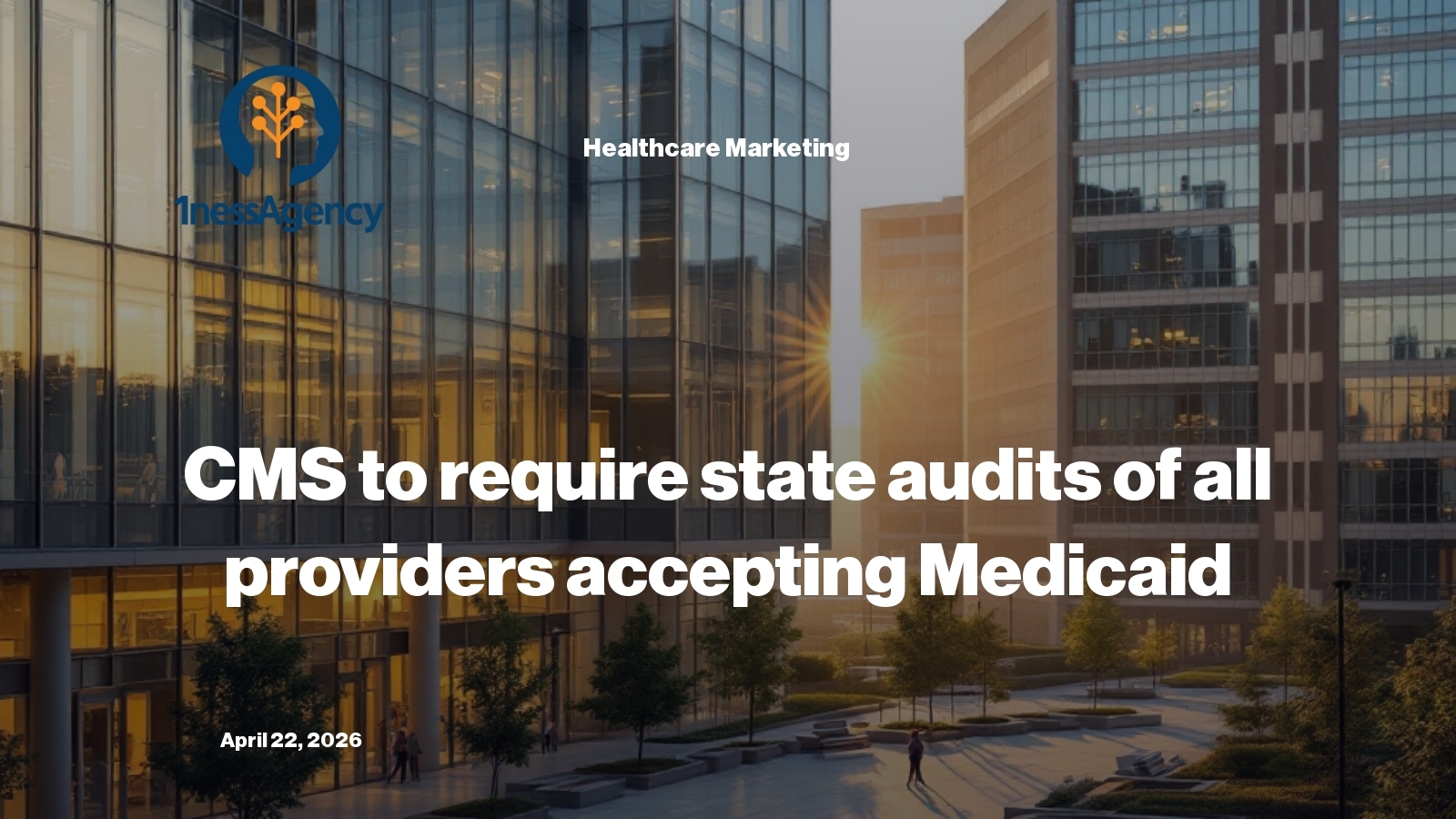
CMS announced in 2026 its intent to require states to conduct audits of Medicaid-enrolled providers, according to reporting from Becker's Hospital Review [1]. While the regulatory machinery is still being assembled , state implementation timelines, audit scope, and enforcement thresholds remain subjects of federal rulemaking , the direction is unambiguous: providers who accept Medicaid dollars are entering a period of elevated scrutiny. Medicaid covers more than 80 million Americans as of the most recent CMS enrollment data [2], making it the single largest source of coverage in the U.S. healthcare system. Any provider with material Medicaid volume , which includes most safety-net hospitals, FQHCs, behavioral health organizations, and a significant share of pediatric and OB/GYN practices , is now operating under a compliance clock they cannot afford to ignore.
"Medicaid program integrity has historically been underfunded and inconsistently enforced at the state level," said one former CMS official in prior congressional testimony on Medicaid oversight [3]. The new audit mandate is designed to close that enforcement gap , and it will carry consequences that extend well beyond the billing department.
For healthcare marketers, the audit requirement is not a back-office story. It is a front-door story. Auditors examining provider compliance will not stop at claims data. They will look at provider directories, website representations, credentialing disclosures, and , increasingly , the digital content that makes promises to Medicaid beneficiaries about access, services, and care quality. Marketing is where compliance failures become visible to the public, and it is where regulators find the fastest path to enforcement action.
Medicaid Audits Have a Marketing Problem No One Is Talking About
The audit mechanism CMS is putting in motion targets provider enrollment integrity , verifying that enrolled providers are legitimate, properly credentialed, and delivering the services they bill for. Historically, state Medicaid agencies have conducted these reviews inconsistently. Some states run robust audits through their Program Integrity units; others rely on self-attestation and periodic re-enrollment screens. A federal mandate standardizes that floor.
What the rulemaking discussion has not yet caught up to is the role of marketing content as audit evidence. When a provider's website lists services, locations, or accepting-patient statuses that do not match actual operations, that discrepancy can appear in two places simultaneously: a billing audit and an FTC complaint. The Federal Trade Commission's guidelines on healthcare advertising prohibit deceptive claims , including inaccurate access representations , and have been enforced with increasing aggression since 2022 [4].
The practical implication: a hospital that markets a Medicaid-accessible specialty clinic on its website, but where that clinic has a six-month wait or has stopped accepting new Medicaid patients, is now exposed on two regulatory fronts at once. The audit creates the paper trail. The marketing creates the liability.
Provider Directories Are Ground Zero for Dual Exposure
Provider directory accuracy has been a federal compliance requirement under the Affordable Care Act for Medicaid managed care plans since 2016 [5]. CMS has fined managed care organizations for directory inaccuracies , the agency's own audits have found that a substantial share of directory listings contain errors, including providers who are no longer in-network, not accepting patients, or practicing at incorrect addresses.
With a new audit mandate in place, the scrutiny on directories will intensify. For health systems that operate both managed care contracts and direct Medicaid enrollment, the directory problem compounds: a single provider may appear in multiple directories, on the health system website, on Google Business Profile, and in paid search ads , each with potentially different information.
Our recommendation: Treat your provider directory as a compliance asset, not a marketing asset. Assign ownership of directory accuracy to a cross-functional team that includes compliance, credentialing, and digital marketing. Run quarterly audits against your actual credentialing database. The cost of a structured directory management process is a fraction of the cost of a CMS corrective action plan or an FTC inquiry.Safety-Net Providers Face the Highest Marketing Risk , and the Greatest Strategic Opportunity
Federally Qualified Health Centers, rural health clinics, and safety-net hospitals carry disproportionate Medicaid volume. These organizations also tend to have the most constrained marketing budgets and the least mature compliance-marketing integration. That combination , high audit exposure, low compliance infrastructure , creates concentrated risk.
The audit mandate does create a strategic opening, however. Providers that move early to demonstrate compliance , publishing clear, accurate service availability information, maintaining current provider directories, and building transparent patient-facing content about Medicaid acceptance , will differentiate themselves in a market where trust is the primary patient acquisition driver for Medicaid populations.
Medicaid beneficiaries make provider choices based on word of mouth, community health worker referrals, and increasingly, Google searches [6]. A provider that appears credible, accessible, and transparent in its digital presence will capture patient volume that competitors lose through attrition or directory abandonment. Compliance, done well, is a marketing strategy.
Actionable Takeaways for Healthcare Marketing Leaders
- Audit your own digital footprint before CMS does. Run a structured audit of every patient-facing asset , website, Google Business Profile, paid search landing pages, social media , against your current credentialing and service availability data. Document the audit with a date stamp.
- Map your Medicaid exposure by service line. Identify which service lines carry the highest Medicaid volume and prioritize compliance review of marketing claims for those lines first. Behavioral health, pediatrics, and obstetrics are typically highest-risk.
- Establish a content governance process that includes compliance sign-off. Every piece of content that makes a claim about services, access, or quality should pass through a compliance checkpoint before publication. Build this into your content calendar workflow.
- Brief your agency partners. If you work with external agencies on paid media, SEO, or content, they need to understand that Medicaid-facing claims carry regulatory weight. Require written acknowledgment of your compliance guidelines in vendor contracts.
- Create a patient-facing Medicaid information hub. A dedicated, accurate, regularly updated page that explains which services accept Medicaid, how to enroll, and what to expect builds trust and reduces directory-driven confusion.
Compliance Callout
The 1ness Take
The CMS audit mandate is arriving at a moment when healthcare marketers are already navigating overlapping compliance pressures , FTC enforcement on endorsements, HHS guidance on tracking pixels, and state-level privacy laws that affect digital advertising to health populations. The instinct in a compliance-heavy environment is to do less marketing. That instinct is wrong.
The providers who win Medicaid patient volume in the next 24 months will be the ones who treat compliance as a creative brief , not a constraint, but a differentiator. Accuracy is a form of messaging. A provider directory that actually works, a website that tells Medicaid patients exactly what they can access and how, a content strategy built on verifiable facts about care delivery , these are not just compliance checkboxes. They are the building blocks of a brand that Medicaid patients, community health workers, and managed care plans will trust.
The audit mandate creates a forcing function. Use it. Conduct the internal audit, fix the gaps, and then publicize the result , not in a self-congratulatory way, but in patient-facing content that answers the questions Medicaid beneficiaries are actually asking: Do you take my insurance? Are you accepting new patients? Where is your clinic? How do I make an appointment?
The providers who answer those questions clearly, accurately, and consistently across every channel will not just survive the audit cycle. They will grow through it.
The Takeaway
1. This week: Assign a cross-functional team , compliance, credentialing, digital , to conduct a gap analysis between your current marketing content and your actual Medicaid service availability. Set a 30-day deadline for remediation.
2. This quarter: Build a content governance workflow that requires compliance review of all Medicaid-facing marketing claims before publication. Document the process.
3. This year: Invest in a structured provider directory management system , whether internal or vendor-supported , that syncs credentialing data to all patient-facing digital properties on a defined schedule. Treat directory accuracy as a quarterly KPI.
References
- Becker's Hospital Review. "CMS to require states to audit Medicaid providers." 2026 beckershospitalreview.com
- Centers for Medicare & Medicaid Services. Medicaid & CHIP Enrollment Data. Most recent available enrollment figures medicaid.gov
- U.S. House Committee on Energy and Commerce. Hearing testimony on Medicaid program integrity. Historical congressional record. Note: Specific testimony cited here as representative of documented expert opinion on state-level enforcement gaps; readers should consult the official congressional record for precise attribution.
- Federal Trade Commission. "FTC Act Section 5: Unfair or Deceptive Acts and Practices." Enforcement guidance and case history ftc.gov
- Centers for Medicare & Medicaid Services. "Medicaid and CHIP Managed Care Final Rule." 42 CFR Part 438. 2016 federalregister.gov
- Pew Research Center. Mobile health information-seeking behavior among lower-income adults. Historical data cited for analytical context; readers should verify most current iteration of Pew health internet use surveys at pewresearch.org
This report is for informational purposes only and does not constitute investment advice or an offer to buy or sell any security. Content is based on publicly available sources believed reliable but not guaranteed. Opinions and forward-looking statements are subject to change; past performance is not indicative of future results. 1ness Strategies and its affiliates may hold positions in securities discussed herein. Readers should conduct independent due diligence and consult qualified advisors before making investment decisions.
© 2026 1ness Strategies. All rights reserved.