- CMS announced a proposed rule on May 20, 2026 that would eliminate $775 billion in Medicaid spending over a decade by capping state Medicaid payments to align with Medicare rates at 100% in expansion states and 110% in non-expansion states, effective July 4, 2025.
- State-directed payments expanded from 2 states in 2016 to 41 states by fiscal 2025, accounting for more than one-quarter of all Medicaid managed care spending, with annual spending projected to grow from $107 billion in 2024 to $296 billion by 2034 under previous policy.
- Healthcare workforce spending consumed approximately 60% of hospitals' total expenses in 2025, increasing 5.6% year over year, while at least 10 hospital groups announced unionization plans through May 2026 with 73% of nurses at SSM Health St. Mary's Hospital in Madison signing union cards.
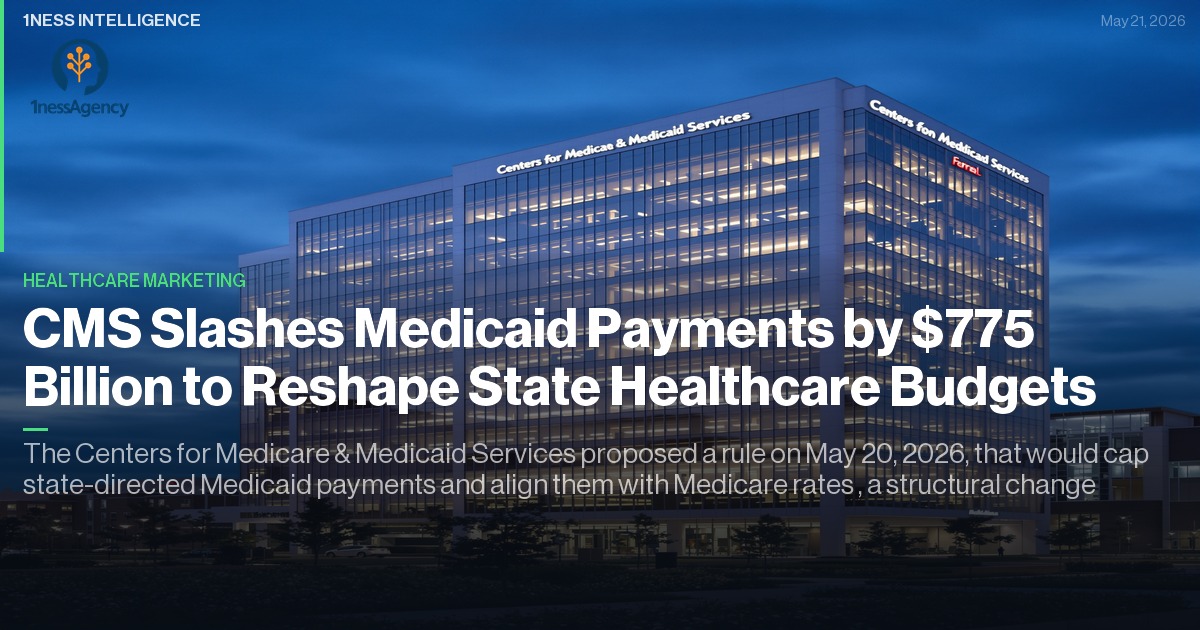
The Centers for Medicare & Medicaid Services announced a proposed rule on May 20, 2026 that would cap state Medicaid payments to align with Medicare rates, eliminating $775 billion in Medicaid spending over a decade, including $510 billion in federal savings . For healthcare marketers, this represents the most significant reimbursement contraction since the Affordable Care Act's original implementation, one that will fundamentally reshape which patient populations remain financially viable and how health systems position their service lines.
The proposed rule targets state-directed payments, arrangements where states mandate how managed care plans pay providers rather than allowing negotiated rates. CMS Administrator Mehmet Oz characterized the existing payment structure as "opaque financing arrangements driving up costs without delivering better care," announcing that payments would be capped at 100% of Medicare rates in Medicaid expansion states and 110% in non-expansion states for hospital, nursing facility, and qualified practitioner services at academic medical centers, effective for rating periods beginning July 4, 2025 . By January 1, 2029, these limits would extend to all state-directed payments for all services across all states and territories.
The timing compounds an already volatile workforce environment. At least 10 groups at hospitals and health systems announced unionization plans or voted to join unions in 2026 through May, with more than 73% of the 870 nurses at SSM Health St. Mary's Hospital in Madison, Wisconsin signing union cards citing staffing shortages and burnout . Workforce spending consumed approximately 60% of hospitals' total expenses in 2025, increasing 5.6% year over year according to the American Hospital Association .
This is not a bookkeeping adjustment. Health systems that built service line strategies around Medicaid margins that exceeded Medicare rates by 10% to 50% now face a choice: radically restructure operations or exit Medicaid business lines entirely. Marketing leaders who positioned their organizations as safety-net providers or community health champions must reconcile brand promises with financial reality.
The Payment Mechanism CMS Is Eliminating
State-directed payments expanded from two states in 2016 to 41 states in fiscal 2025, now accounting for more than one-quarter of all Medicaid managed care spending . Annual spending on these payments was projected to grow from $107 billion in fiscal 2024 to $296 billion by fiscal 2034 under previous policy .
CMS contends that states have exploited these arrangements to boost payments to specific provider groups, typically those capable of supplying the non-federal share of Medicaid funding through provider taxes and intergovernmental transfers. This structure allowed states to draw additional federal dollars without equivalent state spending, creating what the agency calls payment incentives disconnected from care quality .
The proposed rule includes a temporary grandfathering period for certain existing state-directed payments meeting specific criteria, but mandates that grandfathered arrangements phase down by 10 percentage points annually starting with the first rating period on or after January 1, 2028, until reaching the payment limit .
CMS reinforced its position with a final rule issued April 2, 2026 that ended states' ability to use certain provider tax arrangements to generate additional federal Medicaid matching funds. That rule banned states from imposing higher tax rates on Medicaid business than on non-Medicaid business and blocked indirect tax structures designed to bypass those limits. Provider taxes generate more than $24 billion annually for state budgets, with one state bringing in more than $13 billion .
Which Service Lines Face Margin Compression
Academic medical centers face immediate impact. These institutions frequently maintained Medicaid payment rates significantly above Medicare levels through state-directed payment arrangements, cross-subsidizing graduate medical education, trauma services, and specialized pediatric care. The July 4, 2025 effective date for the initial caps leaves minimal runway for operational restructuring.
Safety-net hospitals operate with even thinner margins. Systems that serve patient populations with 50% or higher Medicaid mix built financial models assuming payment rates that will no longer exist. Marketing strategies emphasizing community access and health equity suddenly confront budget reductions that may require service line elimination or facility closure.
Fee-for-service Medicaid practitioners face parallel constraints. The agency plans to cap targeted Medicaid practitioner payments in fee-for-service programs at 100% of Medicare rates in expansion states and 110% in non-expansion states. States with approved payments above proposed limits must submit state plan amendments to remove or update them by the first state fiscal year beginning on or after January 1, 2029 .
Expansion versus non-expansion states create a 10-percentage-point payment differential. Health systems operating in non-expansion states retain slightly higher Medicaid payment rates (110% of Medicare) compared to expansion states (100% of Medicare). This gap may influence market entry decisions, merger targets, and service line investment over the next three years.
The Marketing Strategy Implications
Brand positioning requires immediate reassessment. Health systems that built reputations as Medicaid safety-net providers must evaluate whether that positioning remains financially sustainable. Marketing messages emphasizing community access and health equity need operational infrastructure that can survive on Medicare-equivalent reimbursement.
Patient acquisition cost calculations change fundamentally. A Medicaid patient who previously generated positive contribution margin at 130% of Medicare rates may now generate negative margin at 100% of Medicare rates. Marketing campaigns targeting Medicaid-eligible populations must incorporate revised lifetime value models that reflect compressed reimbursement.
Service line marketing faces triage decisions. Obstetrics, pediatrics, behavioral health, and other service lines with high Medicaid mix require financial modeling that assumes Medicare-rate reimbursement by 2029. Marketing investments in service lines that cannot achieve positive margins at Medicare rates represent capital misallocation.
Geographic market selection becomes more complex. The 10-percentage-point differential between expansion and non-expansion states creates strategic incentives for market entry, facility location, and ambulatory site placement. Marketing leaders evaluating new market opportunities must incorporate state expansion status into financial projections.
Competitive differentiation shifts from access to efficiency. When reimbursement converges toward Medicare rates across providers, operational efficiency becomes the primary margin driver. Marketing messages that emphasize convenience, care coordination, and outcome quality, rather than access alone, align with the new reimbursement reality.
The Workforce Cost Collision
Labor costs represent approximately 60% of hospital expenses and increased 5.6% year over year through 2025 . Simultaneously, at least 10 healthcare worker groups announced unionization efforts or votes in the first five months of 2026, with organizers citing staffing shortages and burnout as primary drivers .
Health systems face compressed margins from reimbursement cuts while confronting labor cost inflation and unionization pressure. This creates a talent retention crisis with direct marketing implications: clinician burnout and staffing shortages erode patient experience, damaging online reputation scores, physician referral relationships, and brand perception.
Marketing leaders cannot market their way out of operational dysfunction. Patient acquisition campaigns fail when inadequate staffing produces long wait times, rushed appointments, and poor patient satisfaction scores. The reimbursement compression from the CMS rule will intensify pressure to reduce labor costs precisely when workforce organizing seeks to increase them.
The collision between margin compression and labor costs will force difficult trade-offs. Health systems may reduce service hours, close underperforming facilities, eliminate low-margin service lines, or restrict Medicaid patient volume. Marketing strategies must align with these operational realities rather than promise access that operations cannot deliver.
The 1ness Take
Healthcare marketers must fundamentally rethink patient acquisition strategy through a margin-first lens. The era of pursuing volume growth regardless of payer mix is ending. The CMS proposed rule creates a three-year window before full implementation in 2029, use it to reposition before competitors do.
Start with financial segmentation of your current patient base. Model every service line's profitability assuming Medicare-equivalent Medicaid reimbursement. Identify which service lines remain viable at compressed margins and which require divestment. Marketing investment should flow exclusively toward service lines that generate positive contribution margin at Medicare rates.
Reposition brand messaging before margin pressure forces reactive cuts. Health systems that proactively shift brand positioning from safety-net provider to value-based care leader control the narrative. Systems that wait until budget crises force service line closures face reputation damage and community backlash.
Shift patient acquisition spending toward dual-eligible and Medicare Advantage populations. These segments offer more favorable reimbursement than Medicaid-only populations under the new rate structure. Invest in marketing capabilities that identify and target beneficiaries eligible for multiple coverage types.
Develop partnership strategies with community health centers and federally qualified health centers that specialize in Medicaid populations. Rather than directly serving high-cost Medicaid patients across all service lines, establish referral relationships where your health system provides specialized services while FQHCs manage primary care. This allows selective Medicaid participation in high-margin service lines while avoiding margin dilution in primary care and routine services.
Build operational efficiency into your brand positioning now. As reimbursement compresses, operational efficiency becomes the only sustainable margin strategy. Marketing messages emphasizing care coordination, integrated services, and outcome quality position your organization for success in a Medicare-rate Medicaid environment. Generic messages about compassion and community access do not.
Prepare for competitor exits and market consolidation. Health systems unable to operate profitably at Medicare-rate Medicaid reimbursement will divest facilities, close service lines, or exit markets entirely. Monitor competitor financial performance and prepare opportunistic market entry strategies where competitors withdraw.
The Takeaway
Healthcare marketing leaders face a reimbursement reset that will reshape patient acquisition economics over the next three years:
Immediate action (next 90 days): Model every service line's profitability assuming Medicare-equivalent Medicaid rates by 2029. Identify which service lines remain viable and which require restructuring or divestment. Redirect marketing investment away from service lines that cannot achieve positive margins at compressed reimbursement rates. Strategic repositioning (next 12 months): Shift patient acquisition focus toward dual-eligible, Medicare Advantage, and commercially insured populations. Reposition brand messaging from safety-net access to operational efficiency and value-based care. Develop partnership strategies with community health centers for selective Medicaid participation in high-margin service lines. Competitive monitoring (ongoing): Track competitor financial performance and market positioning as the 2029 implementation deadline approaches. Prepare opportunistic strategies to capture market share where competitors exit or reduce Medicaid participation. Build operational efficiency and care coordination capabilities that create sustainable competitive advantage when reimbursement converges.The $775 billion reimbursement reduction represents the most significant Medicaid policy shift in a decade. Marketing leaders who treat this as a financial technicality will find their patient acquisition strategies obsolete by 2029. Those who fundamentally rethink which patients to serve, which service lines to market, and how to position their brands will emerge with sustainable competitive advantage.
References
- Condon, A. (May 20, 2026). "CMS to cap state Medicaid payments to save $775B: 7 things to know." Becker's Hospital Review beckershospitalreview.com
- Kuchno, K. (May 20, 2026). "Clinicians push to unionize amid staffing, burnout concerns." Becker's Hospital Review beckershospitalreview.com