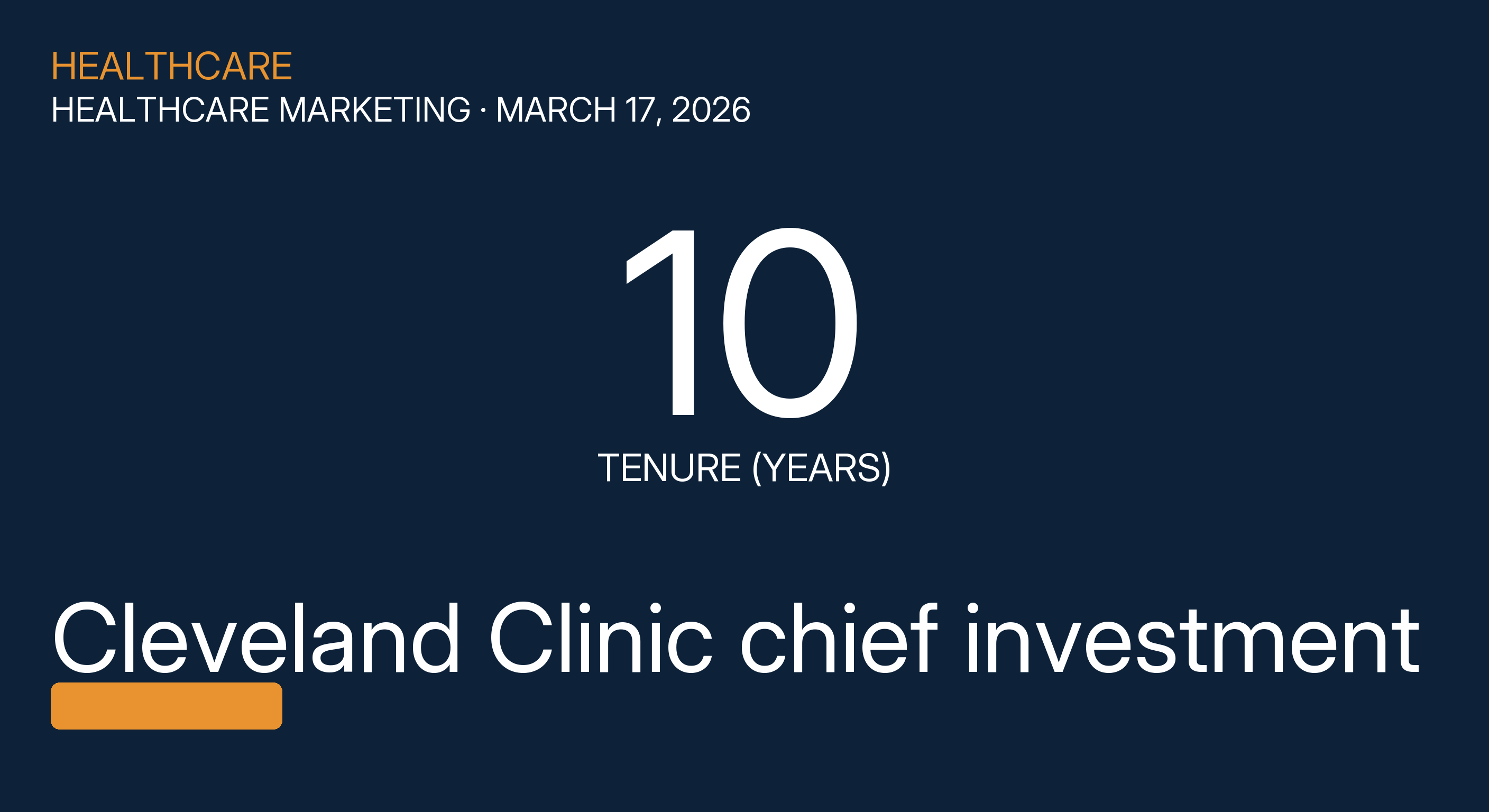
When a Chief Investment Officer departs after a decade at one of the nation's most prestigious health systems, it's easy to dismiss it as routine executive churn. But for healthcare marketers, these transitions reveal critical intelligence about institutional strategy, budget priorities, and where organizations are placing their bets for growth. Cleveland Clinic's CIO exit, and similar movements across health system leadership, signals a recalibration of financial strategy that will directly impact marketing budgets, capital allocation for patient experience initiatives, and the resources available for digital transformation projects that marketing teams depend on.
Executive Transitions as Leading Indicators of Strategic Shifts
C-suite departures after extended tenures rarely happen in a vacuum. A Chief Investment Officer's decade-long run typically means they've shepherded the organization through multiple strategic cycles, economic disruptions, and capital allocation frameworks. Their exit often precedes or accompanies significant strategic pivots.
For healthcare marketing leaders, this matters because investment officers control the purse strings for the initiatives marketers need most: digital infrastructure upgrades, CRM implementations, patient engagement platforms, and the data analytics capabilities that power modern healthcare marketing. When these roles turn over, so do investment philosophies and capital deployment strategies.
Cleveland Clinic, consistently ranked among the top hospitals nationally, has been aggressive in geographic expansion, digital health investments, and ambulatory care growth, all marketing-intensive strategies. A leadership change at the investment level suggests potential shifts in how aggressively the system will pursue these growth channels versus optimization of existing assets.
What marketers should watch: Review your organization's most recent strategic plan and capital budget. Major leadership transitions often trigger strategic planning cycles. If you're midway through a multi-year marketing technology implementation or brand campaign, expect scrutiny. New financial leadership typically conducts portfolio reviews of all major investments within their first 90-180 days.The Financial Reality Reshaping Health System Priorities
Health systems are navigating unprecedented financial pressure. Labor costs have surged 20-30% since 2020 for many organizations. Operating margins remain compressed compared to pre-pandemic levels. Simultaneously, systems face massive capital requirements for infrastructure modernization, cybersecurity, and digital capabilities.
This financial environment changes what gets funded, and what marketing can realistically accomplish. Investment officers are increasingly focused on return on invested capital (ROIC) and faster payback periods for discretionary spending. Marketing initiatives that could once rely on longer-term brand building rationales now need to demonstrate more immediate impact on patient acquisition, retention, and lifetime value.
The shift affects everything from campaign budgeting to vendor selection. Marketing technology vendors that once sold on vision and capability now must prove ROI within 12-18 months. Brand campaigns need more sophisticated attribution models connecting awareness to patient volume. Patient experience investments require clear links to retention metrics and referral patterns.
Strategic implication: Marketing leaders should conduct preemptive ROI assessments of major initiatives before financial leadership does it for you. Build business cases that speak the CFO's language: patient acquisition cost (PAC), lifetime value (LTV), payback periods, and incremental margin contribution. The marketing organizations that survive budget scrutiny are those that proactively demonstrate financial accountability.Capital Allocation Competition Intensifies
When investment leadership turns over, every major capital project gets reconsidered. Marketing competes with clinical program expansion, facility upgrades, technology infrastructure, and physician practice acquisitions for limited capital dollars. This competition has intensified as health systems shift from growth-at-all-costs strategies to more selective expansion.
For marketing, this means several practical changes:
Digital-first becomes non-negotiable. Physical marketing assets (billboards, print campaigns, brick-and-mortar patient access points) face higher scrutiny than digital investments with measurable performance and flexibility. Your marketing mix should reflect this capital constraint reality. Partnerships over ownership. Rather than building proprietary marketing technology stacks requiring significant capital investment, expect increased pressure toward vendor partnerships, SaaS solutions, and outsourced capabilities that convert fixed costs to variable expenses. Service line selectivity. System-wide brand campaigns give way to targeted service line marketing with clear volume and margin objectives. Investment officers want to see how marketing dollars connect to strategic service lines with favorable reimbursement and competitive positioning. Proof-of-concept requirements. Major marketing initiatives increasingly require pilot programs demonstrating results before full funding. Budget for phased implementations rather than big-bang launches.The Takeaway: Navigate Leadership Transitions Proactively
Executive turnover at the C-suite level creates both risk and opportunity for healthcare marketing leaders. Here's how to position your marketing organization during these transitions:
First, audit your current initiatives through a financial lens. Before new financial leadership requests it, prepare ROI documentation for every major marketing program. Quantify patient acquisition costs, conversion rates, and revenue attribution. Identify which initiatives deliver measurable results and which rely on softer brand metrics. Be prepared to defend or pivot. Second, build relationships across the C-suite early. Marketing leaders who maintain strong connections with finance, strategy, and clinical leadership weather transitions better than those who operate in silos. When new investment leadership arrives, they'll ask their peers about marketing's value. Make sure those peers have recent, positive data points to share. Third, reframe marketing as revenue infrastructure. The organizations winning budget battles position marketing not as a cost center requiring capital but as revenue-generating infrastructure that enables clinical programs to reach capacity. Your budget presentations should emphasize patient volume contributions, market share defense, and competitive positioning, outcomes investment officers care about.Leadership transitions accelerate what was already happening: healthcare marketing must demonstrate clear financial returns to secure resources in an increasingly capital-constrained environment. The marketing leaders who adapt their strategies, measurement frameworks, and stakeholder communication to this reality will thrive regardless of who sits in the C-suite.
References
- Becker's Hospital Review. "Cleveland Clinic chief investment officer to exit after 10 years." Hospital Executive Moves. 2024.
This report is for informational purposes only and does not constitute investment advice or an offer to buy or sell any security. Content is based on publicly available sources believed reliable but not guaranteed. Opinions and forward-looking statements are subject to change; past performance is not indicative of future results. 1ness Strategies and its affiliates may hold positions in securities discussed herein. Readers should conduct independent due diligence and consult qualified advisors before making investment decisions.
© 2026 1ness Strategies. All rights reserved.