
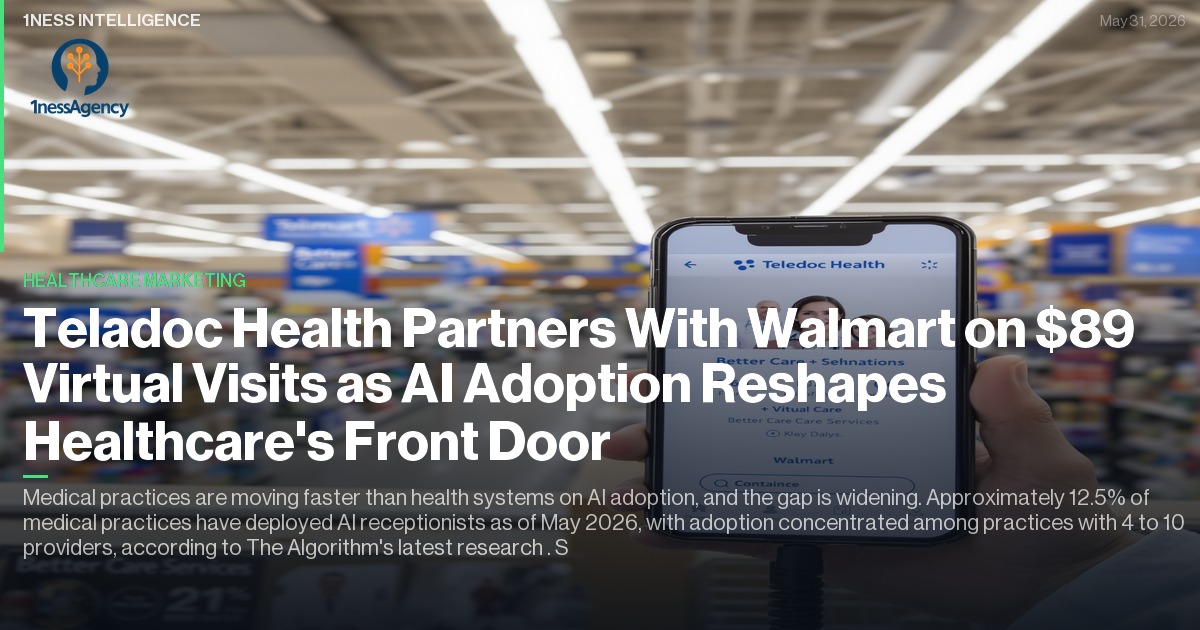
- Approximately 12.5% of medical practices have deployed AI receptionists as of May 2026, with adoption concentrated among practices with 4 to 10 providers.
- Teladoc Health partnered with Walmart to offer $89 cash-pay virtual visits through the retailer's Better Care Services platform across 4,600 U.S. locations.
- Practices with 4 to 10 providers are winning the AI adoption race because they have sufficient patient volume to justify technology investment but lack the bureaucratic inertia that slows enterprise procurement at larger health systems.
Medical practices are moving faster than health systems on AI adoption, and the gap is widening. Approximately 12.5% of medical practices have deployed AI receptionists as of May 2026, with adoption concentrated among practices with 4 to 10 providers, according to The Algorithm's latest research . Solo practitioners and large health systems lag behind, creating a competitive wedge in patient access that mid-sized practices are exploiting. For healthcare marketers, this represents a fundamental shift in how patients experience first contact—and a new battleground for acquisition.
The adoption pattern reveals strategic insight: practices large enough to feel administrative strain but small enough to move quickly are winning the AI front desk race. Meanwhile, Teladoc Health struck a partnership with Walmart to offer $89 cash-pay virtual visits through the retailer's Better Care Services platform, signaling that patient access innovation is happening outside traditional healthcare walls . University of Pennsylvania Health System selected K Health AI agents to support virtual urgent care, demonstrating enterprise-scale confidence in AI-driven patient interaction .
These deployments share a common thread—they remove friction from the patient's first touchpoint. AI receptionists answer immediately, schedule without hold times, and convert intent to appointment faster than traditional call centers.
The patient access market is fragmenting. Practices that automate front-desk operations gain scheduling capacity without proportional labor costs. Practices that don't risk longer hold times, missed calls, and appointment leakage to competitors who answer instantly. For marketers driving paid search, local SEO, or physician referral campaigns, call handling quality now determines whether acquisition dollars convert or evaporate. A Google Ads click that lands on a 10-minute hold is wasted spend. An AI receptionist that books the appointment in 90 seconds captures the patient at peak intent.
The Mid-Market Is Moving Fastest—And That's No Accident
Practices with 4 to 10 providers occupy a strategic sweet spot for AI receptionist adoption . They have enough patient volume to justify the technology investment but lack the bureaucratic inertia that slows enterprise procurement. Solo practices often lack capital or technical sophistication. Large health systems face vendor vetting, compliance review, and integration timelines measured in quarters, not weeks.
This creates a marketing implication: mid-sized practices are becoming more operationally efficient competitors for the same patient population. If your organization is a multi-specialty group or regional health system, your smaller competitors may now answer calls faster, schedule more efficiently, and deliver better first-contact experiences. Patient acquisition cost advantages erode when conversion rates improve for competitors.
The technology enabling this shift has matured. Talkie.ai released Smart Personalization, Conversational Scheduling, and Outbound Caller Agents specifically designed to automate front-desk operations . These platforms now integrate with major EHR systems, handle multi-language conversations, and manage insurance verification—functions that previously required human staff. Ambience Healthcare expanded chart-aware intelligence capabilities across its inpatient platform, showing that AI is moving beyond the front desk into clinical workflows .
Walmart and Teladoc Just Changed the Patient Access Benchmark
The Teladoc-Walmart partnership establishes a new patient expectation: $89 flat-rate virtual care, available where consumers already shop . This isn't telehealth innovation—it's distribution innovation. Walmart brings 4,600 U.S. locations and a consumer base conditioned to expect convenience and transparent pricing. For primary care practices and urgent care operators, this partnership redefines the access standard patients will measure you against.
Healthcare marketers must recalibrate patient acquisition assumptions. Consumers who previously searched for "urgent care near me" now have an in-store alternative at a known price point, with no wait room and no surprise billing. Your local SEO and paid search campaigns now compete with a retail giant's foot traffic and brand trust.
The strategic response isn't to match Walmart's distribution—that's impossible. It's to differentiate on dimensions Walmart can't easily replicate: continuity of care, specialist access, complex chronic disease management, and integrated care teams. Marketing messaging must shift from convenience alone to comprehensive care value. AI receptionists become critical to this strategy because they enable practices to offer comparable access speed while maintaining care continuity.
University of Pennsylvania Health System's selection of K Health AI agents for virtual urgent care shows how enterprises are responding . Rather than cede virtual care entirely to telehealth disruptors, health systems are deploying AI to scale their own virtual access. This creates a marketing opportunity: promote AI-enhanced virtual care as part of an integrated system, not a standalone commodity service.
RAG Licensing Creates a New Revenue Channel—But It Won't Replace Lost Traffic
While AI receptionists automate patient access, another AI development affects healthcare publishers and content creators. Publishers are signing six-figure deals through Snowflake's Cortex Knowledge Extensions platform, licensing content for enterprise retrieval-augmented generation (RAG) systems . The Washington Post, Associated Press, People Inc., and USA Today Network have signed on, with financial institutions paying for access to paywalled content that improves their internal AI tools .
For healthcare marketing leaders who produce clinical content, patient education materials, or thought leadership, RAG licensing represents a nascent revenue opportunity. Enterprises building proprietary AI tools need trusted, clinically accurate content that can't be scraped from the open web. Health systems with robust content libraries could license access to pharmaceutical companies, medical device manufacturers, or healthcare technology vendors building AI products.
However, RAG licensing will not offset traffic declines from AI-driven search disruption. It provides incremental revenue, not a replacement business model . Healthcare marketers should pursue licensing opportunities while simultaneously investing in owned channels—email lists, patient portals, and direct-to-consumer engagement—that don't depend on search traffic.
The Office of the National Coordinator for Health IT continues advancing interoperability through the Trusted Exchange Framework and Common Agreement (TEFCA), which facilitates secure, nationwide electronic health information sharing . Texas-based health information exchange C3HIE went live on TEFCA through connectivity with the eHealth Exchange QHIN in May 2026 . For healthcare marketers, improved data interoperability means better patient attribution, more accurate campaign measurement, and the ability to track patient journeys across care settings.
What Healthcare Marketers Should Do Now
Audit your front-desk conversion funnel. Call your own practice anonymously during peak hours. Measure hold times, abandoned call rates, and scheduling friction. If your practice can't match the instant-answer standard AI receptionists provide, you're losing patients to competitors who can. Test AI receptionist pilots in high-volume access points. Start with appointment scheduling for primary care or routine specialty visits where conversations are predictable. Measure appointment conversion rates, no-show reduction, and patient satisfaction scores. Build the business case for broader deployment. Reframe virtual care marketing around continuity, not just convenience. Differentiate your telehealth services from retail health competitors by emphasizing care team integration, EHR access, and specialist referral pathways that Walmart partnerships can't easily replicate. Explore RAG licensing if you have proprietary clinical content. Health systems with extensive patient education libraries, clinical protocols, or research publications should investigate licensing opportunities through platforms like Snowflake's Cortex or direct enterprise partnerships . Prepare for interoperability-enabled attribution. As TEFCA adoption expands, patient data will flow more freely across care settings . Upgrade your analytics infrastructure to track patient journeys across facilities, measure referral loop effectiveness, and attribute outcomes to marketing touchpoints.Compliance Considerations
AI receptionists must comply with HIPAA regulations when handling protected health information during scheduling conversations. Vendors should provide Business Associate Agreements and demonstrate data encryption, access controls, and audit logging capabilities. State-specific regulations around telehealth prescribing, patient consent, and cross-state licensure apply to AI-enabled virtual care platforms. Marketing claims about AI capabilities must avoid implying diagnostic or clinical decision-making beyond the technology's actual scope to prevent FTC scrutiny.
The 1ness Take
The 12.5% adoption rate for AI receptionists isn't a data point—it's a competitive warning. Mid-sized practices are operationally leapfrogging larger systems by eliminating front-desk bottlenecks, and patient expectations are resetting around instant access. Healthcare marketers who continue optimizing campaigns without addressing conversion infrastructure are pouring acquisition dollars into a leaky bucket.
Our recommendation: treat AI receptionist deployment as marketing infrastructure, not IT operations. Your paid search campaigns, local SEO efforts, and physician referral programs generate patient intent—but that intent converts during the first phone call or web chat. If your practice can't schedule appointments as efficiently as competitors, your cost per acquisition will rise while conversion rates fall. Marketing can't fix a broken front desk, and AI is making that brokenness increasingly visible.
The Walmart-Teladoc partnership reveals a larger strategic truth: patient access innovation is now happening outside traditional healthcare delivery channels. Retail health players are setting new standards for price transparency, convenience, and friction-free scheduling. Healthcare systems can't win on Walmart's terms—but they can win on integration, continuity, and comprehensive care. AI receptionists enable practices to match retail convenience while preserving the care relationships that telehealth commoditization can't replicate.
For content-rich health systems, RAG licensing offers a hedge against AI search disruption. While traffic from Google may decline as AI overviews and chatbots reduce click-through rates, enterprises building proprietary AI tools need licensed, trustworthy content. Explore licensing partnerships now while the market is forming and publishers retain pricing power . But don't mistake this for a primary revenue strategy—it's supplemental income, not a business model transformation.
The organizations that thrive in the AI-enabled patient access landscape will combine instant-response technology with human clinical expertise. AI handles the transactional layer—scheduling, insurance verification, routine questions—freeing human staff to focus on complex cases, empathetic care, and relationship building. Market that combination explicitly. Position your practice as "AI-fast, human-caring" rather than choosing between technology and touch.
The Takeaway
Measure your front-desk performance against the new AI standard. If your average hold time exceeds two minutes or your abandoned call rate exceeds 5%, you're losing patients to practices that answer instantly. Deploy AI receptionists where patient intent is highest and conversations are most predictable. Primary care appointment scheduling, routine follow-up booking, and insurance verification are high-ROI starting points that deliver measurable conversion improvements within 90 days. Differentiate virtual care marketing around integration, not just access. Walmart's $89 virtual visits set a new convenience bar—but you can compete on care continuity, specialist access, and comprehensive chronic disease management that retail health can't replicate.References
- Eastwood, B. (2026, May 31). Bonus Features – May 31, 2026 – 1 in 8 medical practices have deployed an AI receptionist, Teladoc Health teams up with Walmart, plus 21 more stories. Healthcare IT Today healthcareittoday.com
- Davies, J. (2026, May 29). Publishers quietly cut 'six-figure' deals via Snowflake's AI licensing platform. Digiday digiday.com
- Office of the National Coordinator for Health Information Technology. (2026). Advancing the Future of Behavioral Health Data Exchange. HealthIT.gov healthit.gov
This report is for informational purposes only and does not constitute investment advice or an offer to buy or sell any security. Content is based on publicly available sources believed reliable but not guaranteed. Opinions and forward-looking statements are subject to change; past performance is not indicative of future results. 1ness Strategies and its affiliates may hold positions in securities discussed herein. Readers should conduct independent due diligence and consult qualified advisors before making investment decisions.
© 2026 1ness Strategies. All rights reserved.