
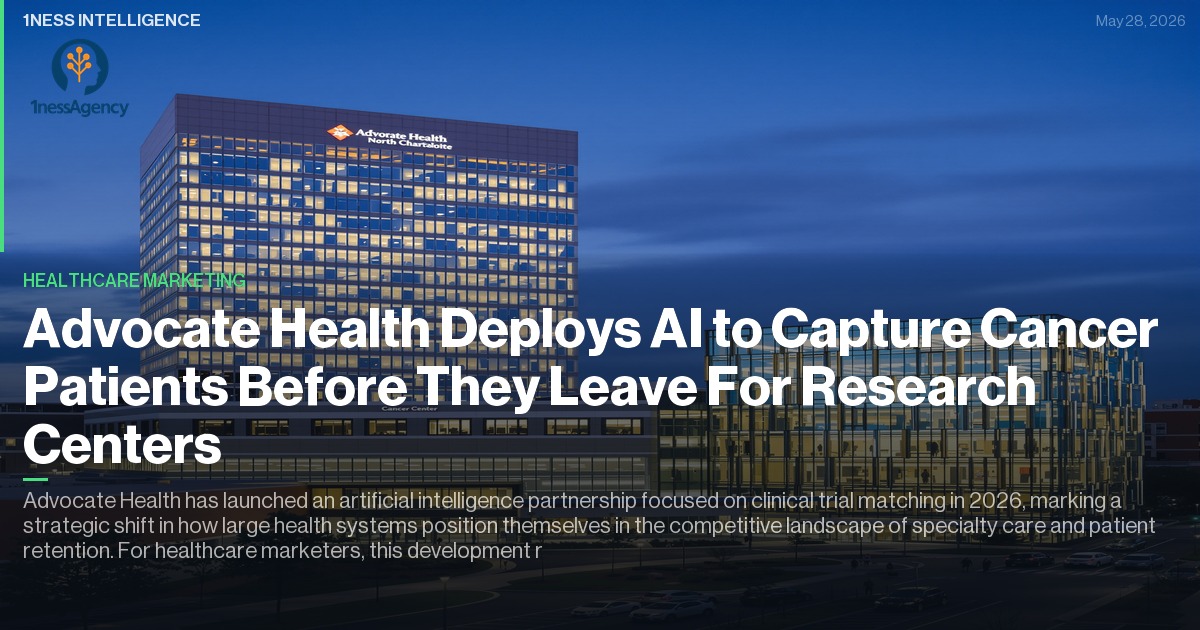
- Advocate Health launched an AI clinical trial matching partnership in 2026 as one of the nation's largest nonprofit health systems following its 2022 merger of Advocate Aurora Health and Atrium Health.
- Clinical trials represent a $50 billion annual U.S. market, yet fewer than 5% of adult cancer patients participate in trials according to the American Cancer Society.
- AI-driven clinical trial matching platforms like Antidote Technologies, Deep 6 AI, and TrialSpark use natural language processing to scan electronic health records and automate patient outreach, replacing traditional physician referral methods that systematically underperformed.
- Trial participation generates downstream revenue beyond research protocols through imaging, laboratory work, supportive care, monitoring services, and long-term specialist relationships that extend patient lifetime value beyond the study period.
Advocate Health has launched an artificial intelligence partnership focused on clinical trial matching in 2026, marking a strategic shift in how large health systems position themselves in the competitive landscape of specialty care and patient retention. For healthcare marketers, this development represents more than a technology adoption story—it reveals an emerging channel where patient education, digital engagement, and revenue diversification converge.
The move by Advocate Health, one of the nation's largest nonprofit health systems following the 2022 merger of Advocate Aurora Health and Atrium Health, demonstrates how AI-driven clinical trial matching is transitioning from academic medical center territory into community health system strategy. The timing aligns with broader industry pressure to retain high-acuity patients who might otherwise seek care at research institutions.
Clinical trials represent a $50 billion annual market in the United States, yet fewer than 5% of adult cancer patients participate in trials, according to historical data from the American Cancer Society. The gap between available trials and patient enrollment has long plagued pharmaceutical sponsors and academic centers. Now, community health systems see an opportunity to capture both the patient relationship and the associated revenue.
This partnership matters for healthcare marketers across all specialties because it previews how AI tools will reshape patient navigation, referral management, and the definition of "comprehensive care" that health systems use to differentiate themselves. When a health system can match patients to cutting-edge therapies through AI, it changes the competitive positioning for oncology, cardiology, neurology, and other high-margin service lines.
The Strategic Value of Clinical Trial Marketing
Health systems historically treated clinical trial recruitment as a clinical operations function, not a marketing opportunity. That calculus is changing. Clinical trials offer three distinct advantages for healthcare marketers building service line strategies.
First, trials provide access to treatments not available elsewhere, creating a genuine competitive moat. A patient with late-stage melanoma who learns about an immunotherapy trial through Advocate Health's AI matching system has a compelling reason to stay within the system rather than seek care at a major cancer center. The trial becomes the retention mechanism.
Second, trial participation generates downstream revenue beyond the research protocol itself. Patients enrolled in trials typically require imaging, laboratory work, supportive care, and monitoring—all billable services. They also develop relationships with specialists who become their long-term care providers. The lifetime value of a trial patient extends far beyond the study period.
Third, clinical trial capabilities signal research credibility. Patients equate research participation with quality, even when community hospital trial portfolios focus on Phase III or Phase IV studies rather than early-stage investigation. The marketing value of positioning a health system as "where groundbreaking research happens" justifies investment in trial infrastructure and AI matching tools.
Advocate Health's specific AI partner remains unnamed in available reporting, but the category of clinical trial matching platforms has attracted significant venture investment since 2023. Companies like Antidote Technologies, Deep 6 AI, and TrialSpark have built natural language processing tools that scan electronic health records to identify trial-eligible patients, then automate outreach through patient portals and secure messaging.
What AI Matching Changes for Patient Engagement Strategy
Traditional clinical trial recruitment relied on physician referrals, which systematically underperformed. Oncologists treating 20 patients per day lack time to mentally catalog which patients might qualify for which of hundreds of available trials. Eligibility criteria involving specific biomarkers, prior treatment lines, and comorbidity restrictions make manual matching impractical.
AI matching inverts the model. Instead of physicians remembering to refer patients to research coordinators, the algorithm continuously scans EHR data and flags eligible patients. The system generates alerts to care teams or triggers direct patient outreach through secure channels. Marketing teams gain a new automated touchpoint in the patient journey.
This automation has implications for content strategy and patient education. Health systems implementing AI matching need library content explaining what clinical trials are, how they differ from standard treatment, what questions to ask, and how to evaluate participation. This content must live in patient portals, be mobile-optimized, and address health literacy across reading levels.
The AI matching also generates data healthcare marketers should track: clinical trial awareness rates, screening completion rates, enrollment conversion rates, and referral source attribution. These metrics belong in service line dashboards alongside traditional patient acquisition cost and lifetime value calculations.
Compliance requirements intensify when AI algorithms drive patient outreach. Any communication about clinical trials must avoid coercion, clearly distinguish research from treatment, and comply with institutional review board oversight. Marketing teams cannot treat trial recruitment like elective procedure promotion. The regulatory guardrails are stricter, and HIPAA rules regarding research use of protected health information apply.
Competitive Implications for Community Hospitals and Regional Systems
Advocate Health's investment in AI clinical trial matching raises the competitive bar for other large health systems and creates a dilemma for smaller community hospitals. If patients begin expecting their health systems to offer AI-matched trial access as part of comprehensive care, systems without this capability face a perception gap.
Community hospitals have three strategic options. First, they can license similar AI matching platforms and build their own trial portfolios, likely focusing on pharmaceutical-sponsored multi-site studies where the sponsor covers costs. Second, they can partner with academic medical centers, positioning themselves as trial enrollment sites within a larger network while the AMC provides research infrastructure. Third, they can ignore the trend and accept that complex oncology, cardiology, and neurology patients will migrate to competitors.
The first option requires investment in research coordinator staffing, regulatory compliance infrastructure, and integration between AI platforms and EHR systems. These are fixed costs that make sense at scale but strain smaller organizations. The second option preserves patient relationships while sharing revenue and research credit with the academic partner. The third option cedes ground in high-margin service lines.
For marketers at regional health systems, the question becomes whether clinical trial access belongs in your brand promise. If your oncology service line markets itself as comprehensive and cutting-edge, can you justify not offering trial matching? If competitors in your market launch AI matching programs, how quickly must you respond?
The dollars matter. Pharmaceutical sponsors pay per-patient enrollment fees ranging from $5,000 to $50,000 depending on trial complexity and therapeutic area. A health system enrolling 200 patients annually in sponsored trials generates $1 million to $10 million in research revenue while retaining those patients for standard care worth multiples of that amount.
HIPAA and Informed Consent Considerations
Marketing clinical trials through AI-generated patient matching introduces specific compliance obligations. Health systems must obtain proper authorization before using protected health information to determine trial eligibility, even when the screening happens internally.
The HIPAA Privacy Rule allows limited use of PHI for research purposes without authorization when an institutional review board or privacy board grants a waiver. However, once a health system contacts a patient about a specific trial, that outreach must follow informed consent protocols. Marketing copy cannot overstate benefits or minimize risks. Claims about "groundbreaking" or "life-saving" treatments require substantiation and IRB approval.
State laws add complexity. California's Confidentiality of Medical Information Act imposes requirements beyond HIPAA. Massachusetts and New York have specific regulations governing research recruitment. Marketing teams must work with legal and compliance departments to ensure outreach language meets all applicable standards.
The FTC's Health Breach Notification Rule applies if AI matching platforms are considered third-party vendors of personal health records. Any data sharing with technology vendors requires business associate agreements and risk assessment. Healthcare marketers implementing these tools should confirm their IT and legal teams have completed vendor due diligence.
The 1ness Take
Healthcare marketers should view AI clinical trial matching not as a research program but as a patient retention and service line differentiation strategy. The actionable opportunity exists in the 6-12 months before your competitors launch similar programs.
Start by auditing your current clinical trial portfolio. How many active trials does your health system sponsor or participate in across service lines? What percentage of eligible patients are successfully enrolled? Where does patient awareness drop off? Most health systems will discover they have more trials than patients know about—a marketing problem, not a clinical problem.
Next, evaluate whether your brand architecture supports clinical trial promotion. If your health system positions itself as a community care provider focused on convenience and local access, adding research credentials may confuse the brand. If you position as a comprehensive academic health system or regional referral center, clinical trials reinforce that promise. Brand strategy should drive whether you lead with AI matching in external marketing or keep it as an internal patient navigation tool.
Build the content infrastructure before implementing AI matching. You need explainer videos, FAQ pages, informed consent templates written at sixth-grade reading level, and care team training modules. The AI will identify eligible patients, but conversion depends on education and trust. Invest in content that addresses patient fears about being "experimented on" and clarifies how trials relate to standard treatment options.
Track clinical trial engagement as a marketing metric. Include trial awareness, screening rates, and enrollment conversion in your service line reporting. If your oncology service line reports 300 new cancer diagnoses annually but enrolls only 10 patients in trials, you have a 3% conversion rate with room for improvement. AI matching should double or triple that rate within 12 months.
Partner with your research and compliance teams early. Marketing cannot drive trial recruitment alone. Successful programs require coordination across clinical operations, research administration, IT, legal, and marketing. Establish a cross-functional steering committee and clarify decision rights before launching patient-facing campaigns.
The Takeaway
Advocate Health's AI clinical trial matching partnership represents a shift in how health systems compete for complex, high-acuity patients. For healthcare marketers, this development opens a new patient engagement channel that combines technology, content strategy, and service line positioning.
Immediate action steps:- Audit your clinical trial portfolio and patient enrollment rates across service lines. Identify gaps between available trials and patient participation.
- Evaluate AI matching platforms by requesting demos from vendors like Deep 6 AI, Antidote, and others. Assess integration requirements with your EHR and patient portal.
- Develop clinical trial content that addresses patient questions, fears, and decision-making needs. Make this content accessible through patient portals, email campaigns, and care team conversations.
- Establish compliance protocols with your legal team for trial recruitment communications. Ensure all marketing materials meet HIPAA, IRB, and state-specific requirements before launch.
The health systems that integrate AI clinical trial matching into their patient engagement strategy in 2026 will establish a competitive advantage that compounds over time as they build reputation, referral networks, and patient loyalty. Those that wait will find themselves explaining why they cannot offer what patients have come to expect.
References
- Becker's Hospital Review. "Advocate Health partners on AI for clinical trial matching." 2026 beckershospitalreview.com
- American Cancer Society. "Clinical Trial Participation." Historical data on adult cancer patient participation rates in clinical trials. Accessed 2026.
This report is for informational purposes only and does not constitute investment advice or an offer to buy or sell any security. Content is based on publicly available sources believed reliable but not guaranteed. Opinions and forward-looking statements are subject to change; past performance is not indicative of future results. 1ness Strategies and its affiliates may hold positions in securities discussed herein. Readers should conduct independent due diligence and consult qualified advisors before making investment decisions.
© 2026 1ness Strategies. All rights reserved.