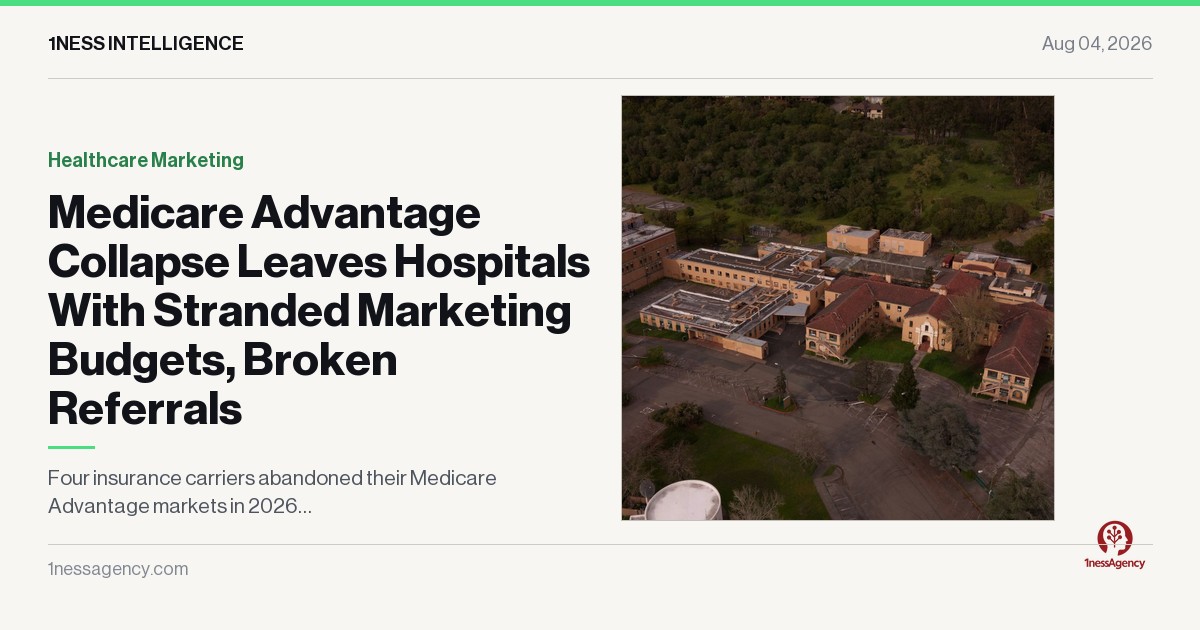
- Four insurance carriers abandoned their Medicare Advantage markets in 2026, marking the most significant MA contraction in over a decade.
- Rural hospitals face over $900 billion in anticipated Medicaid funding reductions over the next decade under the One Big Beautiful Bill Act.
- Sturgis Hospital in Michigan closed in June 2026 after three years as a federally-designated Rural Emergency Hospital, leaving 11,000 residents without critical healthcare access.
- Hospital systems that allocated substantial budgets toward Medicare Advantage beneficiaries now confront stranded marketing investments and broken referral pathways due to insurer exits.
Four insurance carriers abandoned their Medicare Advantage markets in 2026, marking the most significant MA contraction in over a decade and forcing healthcare marketers to recalibrate patient acquisition strategies built around commercial insurance partnerships. The exits arrive as rural hospitals face a perfect storm: more than $900 billion in anticipated Medicaid funding reductions over the next decade under the One Big Beautiful Bill Act, coupled with a shrinking private insurance landscape that once promised stable patient volumes .
The timing exposes a fundamental miscalculation in healthcare marketing strategy. Hospital systems that allocated substantial acquisition budgets toward MA beneficiaries now confront a sudden collapse in their target market, while simultaneously navigating Medicaid cuts that threaten rural facilities already operating on thin margins. In Michigan, Sturgis Hospital closed in June 2026 after three years as a federally-designated Rural Emergency Hospital—the only such facility to shutter completely this year—demonstrating that even federal conversion programs cannot overcome the combined pressure of reduced coverage options and funding cuts .
"The closure could be kind of a canary in the coal mine for rural healthcare," said Lauren LaPine-Ray, vice president of policy and rural health at the Michigan Health & Hospital Association, as Sturgis emergency department utilization declined following its conversion . The hospital's leaders exhausted every option, including seeking buyers, before closing the century-old facility and leaving 11,000 residents without critical healthcare access.
The insurer exits matter beyond their immediate geographic impact. They signal a market correction that healthcare marketers ignored: Medicare Advantage plans promised growth but delivered volatility. Systems that built patient acquisition funnels around MA partnerships now face stranded marketing investments, broken referral pathways, and beneficiaries forced back into traditional Medicare or left scrambling for coverage. For marketing leaders, this is not a coverage gap—it is a strategic failure to diversify patient acquisition channels and hedge against commercial insurance instability.
The MA Market Contracts as Federal Funding Shrinks
The four insurer departures arrive as the Trump administration's One Big Beautiful Bill Act begins reshaping healthcare economics. The legislation reduces Medicaid funding by more than $900 billion over the next decade, with rural areas facing disproportionate impact due to higher Medicaid enrollment rates . Republicans added a $50 billion Rural Health Transformation Program to secure votes from holdouts, but implementation challenges emerged immediately.
Four senators, including Maine Republican Susan Collins who helped architect the rural health fund, sent a letter to Centers for Medicare & Medicaid Services Administrator Mehmet Oz the day before Sturgis closed, warning that the agency's fund structure "may unintentionally disadvantage many of the rural hospitals and clinics the program was intended to support" .
More than 50 rural hospitals across 20-plus states have converted to the stripped-down Rural Emergency Hospital model since Congress created it in 2023, but the Sturgis closure exposes a flaw in the conversion strategy: federal designation alone cannot compensate for lost patient volumes when commercial insurers exit and Medicaid enrollment shrinks . Approximately 1,700 hospitals nationwide qualify for the REH model, but marketing leaders now question whether the designation attracts patients or simply delays inevitable closures.
The insurer exits compound the Medicaid funding crisis. Hospital marketers built patient acquisition models assuming MA growth would offset declining fee-for-service Medicare. Those models now fail. Systems need emergency recalibration: which service lines survive without MA volumes? Which geographies become unsustainable? Which partnerships with commercial insurers remain viable?
Follow the Money: Patient Acquisition Costs Rise as Coverage Options Narrow
The MA exits force healthcare marketers to confront a brutal financial reality. Patient acquisition costs for MA beneficiaries typically run lower than fee-for-service Medicare due to bundled referral relationships and integrated care networks. When insurers abandon markets, those beneficiaries revert to fragmented coverage, requiring systems to rebuild acquisition pathways from scratch.
Rural hospitals face even steeper challenges. Sturgis Hospital's emergency department volumes declined after its REH conversion, suggesting the model fails to attract patients despite federal support . Marketing leaders must answer: if federal designation and emergency services cannot sustain volumes, what service mix can?
The $50 billion Rural Health Transformation Program offers little immediate relief. Implementation delays and structural disadvantages identified by Collins and fellow senators mean funds may arrive too late for facilities already operating in crisis . Marketing budgets cannot compensate for systemic funding failures, but they can shift to defensive strategies: patient retention over acquisition, geographic consolidation over market expansion, and partnership with remaining insurers over broad network development.
Hospital systems in markets where insurers exited face a stark calculation. Every MA beneficiary who transitions to fee-for-service Medicare represents lost predictability in patient flow, higher administrative costs, and reduced leverage in rate negotiations. Marketing leaders need immediate data: How many MA beneficiaries in your service area lost coverage? Which insurers remain? What percentage of your patient acquisition budget targeted MA partnerships that no longer exist?
Medicaid Cuts and Disability Services: The Cascading Impact on Patient Populations
The One Big Beautiful Bill Act's Medicaid reductions intersect with another 2026 policy shift that threatens patient volumes: the Department of Justice's June legal opinion reversing decades of disability rights enforcement . The DOJ now argues federal disability laws do not require states to provide home-based services rather than institutionalization, contradicting a 1999 Supreme Court ruling that guided civil rights enforcement for 27 years.
The opinion affects approximately 40 million adults and 5 million children with disabilities . For healthcare marketers, this represents a fundamental shift in care settings. If states push beneficiaries from home-based care into institutions, patient acquisition strategies built around outpatient services, specialty clinics, and community-based care collapse. Conversely, institutional care marketers must prepare for potential patient volume increases—though Medicaid funding cuts may prevent states from expanding institutional capacity.
Virginia resident Amanda DeSimone-Shabrack saw her state-funded home healthcare aide hours reduced from 30 to 18 hours weekly for her high-needs autistic son . She now questions whether she can continue caring for him at home without adequate support. Thousands of similar cases multiply across Medicaid-dependent populations, creating uncertainty about where patients will receive care and whether marketing investments in community-based services remain viable.
The Department of Health and Human Services has not clarified how the DOJ opinion will affect Medicaid waivers that enable home and community-based services. Marketing leaders at systems with significant Medicaid revenue—particularly those serving disability populations—need scenario planning: if states reduce home-based services, which institutional care lines expand? If patients cannot access community-based care, where do they go? If they go nowhere, what happens to your patient volumes?
The 1ness Take
Healthcare marketers spent the past decade chasing Medicare Advantage growth and building acquisition models around commercial insurance partnerships. That strategy is now obsolete. The four insurer exits expose a more dangerous trend: healthcare marketing leaders optimized for a market structure that is actively collapsing.
Here is what changes immediately. First, diversification becomes non-negotiable. Any system with more than 30% patient acquisition investment concentrated in MA partnerships faces existential risk. Shift resources toward fee-for-service Medicare retention, direct-to-consumer channels, and partnerships with the remaining stable insurers. Second, rural healthcare marketing must abandon growth models entirely. The Sturgis closure proves federal programs cannot overcome the combined pressure of insurer exits and Medicaid cuts. Rural marketers need defensive strategies: patient retention, service line consolidation, and geographic partnerships that spread risk.
Third, disability and Medicaid-dependent populations require immediate scenario planning. The DOJ's reversal on disability rights enforcement, combined with $900 billion in Medicaid cuts, creates uncertainty about where patients receive care. Marketing leaders cannot wait for policy clarity—build contingency plans now for both institutional volume increases and community-based service contractions.
Fourth, stop treating policy changes as external factors. The MA exits, Medicaid cuts, and disability rights reversals are not background noise—they are the primary drivers of patient volume and revenue over the next 36 months. Marketing strategy must begin with policy analysis, not brand positioning or digital channel optimization.
Finally, recognize that traditional patient acquisition metrics are breaking. Cost per acquisition, lifetime value calculations, and channel ROI models all assume stable insurance markets and predictable patient populations. Those assumptions are false. Marketing leaders need new frameworks that account for coverage volatility, policy-driven volume shifts, and the possibility that entire patient segments disappear or relocate to different care settings with little warning.
The healthcare marketing playbook written for stable insurance markets and predictable federal funding is obsolete. The new playbook starts with risk management, policy monitoring, and the recognition that patient acquisition strategy must flex with political and regulatory changes no longer measured in years but in months.
The Takeaway
Healthcare marketing leaders face immediate decisions as the Medicare Advantage market contracts and federal funding shifts reshape patient populations:
Audit your MA exposure immediately. Calculate what percentage of patient acquisition investment and projected volumes depend on insurers that exited or may exit. Diversify away from any single payer relationship that represents more than 30% of your acquisition budget. Build policy monitoring into marketing operations. Assign responsibility for tracking Medicaid waiver changes, CMS guidance on rural hospital programs, and state-level responses to federal funding cuts. Policy shifts now drive patient volumes more than brand campaigns. Develop scenario plans for Medicaid-dependent populations. Model patient volume changes if your state reduces home-based disability services or if institutional care demand increases. Identify which service lines face risk and which may see unexpected growth. Do not wait for policy clarity that may never arrive—build flexibility into your marketing strategy now.References
- Tribble, S.J. & Leys, T. (2026, August 3). Earlier Lifeline for Rural Hospitals Faces Test Under 'Big Beautiful' Law. KFF Health News kffhealthnews.org
- Armour, S. (2026, August 3). People With Disabilities Fear Service Cuts as Trump's DOJ Questions Legal Protections. KFF Health News kffhealthnews.org
This report is for informational purposes only and does not constitute investment advice or an offer to buy or sell any security. Content is based on publicly available sources believed reliable but not guaranteed. Opinions and forward-looking statements are subject to change; past performance is not indicative of future results. 1ness Strategies and its affiliates may hold positions in securities discussed herein. Readers should conduct independent due diligence and consult qualified advisors before making investment decisions.
© 2026 1ness Strategies. All rights reserved.